Archive for the ‘Nepal’ Category

Bisket Jatra

Posted: April 15, 2014 in Nepal

We arrived in the city of Bhaktapur (15km East of Kathmandu) to masses of people. We had heard that there was a festival starting soon but didn't know anything further than that. We didn't know it at this point, but this would turn out to be one of the most bewildering events either one of us had ever witnessed.

It turns out that the festival is called “Bisket Jatra” and it coincides with the Nepali New Year where they are celebrating the coming of year 2071 according to the Nepali calendar. Bhaktapur is only 6.6 square kilometers in size and has a population of more than 225,000 people.


After finding a hotel room, we were astonished to see carpenters working on a 30 foot high wagon-type contraption only half a block from our hotel. Was this a Nepali Trojan horse or something?


We followed large masses of cheering people to a place called Pottery Square where we stood elbow to elbow with thousands of enamored Nepalis' while the New Years ritual took place. Vendors were out in full force, selling ice cream, balloons, paan, and a type of jam or jelly in a bag that people slurped up (which look incredibly unappetizing to my Western eyes). People seemed to be absolutely everywhere you looked – even on the roofs of surrounding buildings.


A large wooden pole, I would estimate nearly 100 feet long, was being erected in the square. Three long, thick ropes were being pulled by hundreds of young Nepali men to hoist the pole. They pulled in synchronized bursts to which the crowd would chant encouragements in time with each burst.


After each successive pull, men would rush to crib the pole in place with large forked trees (as to not lose any progress). Slowly, foot by foot, the pole was raised until it sat vertical in the ground. This is done at two separate locations in the city and these poles are torn down in a similar manner on New Year's Day. One pole broke and nearly crushed several onlookers in the square.


After the ceremony, it was time for us to attend the next event, the pulling of the wagon. This was crazy. The wagon was pulled again by hundreds of Nepali men with three thick ropes. The wagon moved slowly through the city with the wheels slotting into wide tracks in the roadway that seemed to have been there for centuries. Again, crowds gathered around the labourers yelling encouragement as they pulled the massive wagon through the town. I would have to estimated that the crowd exceeded 40,000 in number at this point.

I tried to take some shots of the crowd but it was too dark at this point


The crowds' enthusiasm seemed to build by the minute, culminating in one single event. The wagon broke over a hill and sped rapidly downhill towards the men who were pulling it a few seconds ago. Several of them tried to jump on the moving wagon and were thrown underneath. Last year three people died doing this. This is the video I captured:


It appeared to me that several people were seriously injured although I have not heard a news report yet. Maybe they needed the best push-cart driver in all the land to drive the wagon.


The next day we awoke to huge amounts of people enjoying another day full of festivities, including singing and dancing:


We're now off to Hong Kong – trading in our hiking boots and Hinduism for skyscrapers and Cantonese.
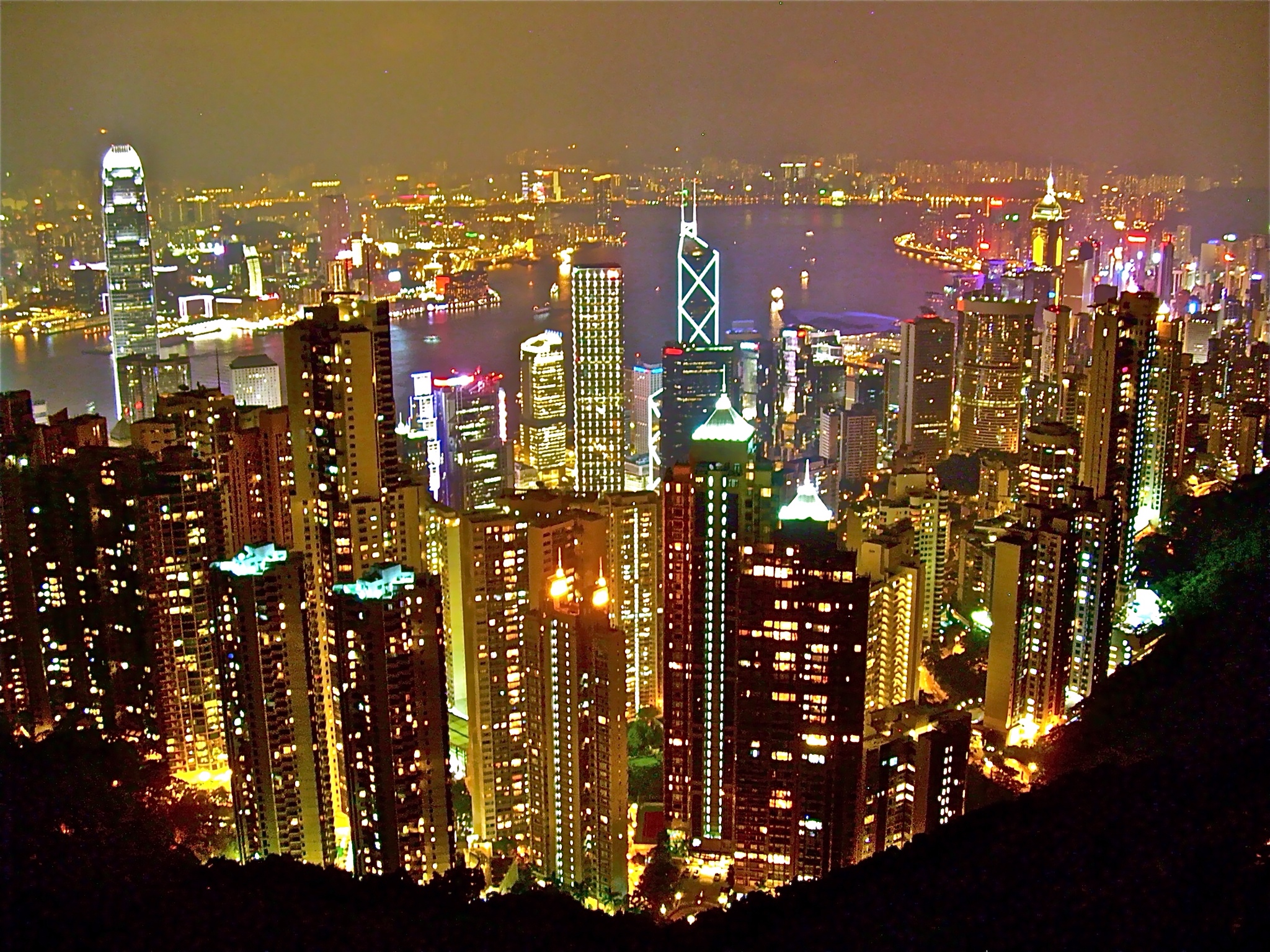
 

Hong Kong skyline


Hong Kong is also the home to legendary martial arts actors Bruce Lee and Jackie Chan.


Let me show ya somethin about Nepal


Top 10 reason you know your in Nepal


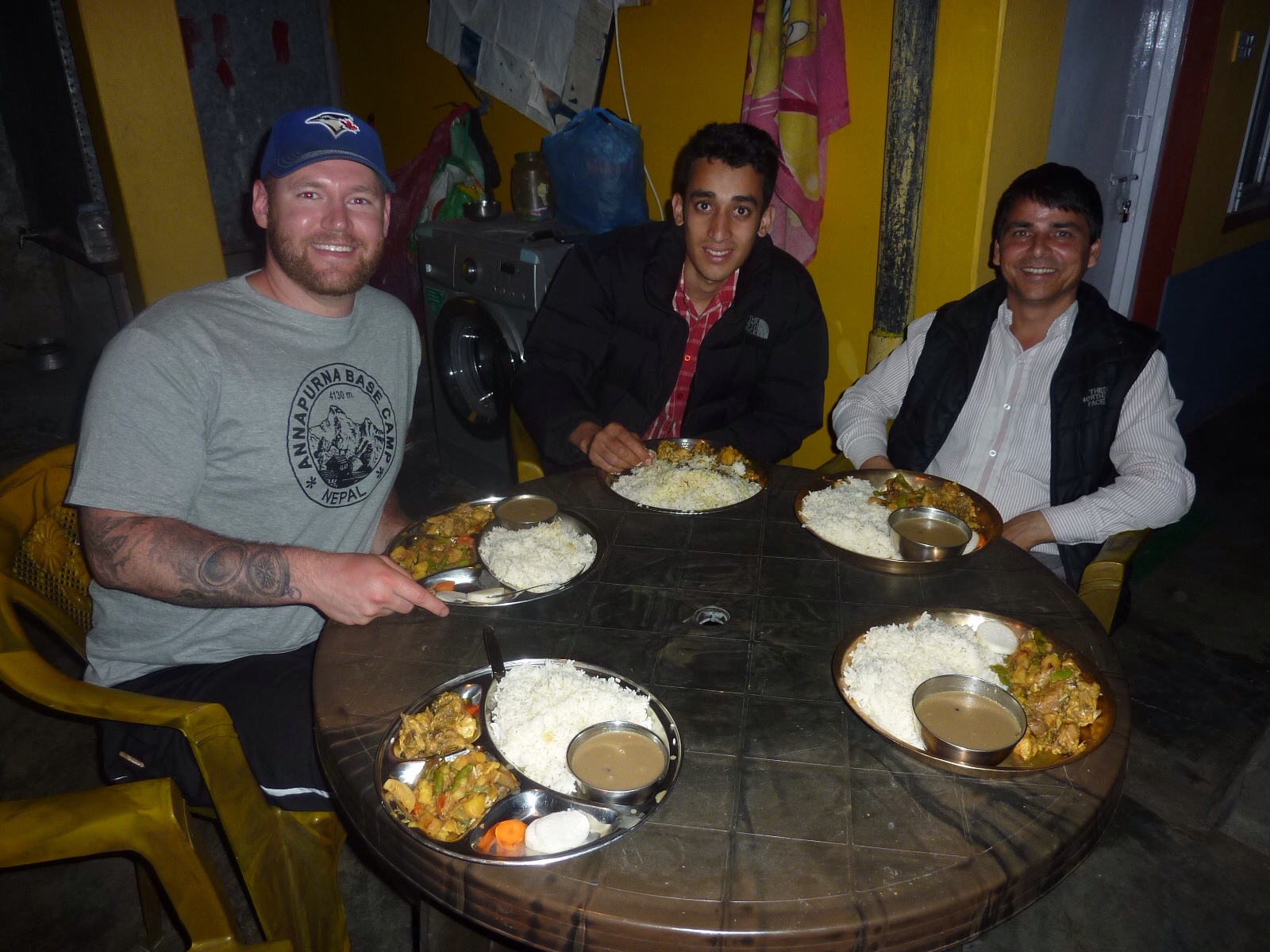
1. Daal Bhat. This is the national meal eaten by nearly all Nepalis twice a day. I believe the literal translation is lentil rice. Typically this meal is served on fancy metal trays separated by compartments. Lentils and spices are mixed together to make a sort of soup called “Daal”. This is often served with a side helping of spicy potatoe chunks and vegetable curry. Since this is the national meal it is all you can eat everywhere. If your not full, you can get a second helping no matter where you are. I wasn't so fond of Daal Bhat but Megan seems to really enjoy it.


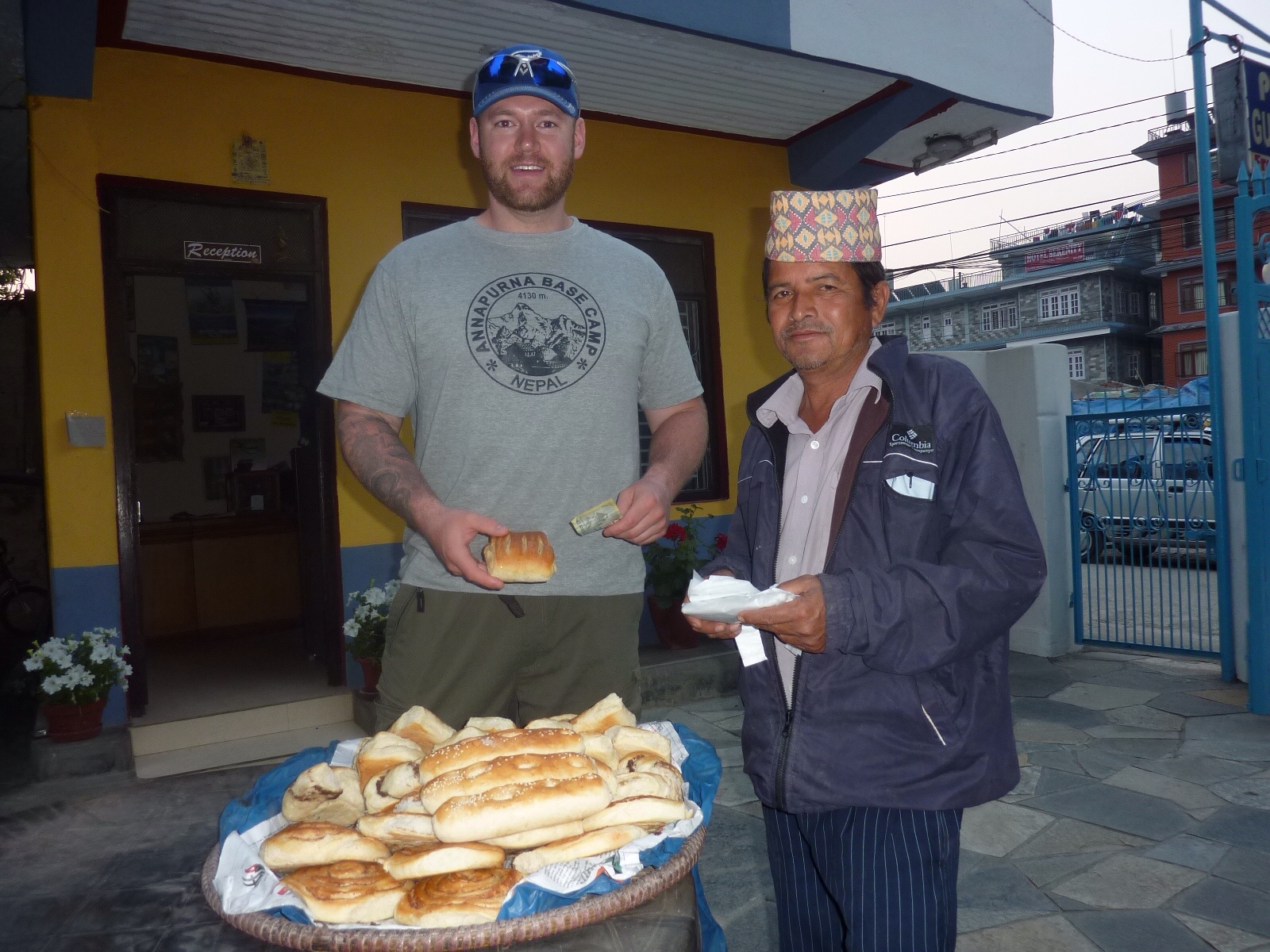
2. Dhaka Topi. Everywhere in Nepal men can be seen wearing a hat called Dhaka Topi. Nepalis consider Dhaka topi as a source of pride, and it is very much attached to the culture. It is widely worn by government employees, and forms a part of the national dress. Though the history of Dhaka topi is still debated, it is believed to be used by the Nepali people since at least last two hundred years.


3. Insane driving. This seems to be quite common in nearly all of the developing countries I have visited although Nepal has taken it to a new level. Drivers weave in and out of traffic with extreme precision dodging motorbikes, trucks, pedestrians, and farm animals in the process. Sometimes mere inches are all that separate trucks and buses as they meet on the highway. Passing vehicles around corners or over hills are commonplace and it's not uncommon to see vehicles slam on their brakes to narrowly avoid a collision. Drivers honk their horns continuously not out of frustration but rather to let the other vehicles and pedestrians know that they are coming. Us Westerners are always death gripping our seats in anticipation of a crash even though things seem to work out and the driver knew what he was doing all along. The lack of electricity in Nepal means their are no traffic lights which means that every intersection quickly becomes somewhat of a free for all.


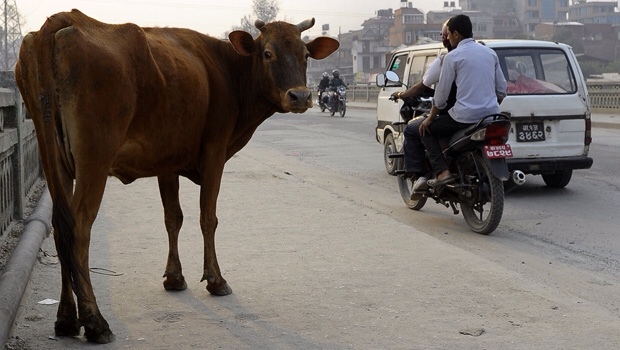
4. Cows everywhere. Since cows are a sacred animal in the Hindu religion, cows can be seen absolutely everywhere. It's not uncommon for traffic to be backed up only to find that the cause was a lazy cow laying in the middle of the road. Sometimes Megan and I will have to vacate the sidewalk because the cows have taken it over. It's also illegal to eat beef in Nepal unless the beef has been shipped to Nepal from India (which can seem a bit odd I admit).


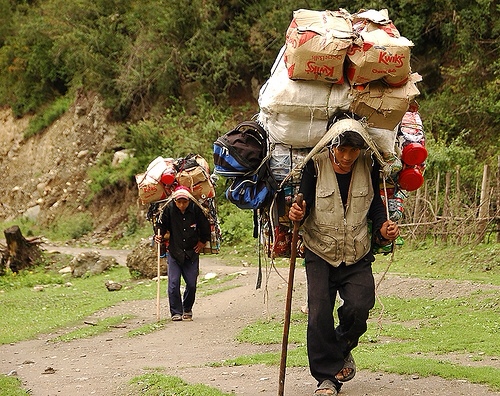
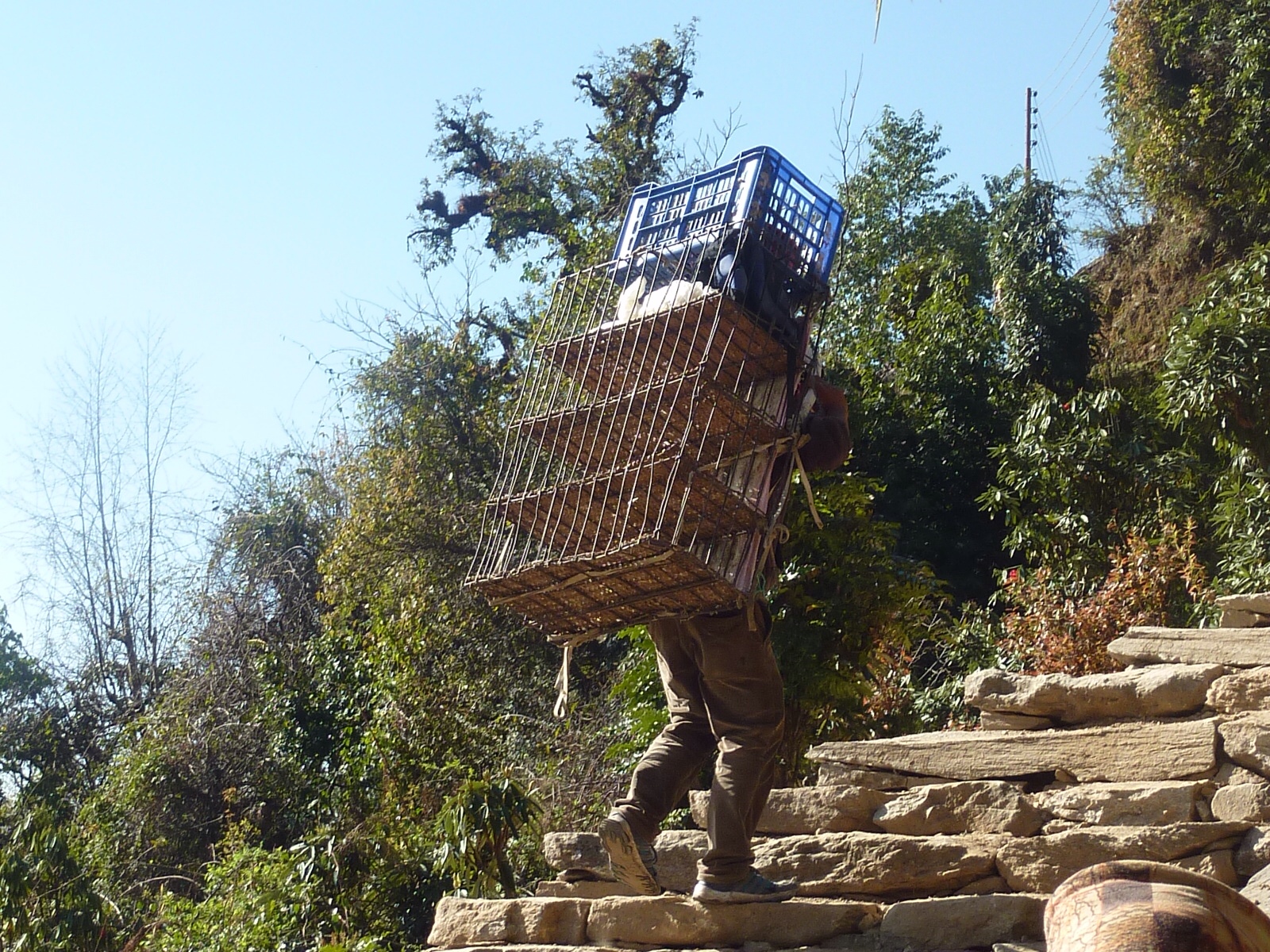
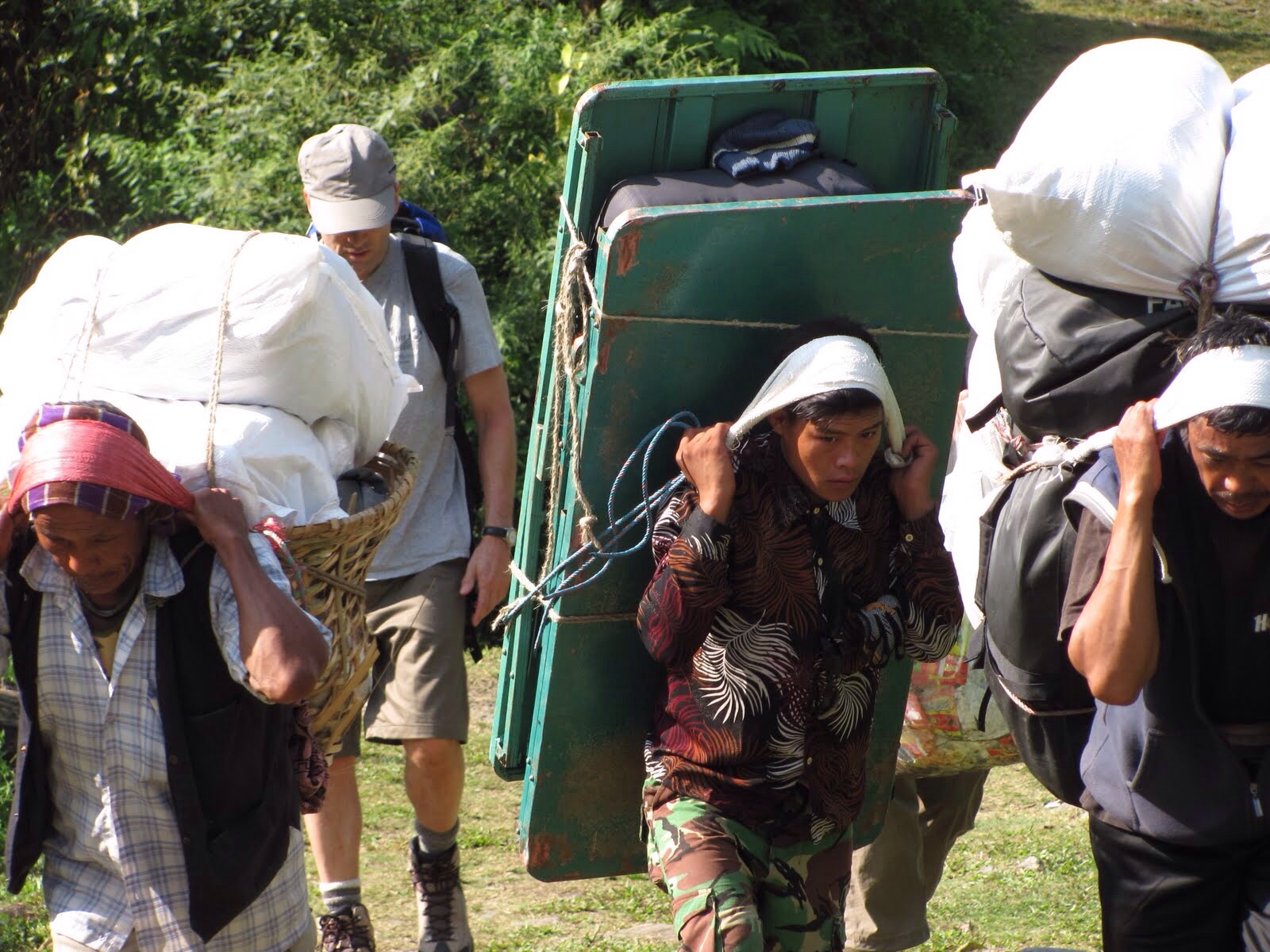
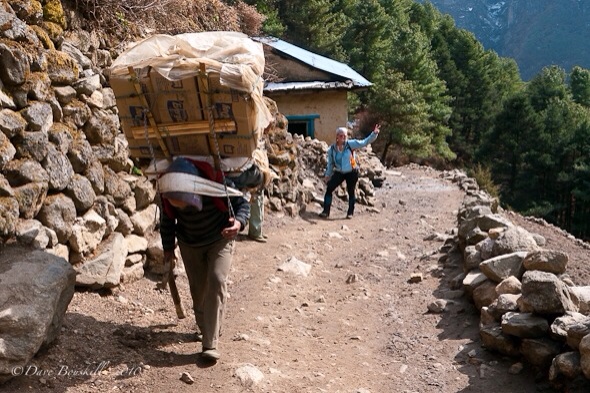
5. People packing crazy loads. This pertains mostly to the mountainous regions of Nepal. Porters are expected to carry loads of 40KG on their backs for days at a time. On top of this, they secure the load with a rope that is tied around their heads. I'm tempted to try it although Meg won't allow it because she thinks it will break my neck. She's probably right. One British gal we met on our hike told us that she had seen a woman packing a refridgerator on her back! It was amazing to hike for a days deep into the mountains to find a huge guesthouse built at the top of a mountain. I found myself constantly thinking “How the hell did that build THAT up here?!”. Every piece of lumber, every bag of cement, every table and chair, EVERYTHING had to be packed up there. It's almost like a system of ants constantly carrying supplies throughout the trails.


Our guide estimated that for a two day trip a porter might earn as much as 70 rupees/KG packed. 70 rupees is equal to 75 cents Canadian. Not much really.


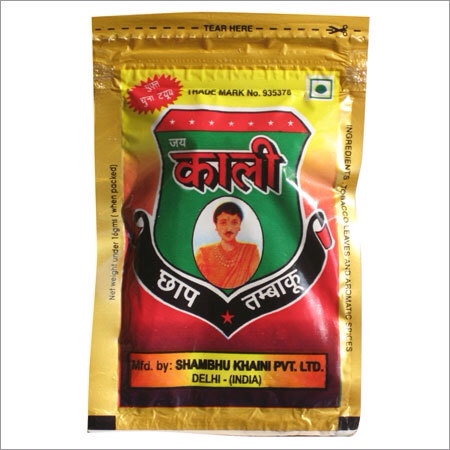
6. Surti (pronounced soor-ti). Surti is the common tobacco found in Nepal. It comes in a small packet that contains tobacco flakes mixed with a white lime substance used for better absorption. Our guide Lal said that the majority of guides and porters in Nepal use Surti and that 70% smoke cigarettes on top of that. A 30 gram package usually sells for 15 rupees (20 cents Canadian). It actually not to bad although in my estimation it's much stronger than typical Westen tobacco.


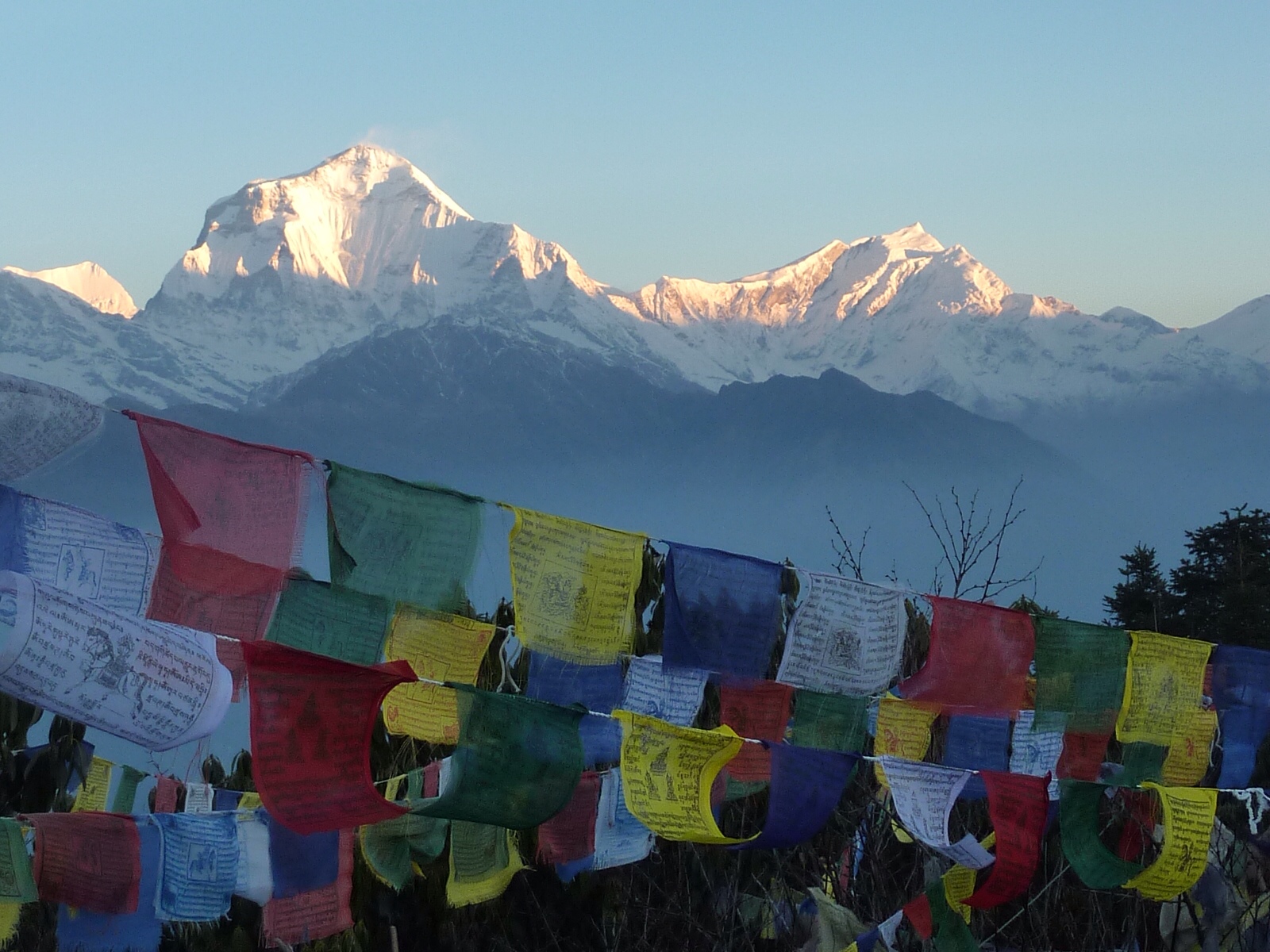
7. Prayer flags. Buddhist prayer flags are found all over the Himalayan regions. The flags are organized in groups of five, each one being a different color and in a specific order. Each color represents a different element of the earth (wind, fire, water, etc.). In tradition Tibetan medicine, when all these elements are in balance a body is considered healthy.


Picture taken at Poon Hill on March 31


8. Momos. Momos are the traditional appetizer in Nepal. It's a number of small dumplings organized in a circle on your plate. Each one is filled with your choice of meat, egg, or vegetable. They are delicious and certainly one of the things I will miss about Nepal. They are served with a spicy dipping sauce and usually cost around 200 rupees ($2.30 Canadian).


9. Use your right hand. It is immensely important in Nepal to use the right hand to perform certain tasks and the left hand to perform certain tasks. If you are shaking someone's hand, accepting money, eating food, etc. – you must use your right hand for this. It is considered your clean hand. If you are doing anything in the toilet, wiping your nose, etc. – you must use your left hand. Mixing these up can be considered a big insult in Nepal. This is why you must always walk clockwise around temples or stupas. Because if you wak counterclockwise, your dirty hand is towards the religious building/ symbol. Even if you are only waving to someone you should always use your right hand.


10. Gurkha knives. Nepalis are extremely proud of their Gurkha warriors. During 1814-1816 Britain and Nepal were looking to expand borders and met in what is now known as the Gurkha war (or Anglo-Nepalese war). Despite being largely outnumbered, Gurkha troops seemed to surprisingly hold their own against the British troops. The war ended with the signing of a treaty that saw Nepal give up land for a small sum of money. The British grew an immense respect for the Gurkhas and in World Wars 1&2 the British enlisted the help of more than 200,000 Gurkhas to fight in the British armies – playing a key role in the battle of Gallipoli to name one battle. Now Gurkha knives called Khukuris are sold in souvenir shops everywhere in Nepal.


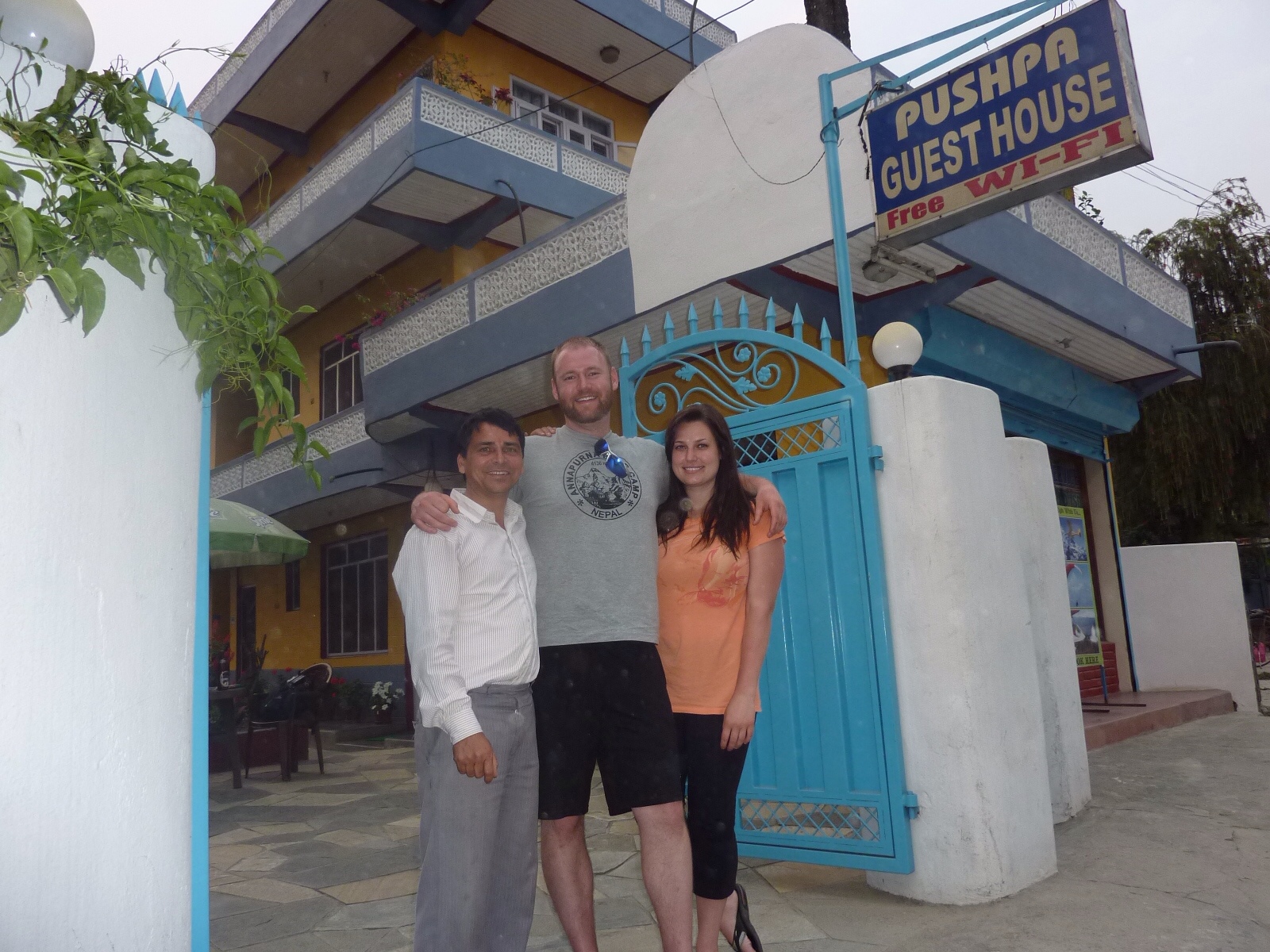
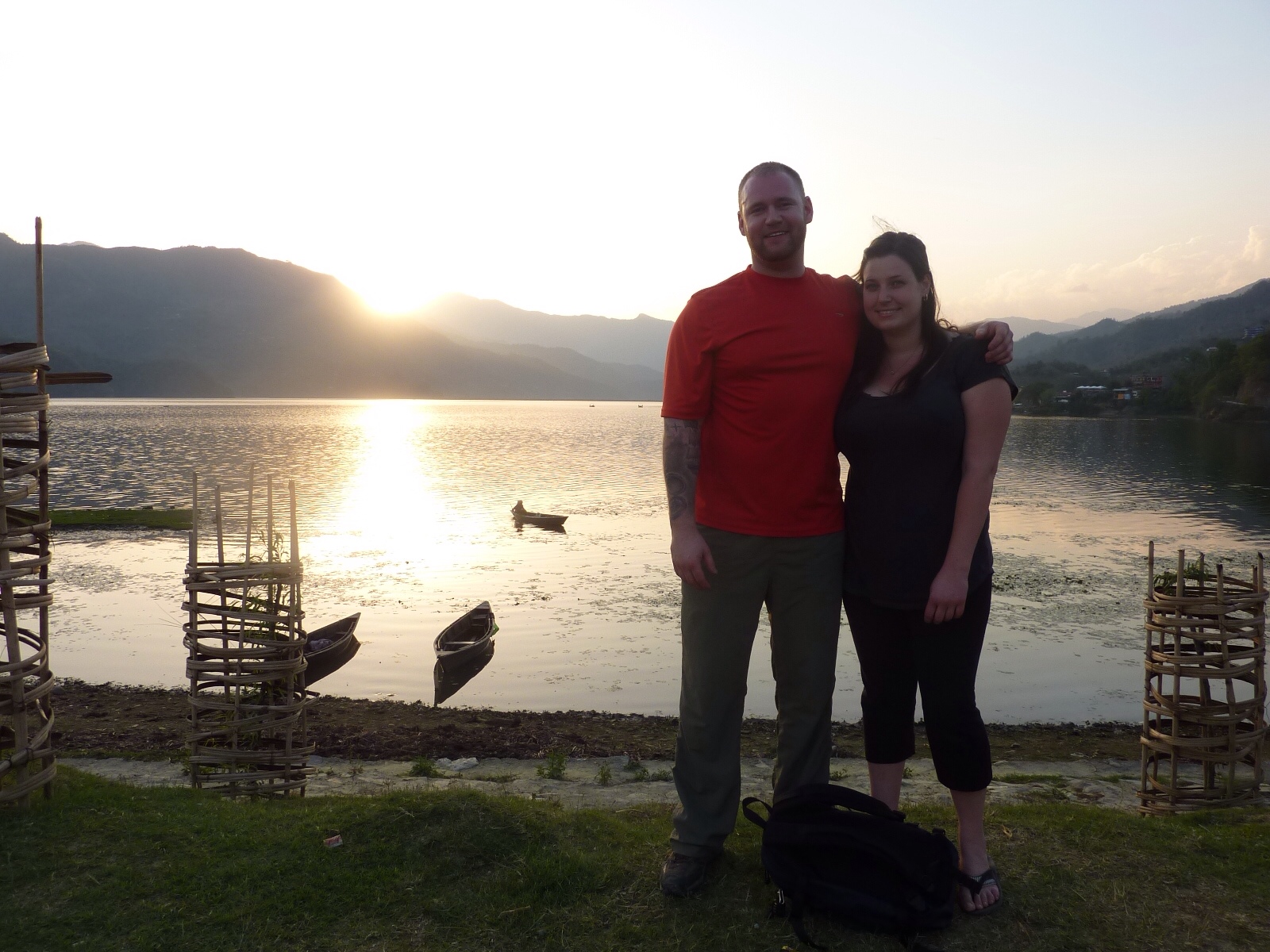
We have now left Pokhara and have taken a bus to the historic city of Bhaktapur. I feel I need to thank our gracious hosts in Pokhara – Raj and Onita at Pushpa guesthouse. We got to know this wonderful couple very well and I will always remember our time together at Pushpa. I learned a lot about the politics, culture, and what it's like to be a businessman trying to make his way in Nepal from Raj. If anyone is visiting Nepal in the future I highly recommend you look this guy up for accommodation or for trekking.

Raj, Jason, and Megan - April 11, 2014 at Pushpa


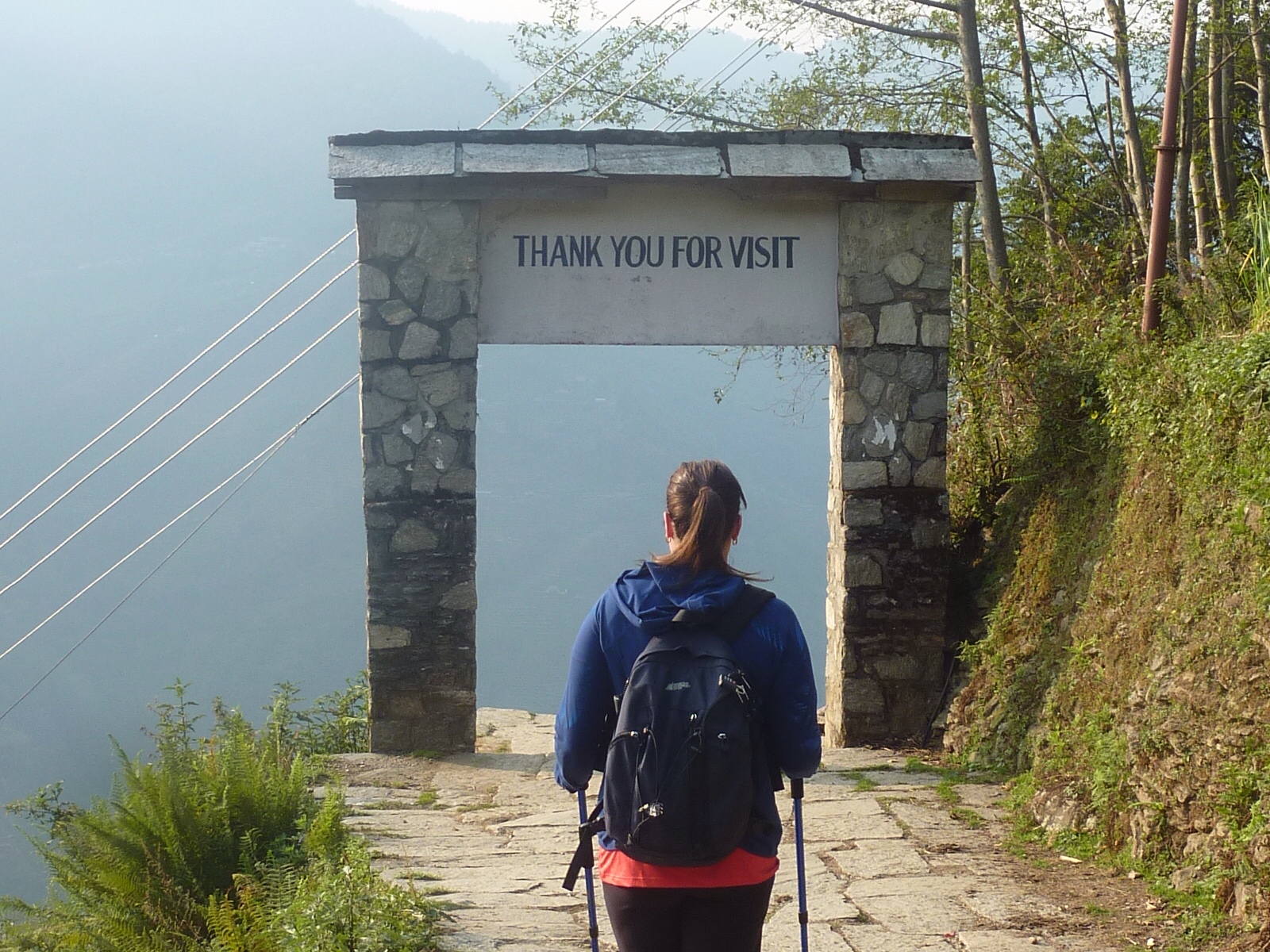
The End of a Great Trek

Posted: April 10, 2014 in Nepal


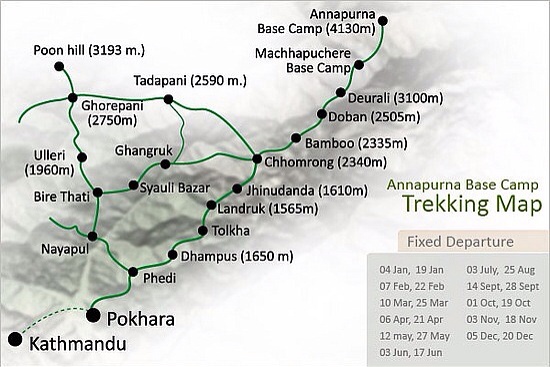
Day 8 (Doban to Chhomrong)

Starting Elevation: 2505m


Once again we backtracked along a picturesque river valley, passing terraced rice fields and long, waterfalls in the process. The long downhill stretches made our knees feel like they were full of loose ball bearings bouncing around. At times I felt like I could use a shot of grease to the knees like the tin man from Wizard of Oz. At points Megan and I would look at each other and wonder how we ever made it up such a steep incline.


Even though downhill is hard on the joints, it was still much easier than the going uphill and we were thankful for that. We also covered nearly double the distance on the way down – as we could travel much faster and needed less frequent breaks to inhale our 1 Litre water bottles.


We passed three teenagers along the way hauling 15 foot long pieces of timber up the mountain. The long length of the loads forced them to walk sideways to avoid crashing into the many trees that bordered the narrow paths. Seeing something like this made me feel like a complete wuss for thinking my 18 KG backpack was cumbersome.


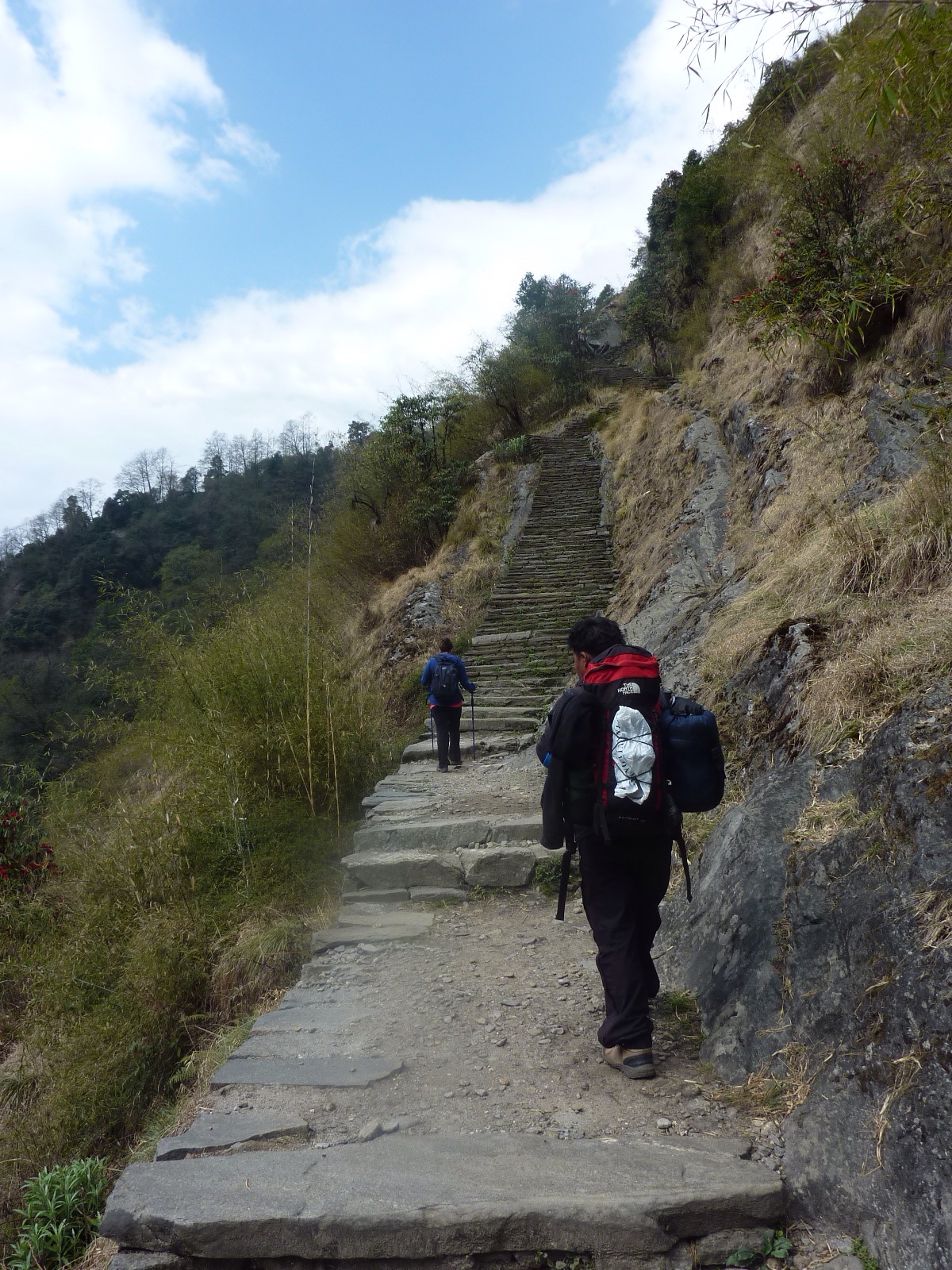
The day ended with us climbing 3000 steps to get to the top of the village of Chomromg. It took us an hour and a half to conquer the 3000 steps (something that would have taken us 3 hours at the start of the trek).


We capped of the day by ordering a large tuna, egg, cabbage, carrot, onion, garlic, cheese, and tomato pizza at our wonderful guesthouse.


Total trekking time today: 6 hours


Day 9 (Chomrong to Ghandruk)

Starting elevation: 2340m


The day started with a steep 2 hour descent down to a gushing river. We crossed over a makeshift bridge made of trees and hay and began a 2 hour uphill climb to a small village where we enjoyed a cup of hot lemon tea before carrying on.


Soon after we passed by a family moving their herd of mules and we stopped to give a small child a piece of chocolate we had in our backpacks. The child was thrilled and so was the mother. We gave a piece to the mother as well which the child quickly snatched out of her hand before reluctantly letting his mother have a piece.


For whatever reason, we seemed to spend a lot of time on the side of the trail today waiting for local ranchers to move their mules and horses past us on the trail.


Megan gets caught in the middle of another mule drive


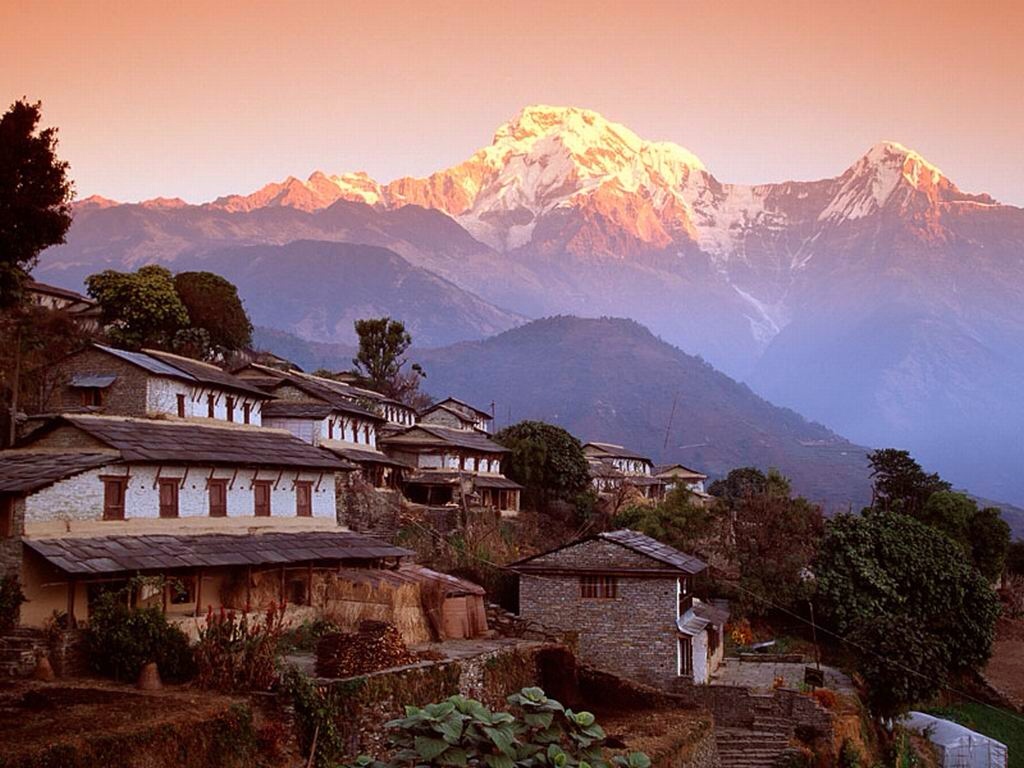
Finally we reached the old village of Ghandruk. This is easily one of the most popular villages to trek to in Nepal and it's easy to see why. The streets (if I can call them that) were bustling with life. Children were playing and women were dressed in elaborate colourful clothes. Houses changed from the typical thatched roofed houses to brick houses with stone slab shingles.
 

As we are admiring our new home for the night, a man passes us on wobbly legs. He is trying to pack seven mattresses on his back and is having a hard time doing it. The whole thing looked a little comical as he staggered past us in a zig zag pattern with each step being an abrupt, deliberate movement.
 

Total trekking time today: 5 hours


Day 10 (Ghandruk to Kimche)

Starting elevation: 2012m


We woke up early and hiked a short 1.5 hours to a village called Kimche where we bargained with a local jeep driver to take us 2.5 hours back to Pokhara. On the way we passed a cow that shockingly had the sense to kneel down on its front legs to get to some low lying grass just off the path. I had never seen anything like it so I had to snap a picture.


Total trek time today: 1.5 hours

The finish line


After 10 long days we were finished our trek with mixed emotions. On one hand, we were going to miss the daily routine we had become accustomed to. Spending time with our great guide, being in such beautiful scenery, late night card games, early morning tea drinking. On the other hand, our bodies were telling us it was time for a rest.


Total trekking time: 56 hours


Tips for anyone who would like to do this hike:


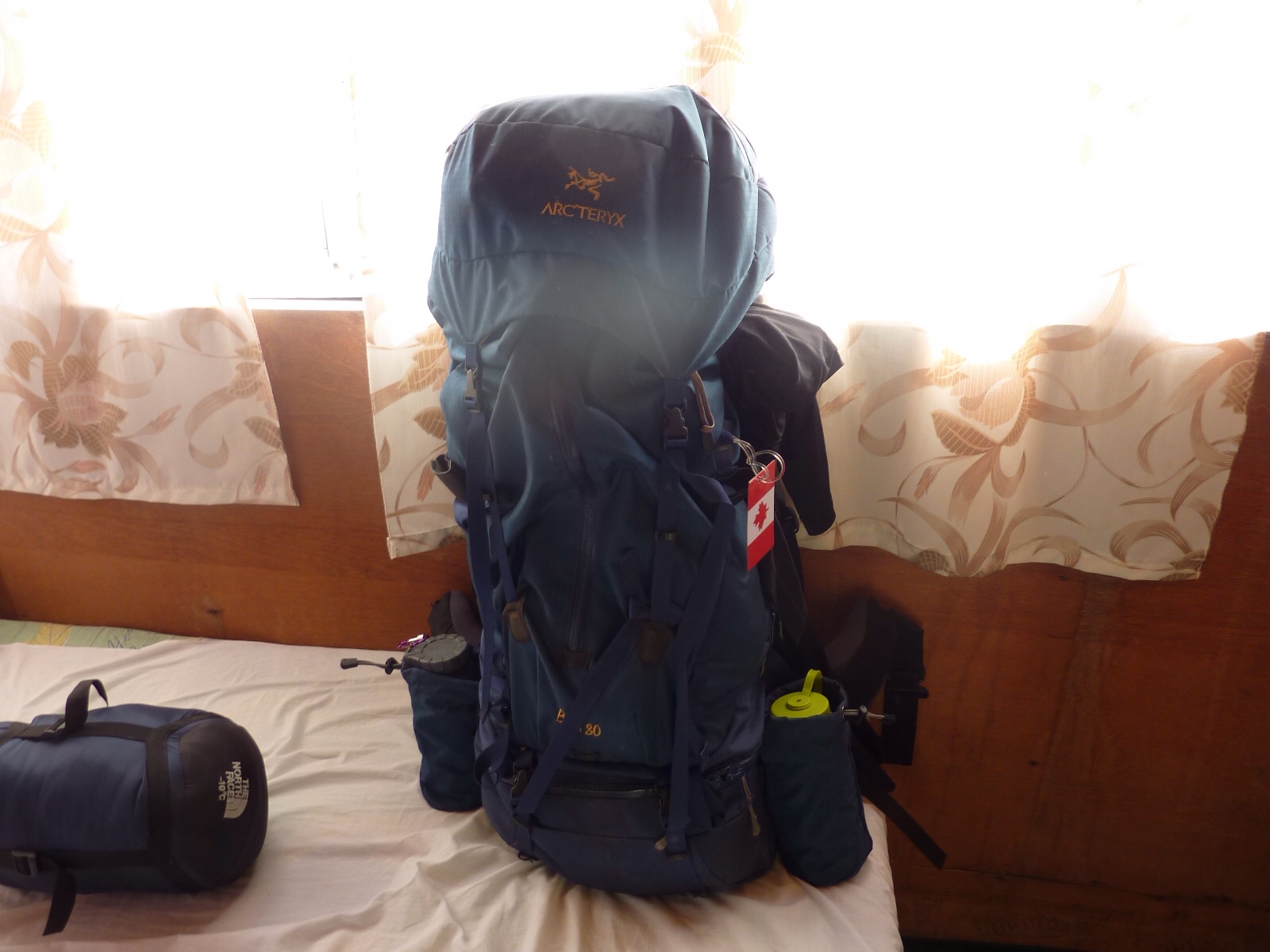
1. Pack light. I didn't see anyone else packing an 80L pack on the trail and we shouldn't have either.


My pack weighed about 18KG (40+lbs) and even though the Nepali locals pack this kind of weight, I wouldn't recommend it. Not on a 10 day hike with such extreme elevation changes. If we did it again I would take a 40L pack.

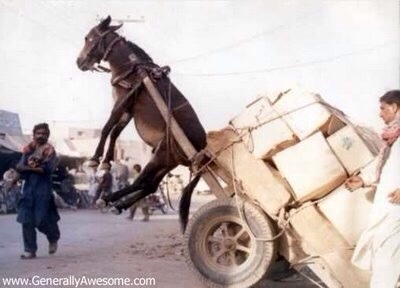
At times I felt like this


2. Bring a guide. It is possible to do this trek without a guide but a guide is so helpful in so many different ways. Our guide costed us $25/day – not a lot by Western standards. With that, we got:

  • Someone to show us the way. For the most part it was self explanatory but there are a few times when we didn't know which route to take.
  • A translator. At many of the teahouses the staff do not speak English. Trying to communicate with them would have been so much more difficult without Lal there. He helps us order food, choose a room, pay the bill, etc.
  • Someone to explain what the heck is going on. When passing through villages we see all sorts of things that make me go:

Whether it's men making a thatched bamboo roof, grinding barley, or drying millet to make alcohol. It's so nice to have someone there to explain what is going on. Lal was born and raised in a small rural village so he always knew what was going on and how to explain it. To me, this is the most important reason to get a guide.


3. Bring warm clothes that you can layer. The first two days of the trek we wore shorts and t-shirts. The last two days of the trek we wore every piece of clothing that we had (long underwear, two pairs of socks, long sleeve shirt, sweater, jacket, mitts, toque) – at night it got as cold as 0 degrees Celcius with no heater. You need to be prepared to take off and put on layers multiple times every day. Also, stay away from cotton. It absorbs sweat and takes ages to dry. Instead, pack clothes that can dry overnight with little or no help from sunlight/wind.


4. Aquatabs. These little babies are life savers.

We saw multiple people along the trek who were packing around large filters or cumbersome instruments to filter their drinking water. Or worse yet, we saw many people buying bottled water every time they needed a drink. This is not necessary. Take a pack of aquatabs, drop one in your water bottle each time you fill up, shake it a couple times, wait 30 minutes, and enjoy. They take up next to no room in your pack. Nepal already has a litter problem – why compound this problem by buying and throwing away dozens of plastic water bottles? I'm not one of those hippies that drives a Prius and sniffs their own farts but the older I get, the more priority I put on preserving our planet.


Now we're back in Pokhara and in relaxation mode. I'll update soon. I'm way behind on blogs.


PS. This beard is getting really big and itchy. I'm starting to feel like Tom Hanks in Castaway.

Wilson!


On the Doorsteps of Giants

Posted: April 4, 2014 in Nepal

Day 6 (Himalaya to MBC)

Starting Elevation: 2920m


As the night was winding down on day #5, we were playing cards in our tea house with a couple of Nepali's when we heard a loud low rumbling noise. The noise was similar to the rumbling sound that thunder makes. It was an avalanche. Everyone rushed outside to see if they could spot it and we did. Lal pointed it out to me high on one of the mountains across the river from us. It lasted for about a minute before it petered out and our card game resumed. I remembered our guide mentioning avalanches but it was kind of something that was never mentioned again. Neither Meg or I realized that it was a concern.


The next morning we woke early and started the slow, incredibly steep climb to the next village called Deurali. It was snowing heavily which made visibility poor and it was quite a bit tougher to get proper footing as we climbed. After 2 hours we made Deurali and our guide Lal told us to come into the tea house for a rest and a cup of hot tea. He told us that we wouldn't be leaving the guesthouse until conditions improved because the risk of an avalanche was too high. Lal had done this trek more than a hundred times so we listened to every word he said.


After an hours wait, conditions had not improved much but Lal had devised a plan. He said that we would be joining another group and carrying on to MBC despite the weather. We made it perfectly clear that safety was a much bigger priority to us than finishing the hike and that if we had to turn around it wasn't the end of the world. He assured us that it would be safe. He instructed me to lighten my backpack and leave whatever contents that I could behind in Deurali at the tea house. I did so and we carried on.


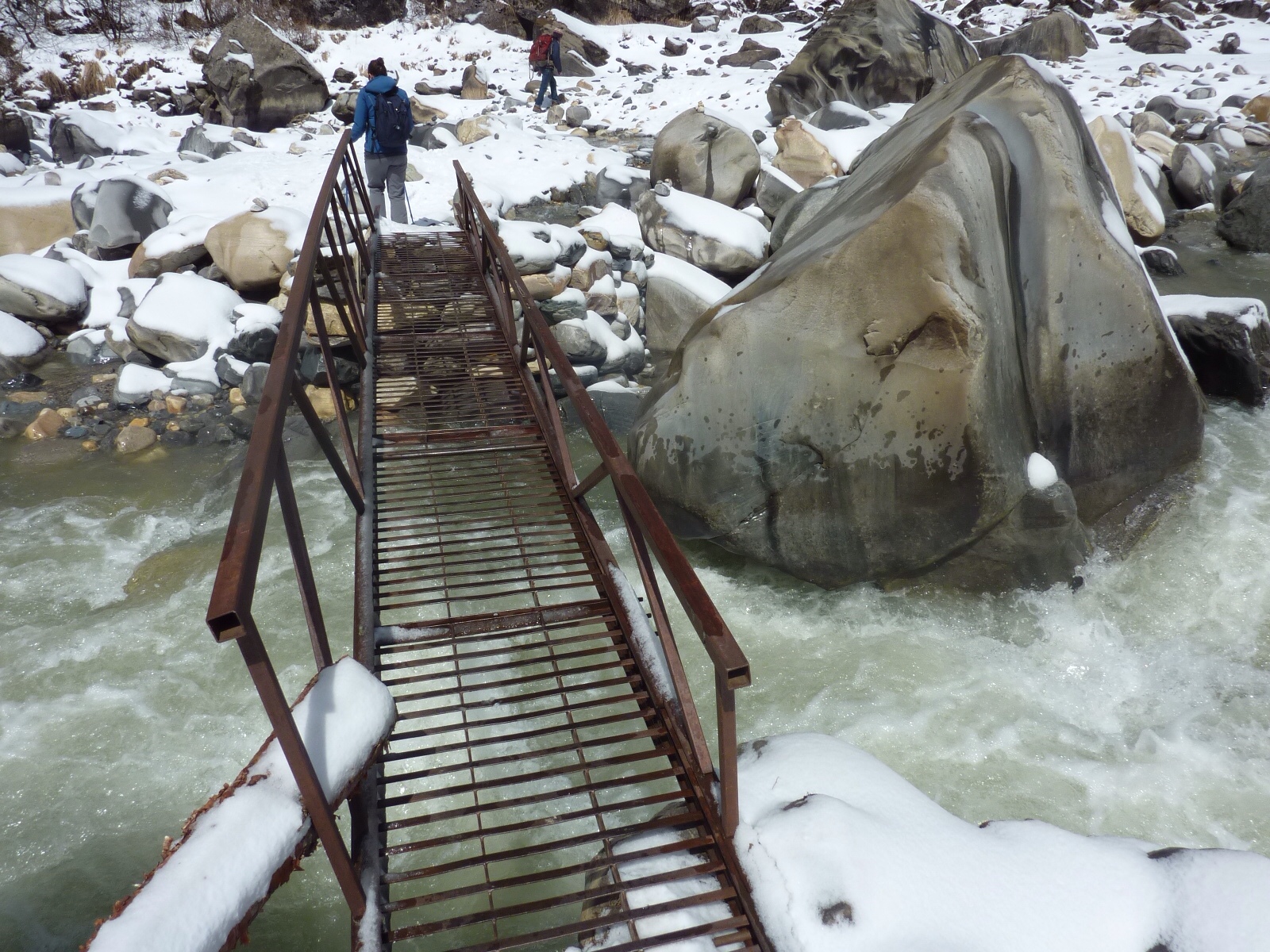
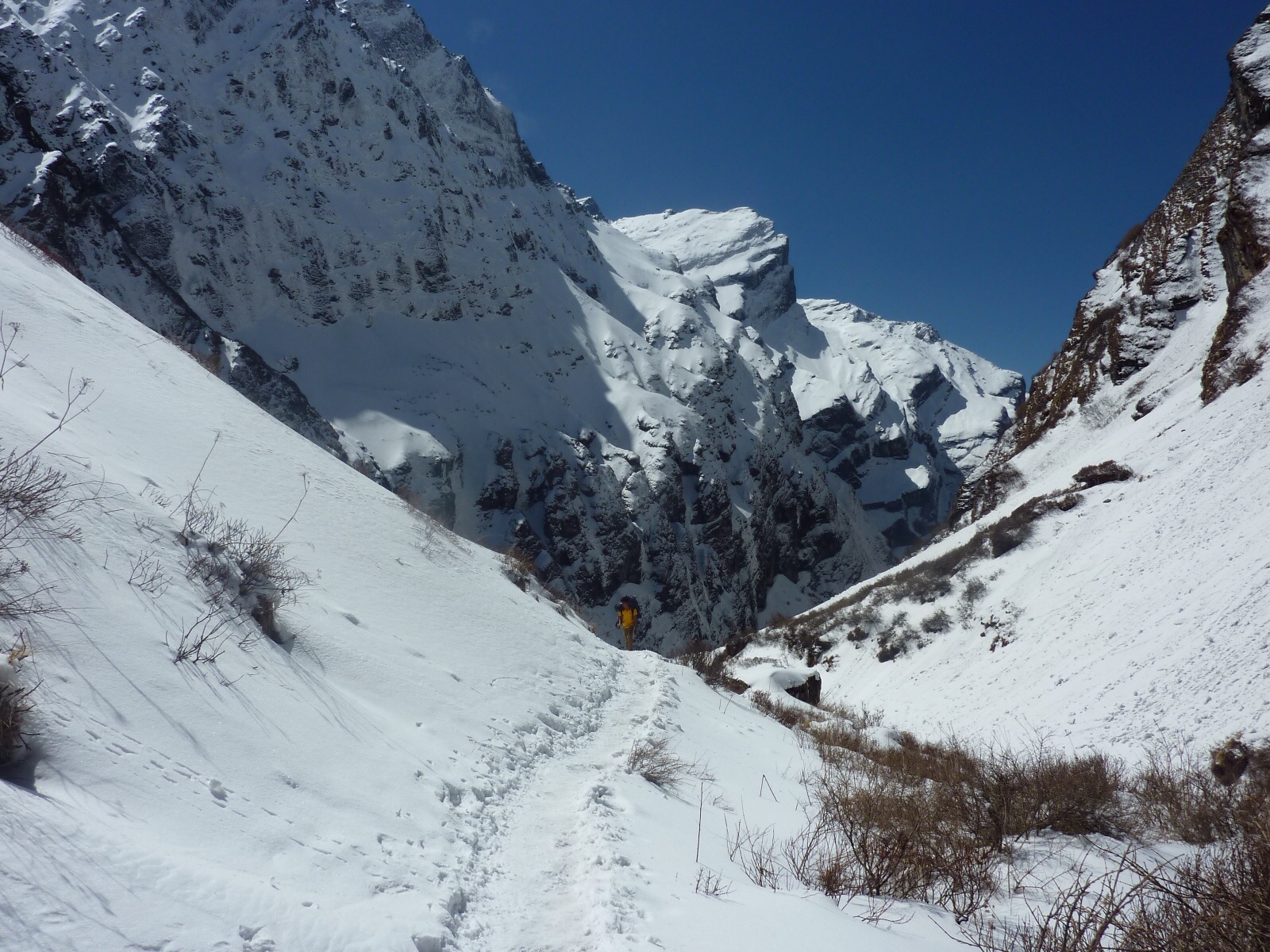
The terrain changed dramatically almost instantly. Instead of a dirt path, we were walking only on snow and scattered rocks. Occasionally we would have to cross an emerald green stream on brown steel bridges.


A couple of times a loud crack was heard and our guide would survey the surrounding mountains before assuring us everything was ok and we could continue walking. After 3 hours of uphill walking, we finally made it to MBC (Machapuchre Base Camp) where there was now no danger of avalanches. Megan wants to add that this day was the most tired her legs had been all trip.

MBC guesthouse


The views were fantastic. We played a couple games of cards and retired to bed in anticipation of an early morning trek to ABC.

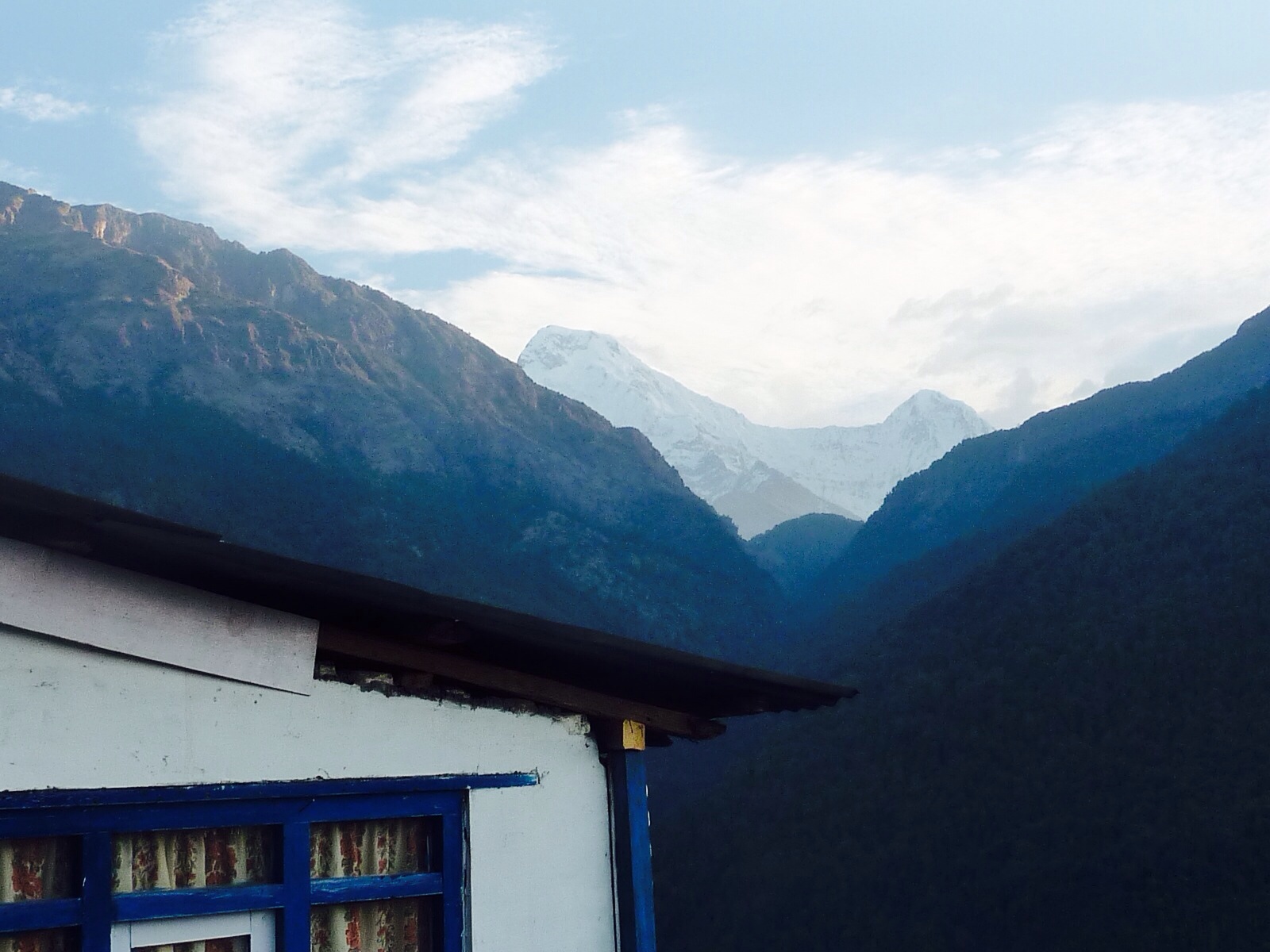
View from outside our room at night


Total trekking time today: 6 hours


Day 7 (MBC to ABC)

Starting Elevation: 3730m

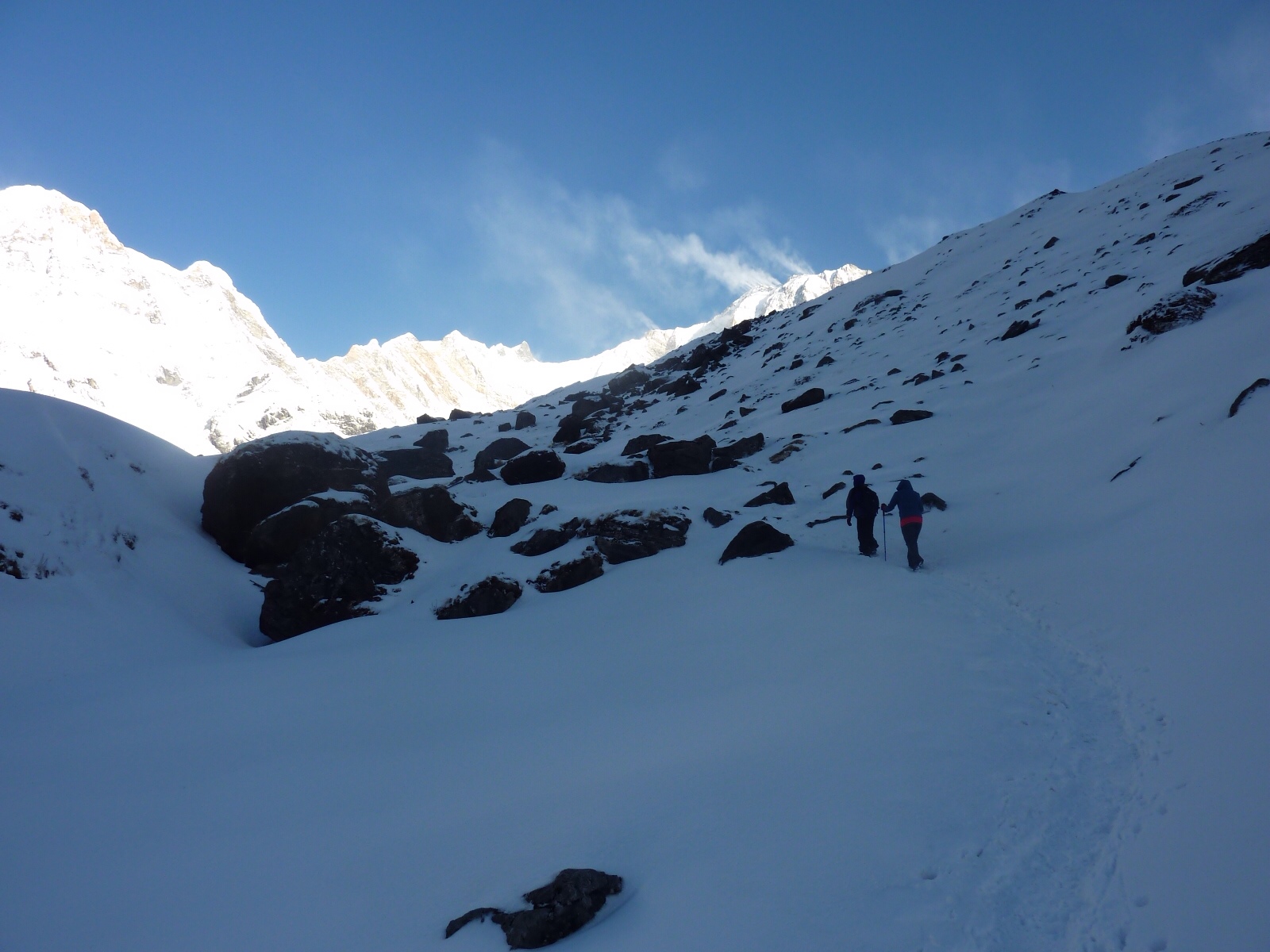
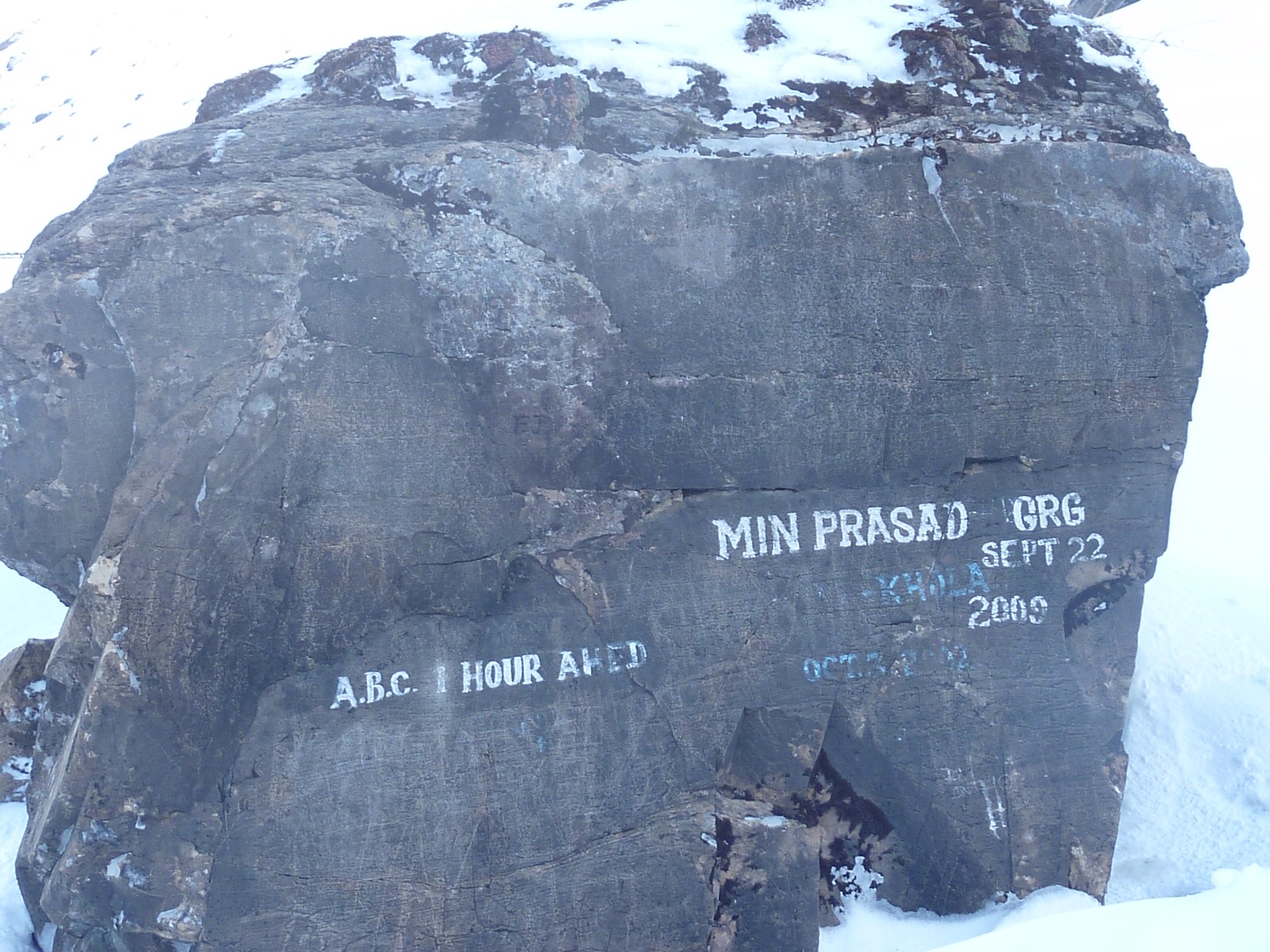
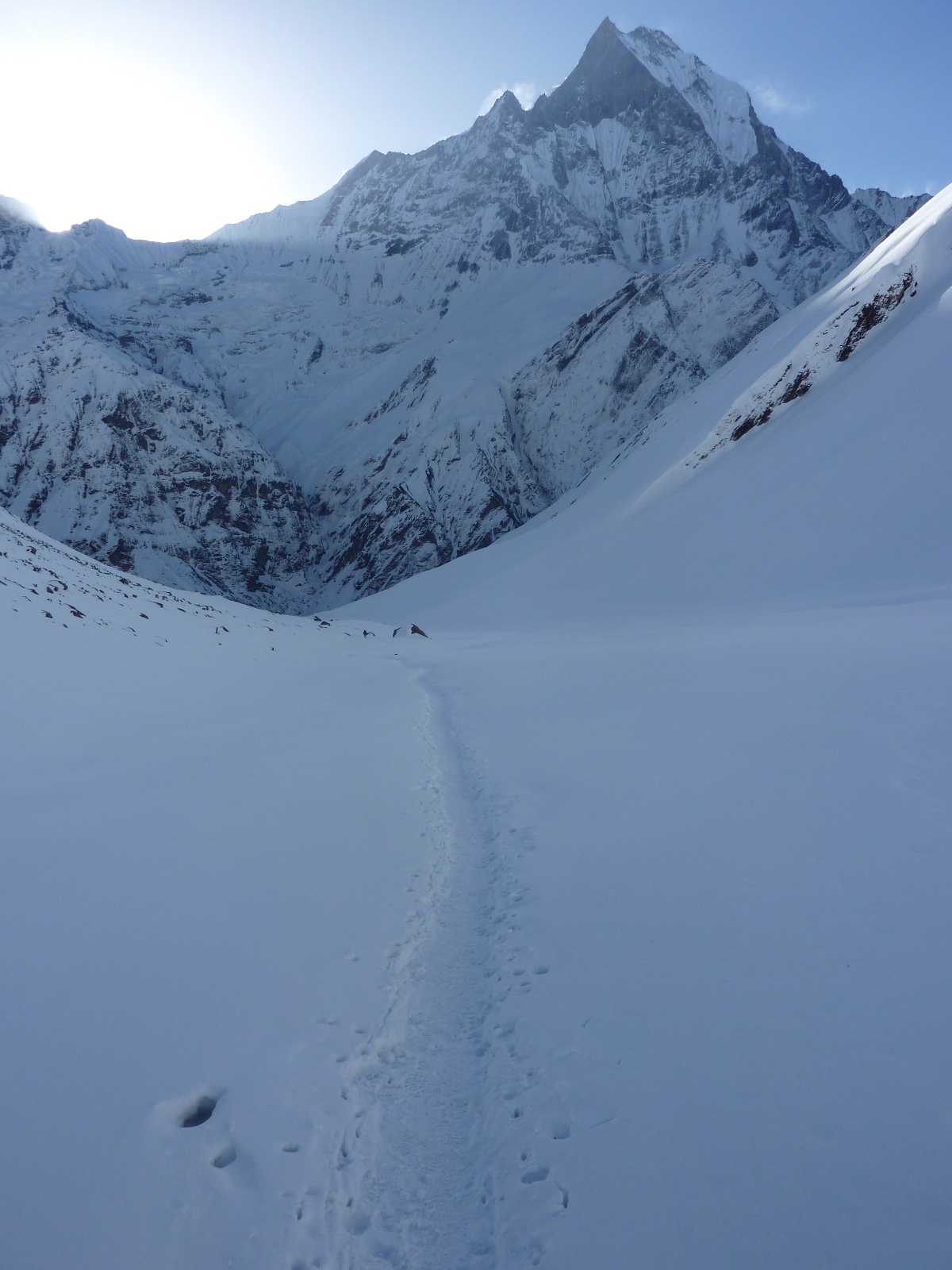
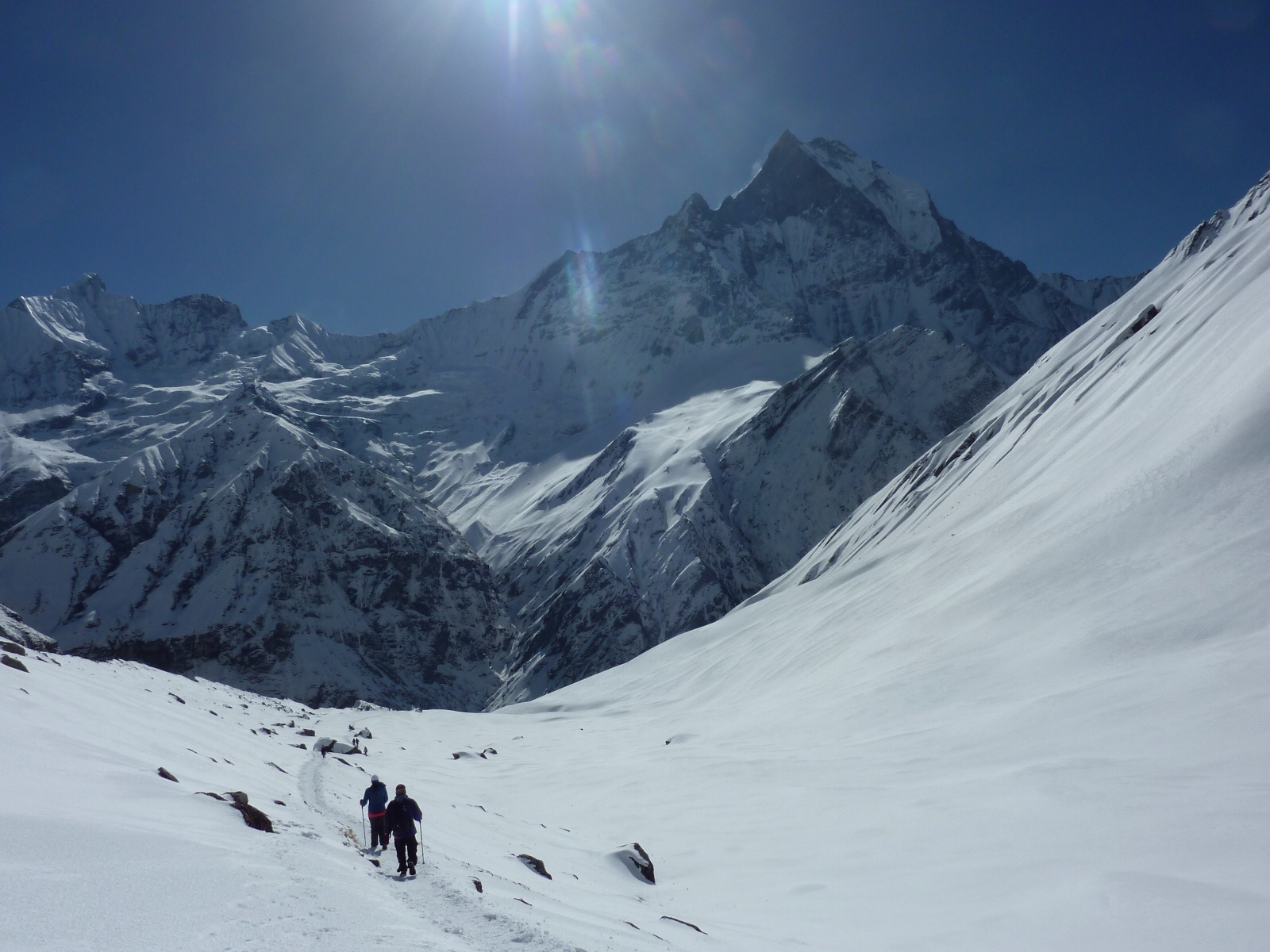
The next morning we ate a handful of almonds and some fruit bars and started our hike to ABC. It was a clear, pristine morning and every time we took a step the snow would make that distinct crunching sound. It was a two hour uphill trek that traveled right between two mountains.

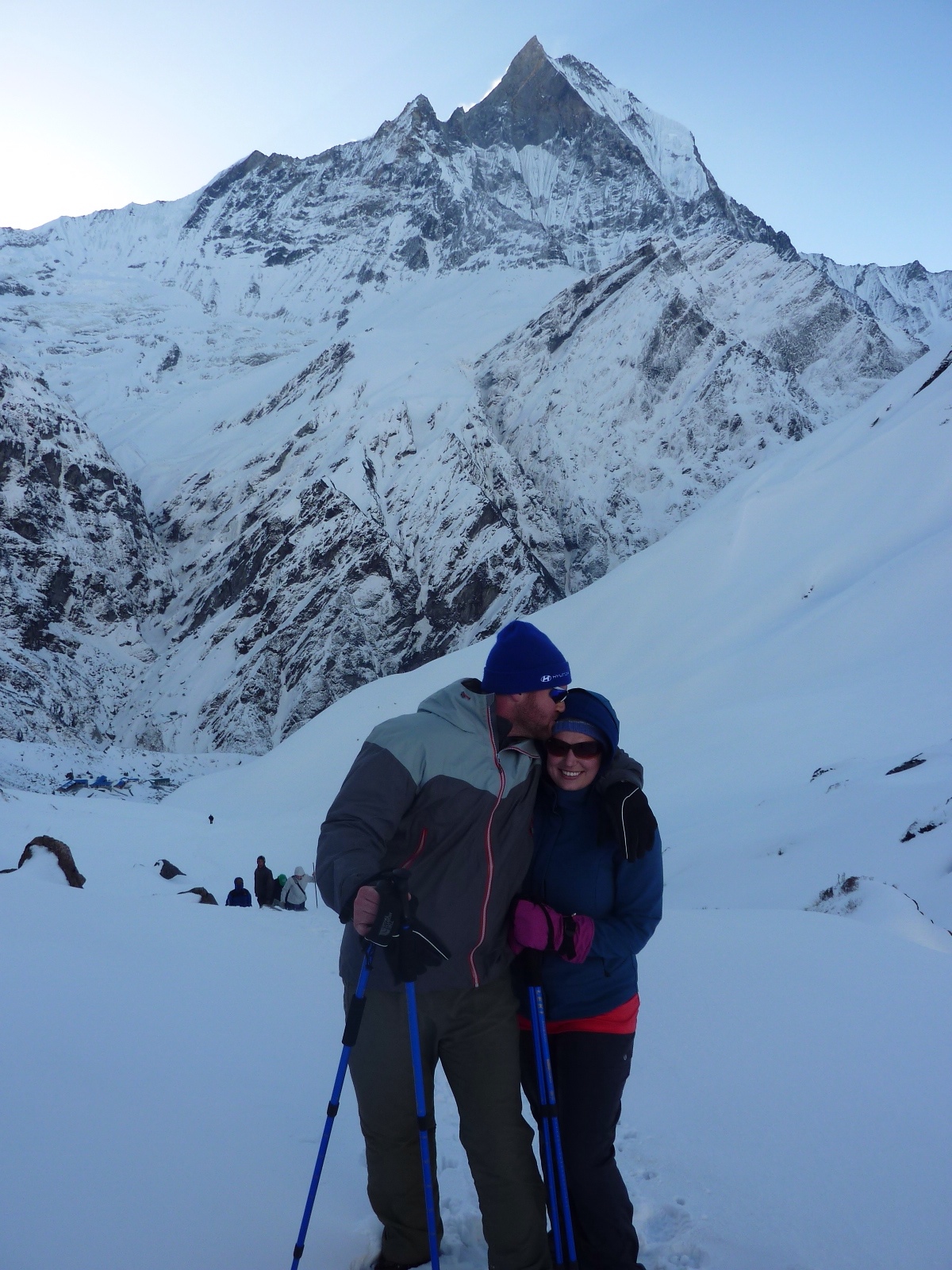
We were so excited that the pinnacle of our hike was so close. Finally we passed over a hill and we could see Annapurna Base Camp (ABC).

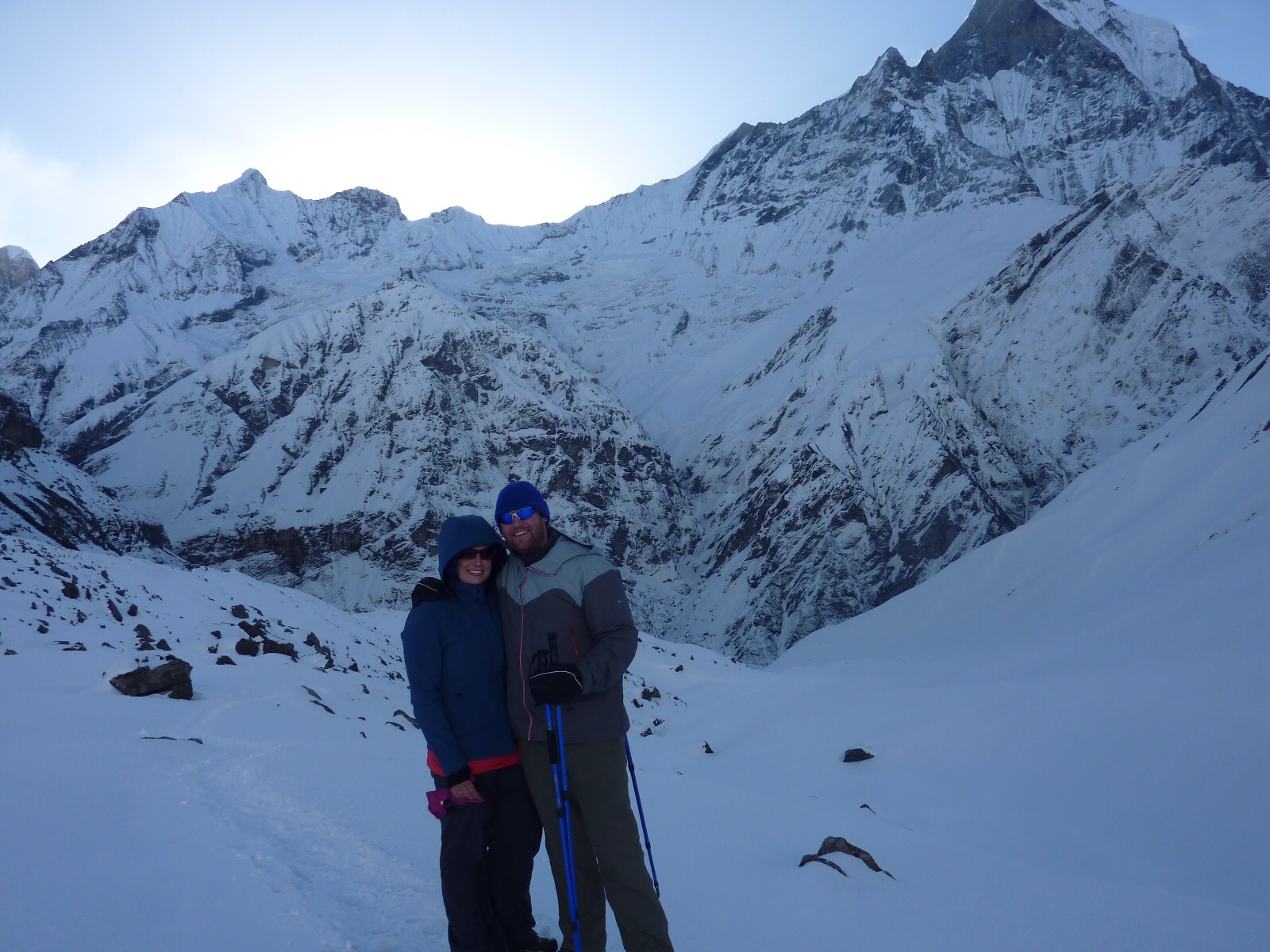
Megan said “I never actually thought we were going to finish it until I could see the end in sight”. The three of us met in a big hug at the top in celebration.


ABC elevation: 4130m

It really was something to see. It felt like being surrounded by giants.

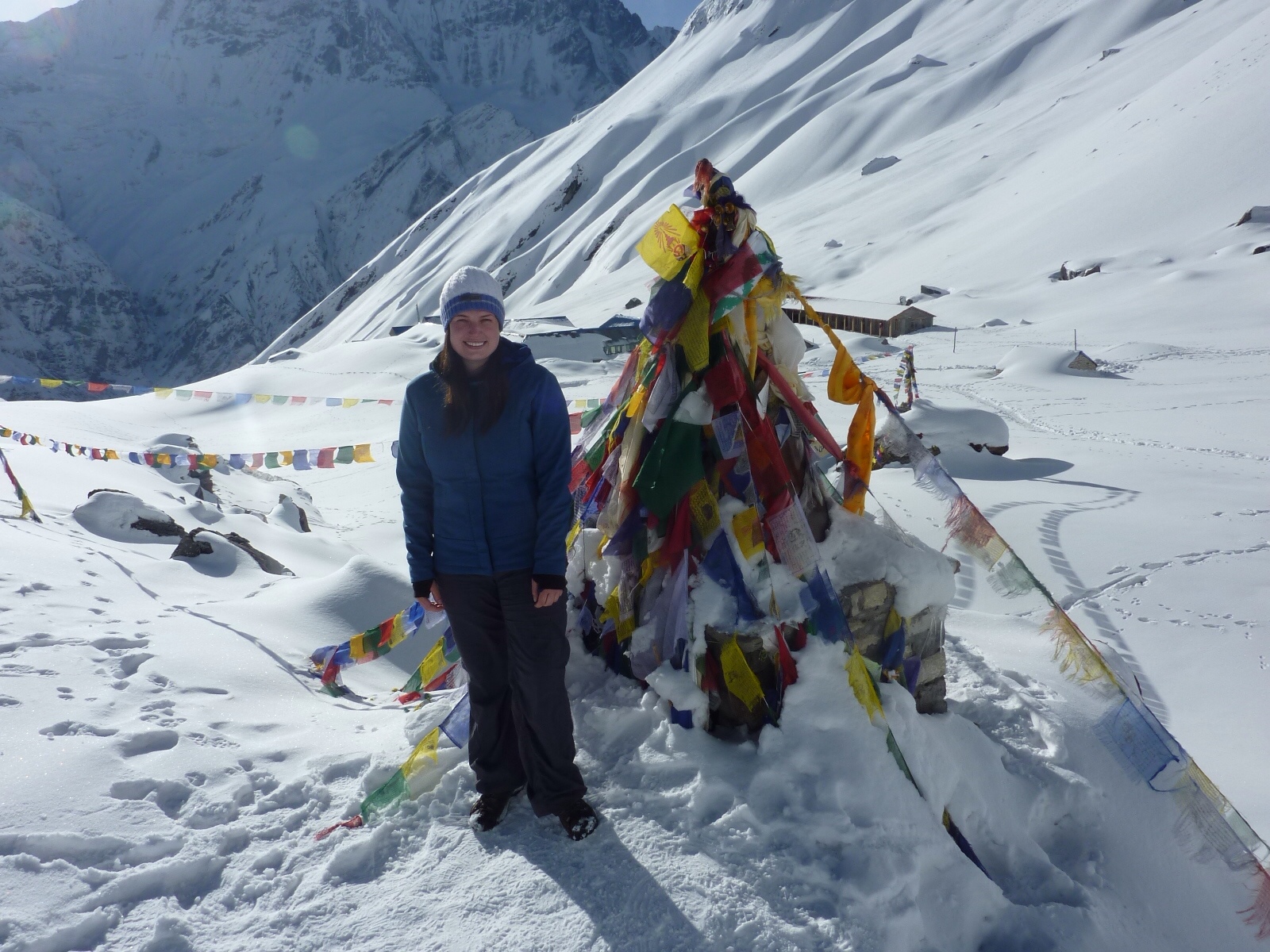
Megan in front of a memorial erected for those killed climbing the surrounding mountains

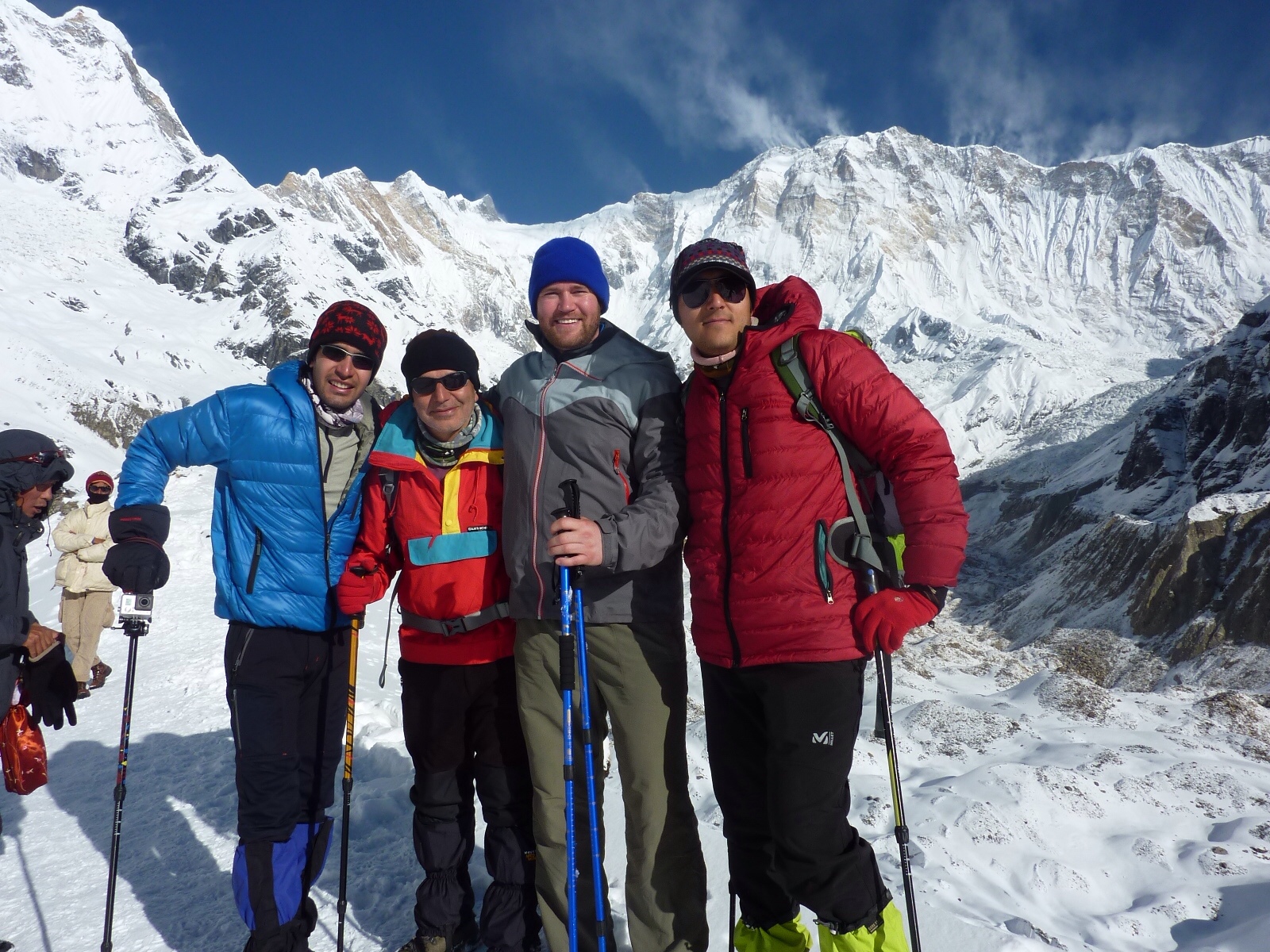
Me with some Iranian friends I met during the trip. Well educated, nice people. Very interesting to talk politics with them.

Lal showing off


After an hour at the top we had a cup of hot tea and breakfast before starting our descent.


Oh, we also signed our respective country's flag at the top, as is tradition.


Now to start the descent. We were so energized from actually making it to ABC that we couldn't stop walking.

We just walked…..

Meg and Lal heading back down to MBC


And walked…..


And walked……..


Everywhere I went I walked..


We ended up walking for another 5 hours, making it all the way to the village of Dobhan. After a game of cards and an ice cold shower we hit the hay – exhausted.


Total trekking time today: 8 hours


Note: To the parents – we are safe and completely out of avalanche territory now. We are on our way back to Pokhara.


Note: This is the second blog post today since we have just got internet.

Day 5 (Sinuwa to Himalaya)

Starting elevation: 2360m

Oh the land, it is a changing

The day began with a tough uphill slog for an hour. On these type of inclines, we try to take a 2-3 minute water break every half hour before carrying on. The trail is starting to look much different the further into the mountains we get. For one, we no longer pass barnyard animals on our treks – hence why we cannot eat meat this far into the mountains. Also, the trail has become much smaller and instead of having nice steps to climb, we have a much more rough trail. Rocks are roots are scattered about the trail making for much more debris to step over.

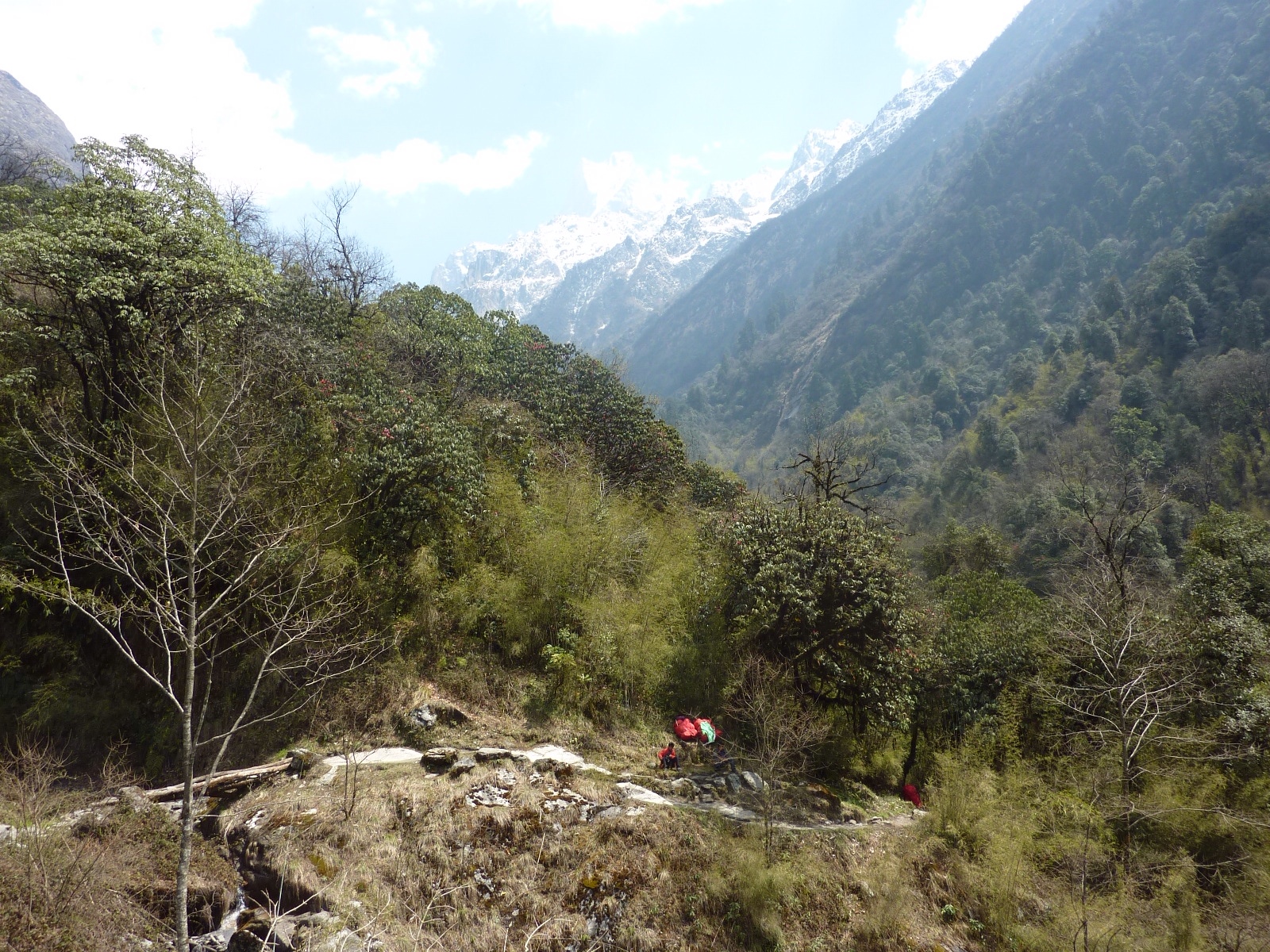
From there the trail wound throughout several valleys, and crossed multiple small steel bridges along the way.

After 3 more hours of rollercoaster hiking (up, down, sideways, etc.) we settled down for a tuna-cheese-spaghetti and veg noodle lunch in the small village of Dobhan.

Another thing we've noticed as we get further back in the mountains is that villages no longer appear very half hour. Instead it's 2 or more hours of hiking in between villages. After lunch signs informed us that we are getting into holy land and that spitting and pooing outdoors will no longer be permitted.

Where's my Immodium?

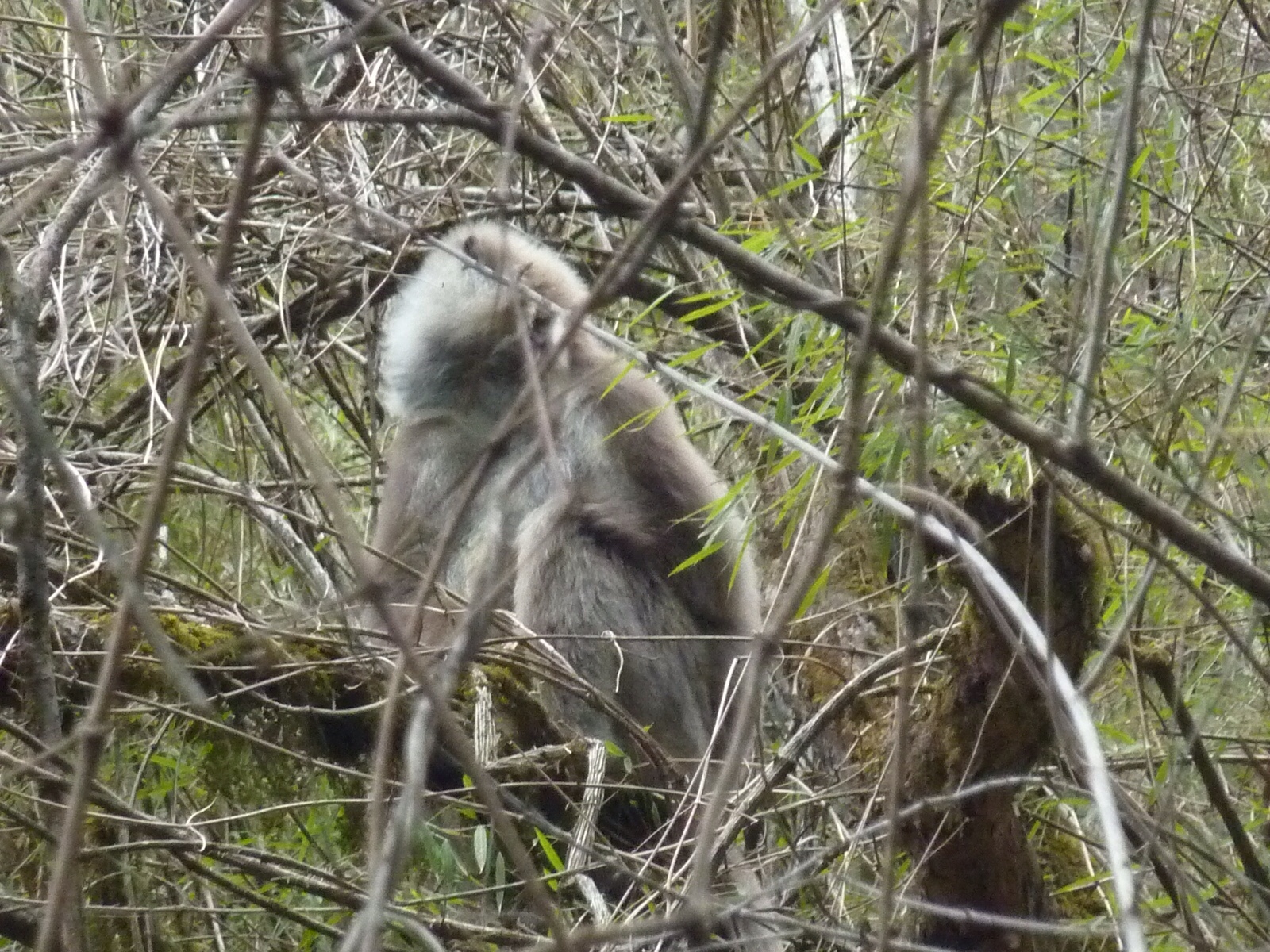
A half hour before the end of our hiking day we spotted a group of grey furred monkeys hanging out in the trees just before the village of Himalaya. I tried to capture some good pics but the damn things are so elusive.

Literally less than one minute after reaching our destination (the small village of Himalaya), it started raining buckets and then hailing buckets.


Total trekking time today: 6 hours

Tomorrow we start our last push to get to base camp!


The Annapurna Base Camp (ABC) trek continues

Day 3 ( Ghorepani to Poon Hill to Ghorepani to Tadapani)

Starting Elevation: 2860 meters

The day started off at 5AM. We donned our headlamps and started the ascent to Poon Hill. Poon Hill is a viewpoint only an hours hike from Ghorepani. The objective is to get to the viewpoint in time to watch the sun rise overtop of the Himalayas. The steep incline made sure that both Megan and I were sweaty messes by the time we reached the top. But it was worth it.

I was quite surprised at how many people made the one hour early morning hike. I would have to say at least 175 people were on Poon Hill in time for the sun rise.

People scrambled to find the best possible place to capture the sunrise with their expensive cameras with lens's as long as my arm. I suppose all the ruckus took away from the serenity of it all, but nonetheless the views were quite amazing once the sun starting cresting the mountain tops.

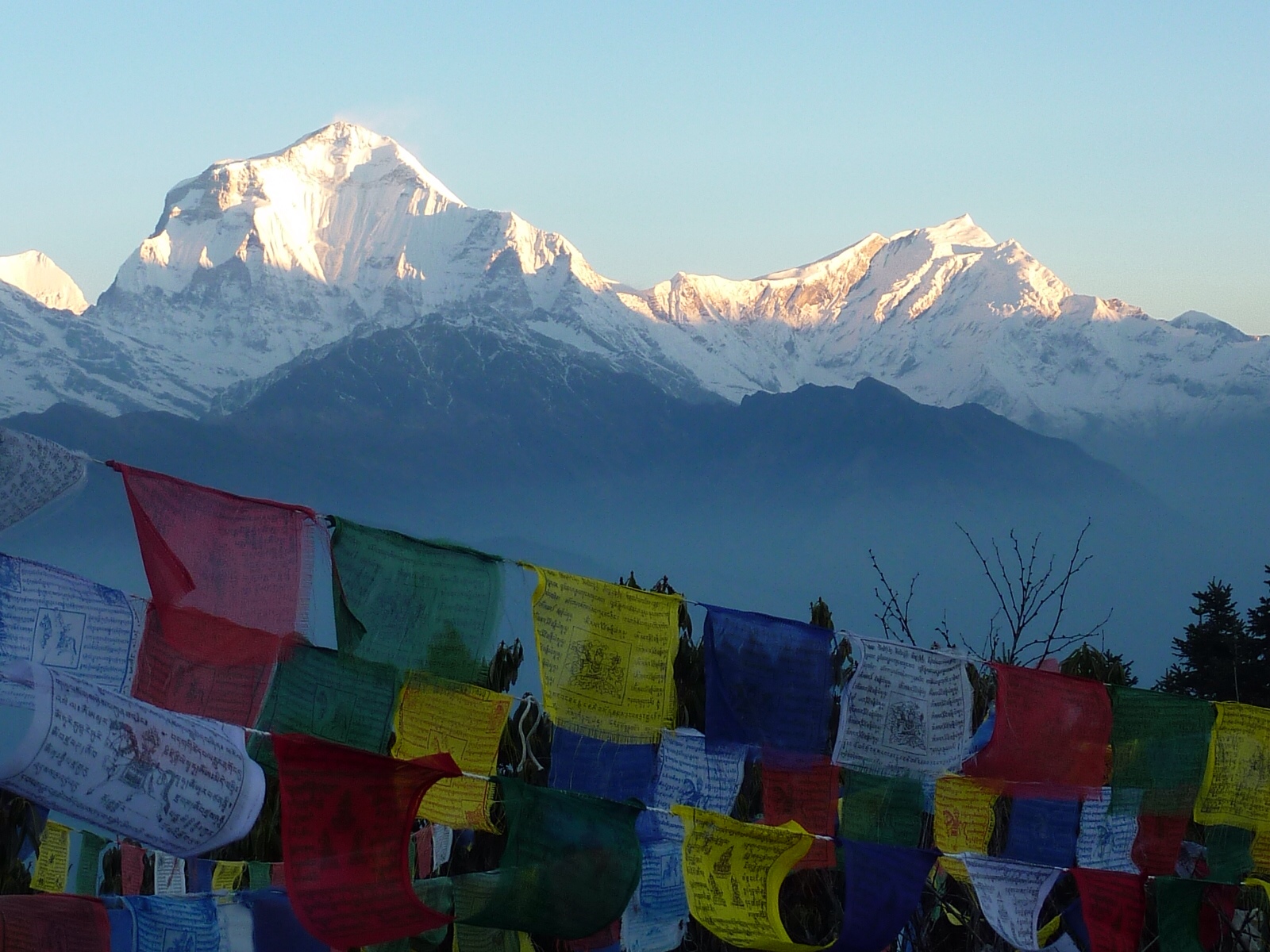
Megan and I in front of Dhaulagiri mountain (8175m). 8th highest mountain in the world.

The coloured paper behind us are Buddhist prayer flags and can be found at most important sites in the mountains. Buddhist believe they give good fortune when the wind blows through them.

Someone was actually selling hot tea on Poon Hill which was a nice treat before we had to retreat back down the hill to Ghorepani to pack our bags, have a quick breakfast, and continue on our way to ABC.

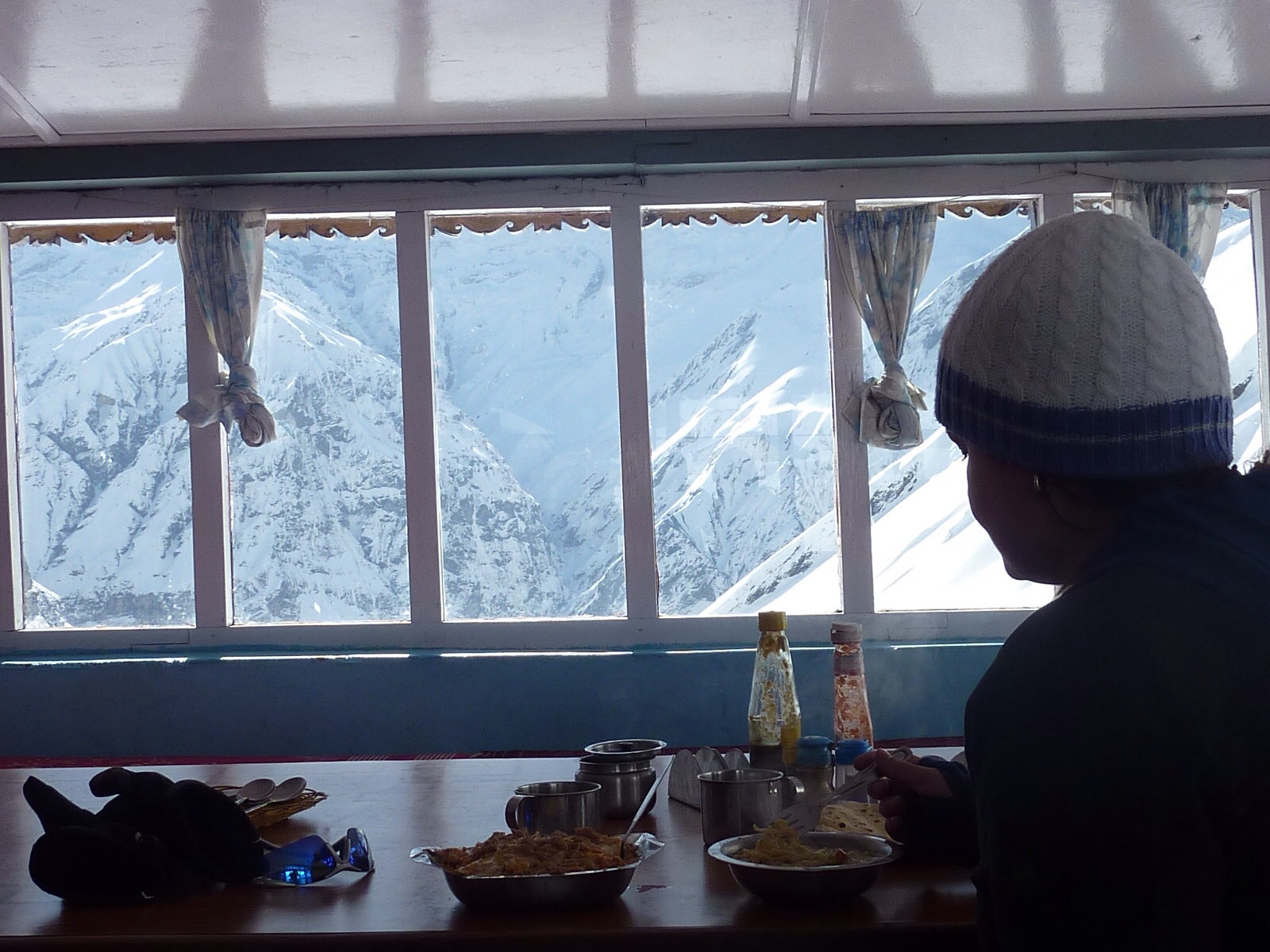
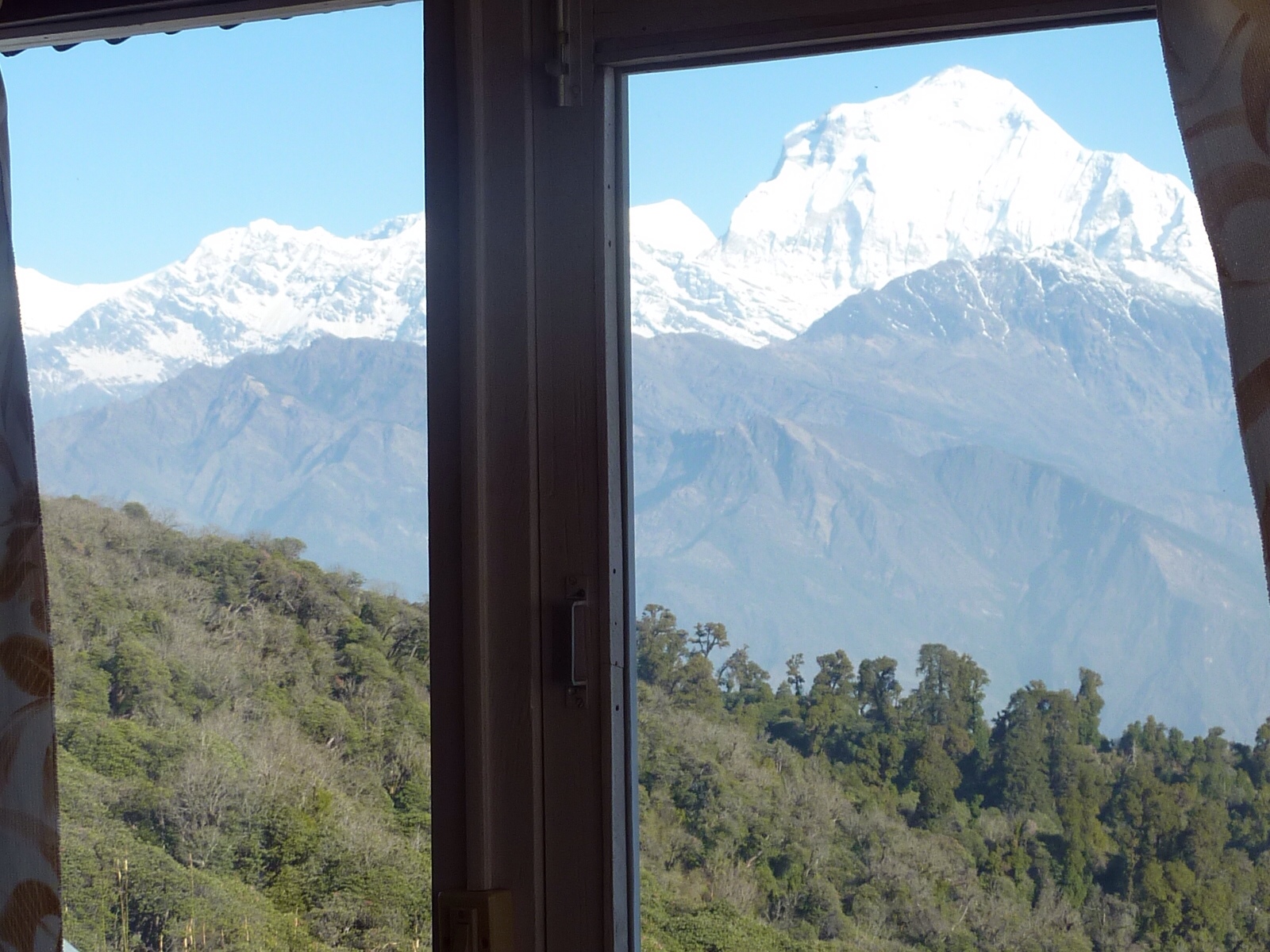
Enjoying the view from our guesthouse window before hitting the dusty trail again

As the hike started, we quickly found ourselves climbing steadily again for an hour or more until we had gained another 450 meters in elevation and had another beautiful lookout over the landscape.

The trail eventually levelled off where we enjoyed a modest incline or “Nepali flat” as our guide calls it. After 4 more hours of ups and downs we ascended a sharp incline for 45 minutes before reaching our destination of Tadapani.

Tadapani was a tiny little village with a brilliant view and a crappy guesthouse. Our guide suggested we stay the night at this small teahouse and it turned out to be a bit of a nightmare. We checked in to our room and immediately noticed that the room was falling apart. Electrical tape held the light fixture together, huge cracks ran the whole length of the dirty concrete walls, and the blankets we were provided were stained (Megan says thank god for sleeping bags).

We decided to look for another room in another guesthouse. When our guide told the news to the female guesthouse owner she looked quite offended and continued to follow us (incognito style) when we were looking at other rooms. It was really awkward. We kind of felt guilty and ended up just staying at the original guesthouse despite its shortcomings.

We were not in the guesthouse owners good books. After checking in I asked if I could purchase some laundry soap to hand wash some of my sweaty clothes. She handed me a bar of soap that looked like it came out of the ass end of a cow and walked away. I stood there shocked. How does someone even acquire a bar of soap that looks like this? Crusty brown with chunks of newspaper hanging off of it. My god.

Then I ordered a beer to drink before dinner and as soon as I got the top off – it exploded. That beer bottle was sitting at about 500 psi before I opened it. Beer everywhere. Stay calm Jason.

We were charged full price for the soap and the beer. These are the unpredictable adventures that make traveling so fun. The place wasn't all bad. The dining area was cozy and we had some enjoyable conversation with a Japanese tour group before retiring to bed early.

Total trekking time today: 6 hours

Day 4 (Tadapani to Sinuwa)

Starting Elevation: 2400m

After a surprisingly good sleep we woke up to the Japanese tourists going coo coo for coco puffs with their cameras. Each one had a tripod set up with a monsterous camera which they snapped steadily at the sun rising over the mountains. It was a lovely view – I'll give them that.

After our usual breakfast of muesli and fruit, we started trekking. This turned out to be my favourite day of the trip so far.

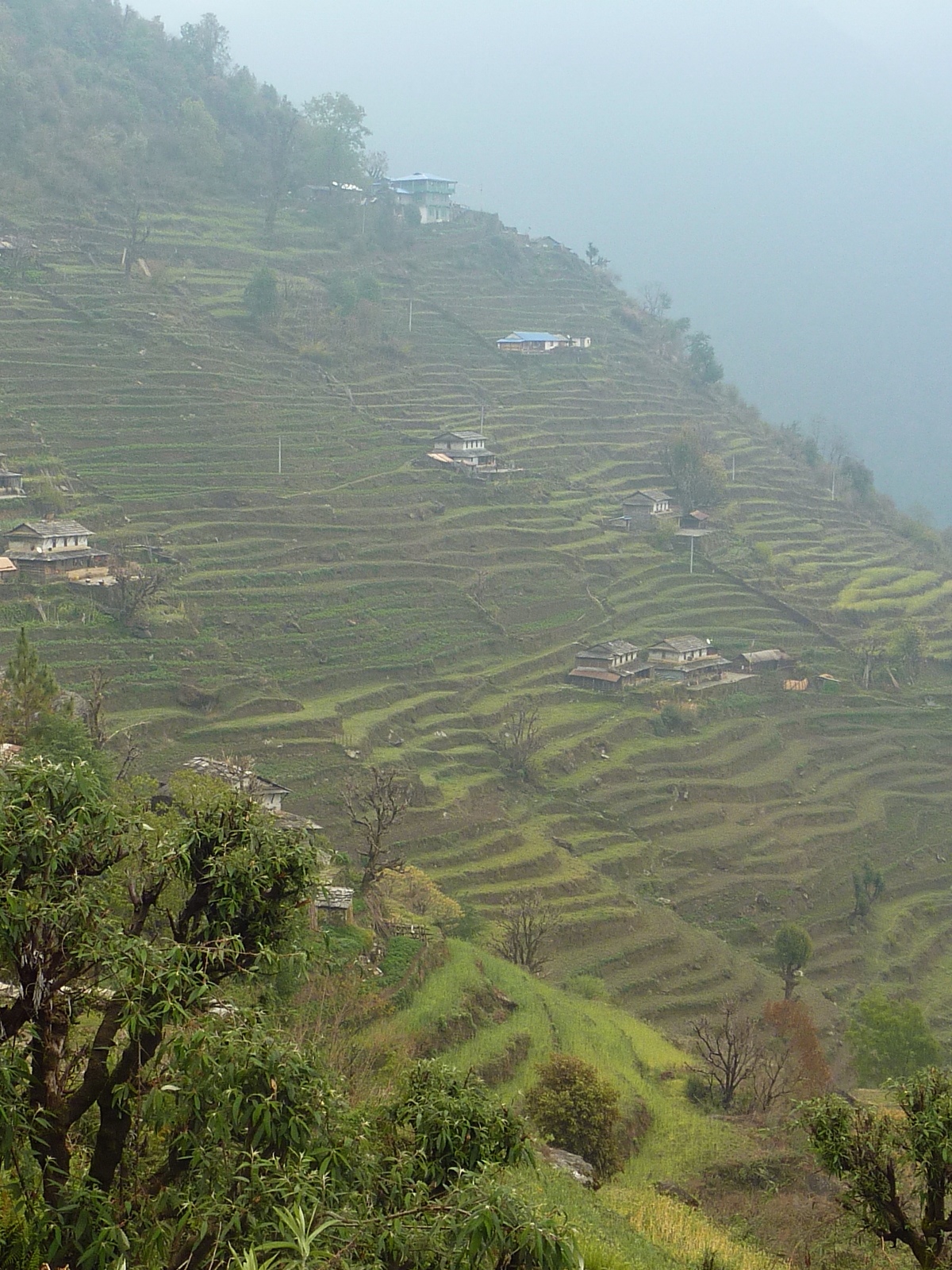
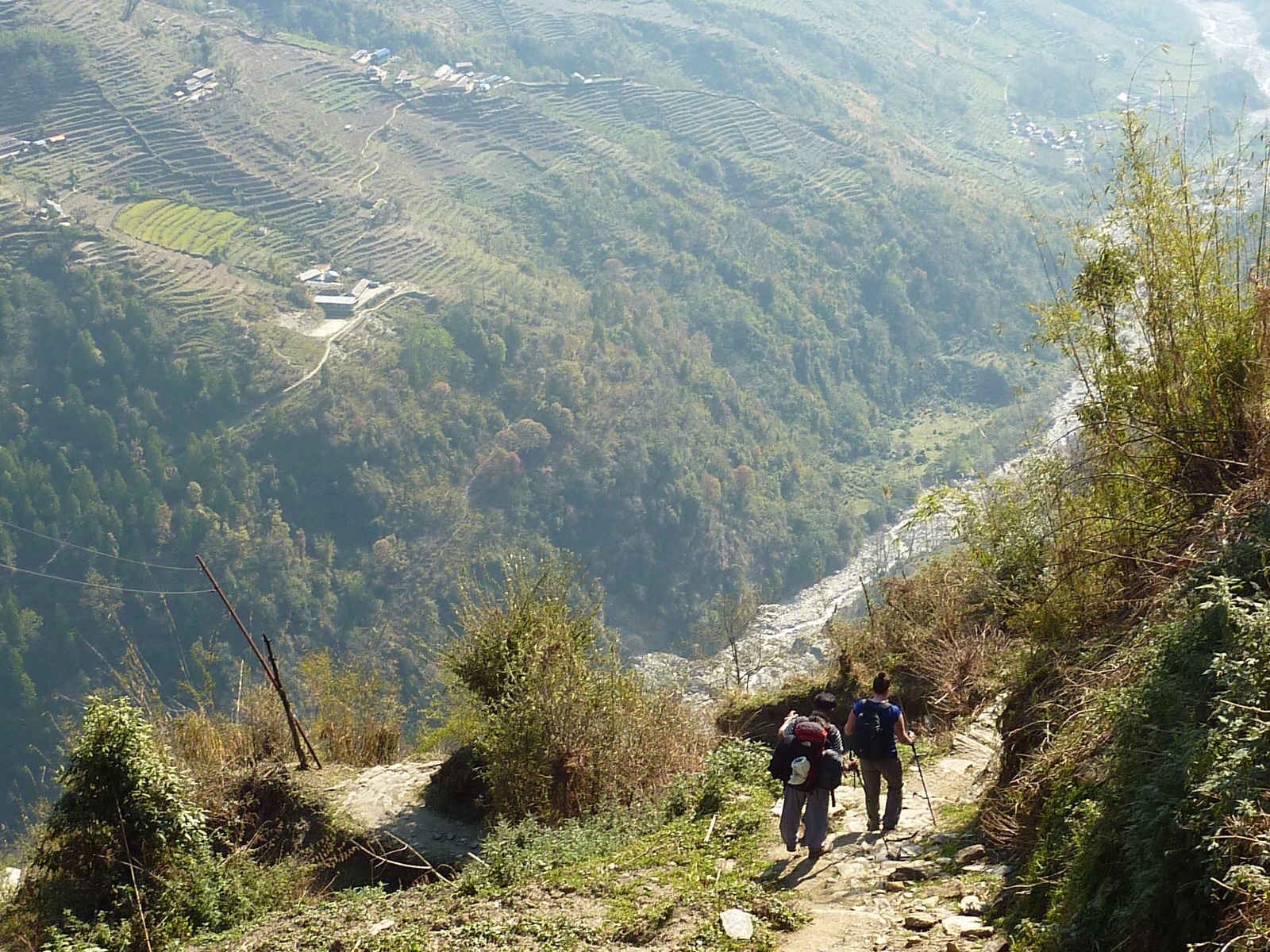
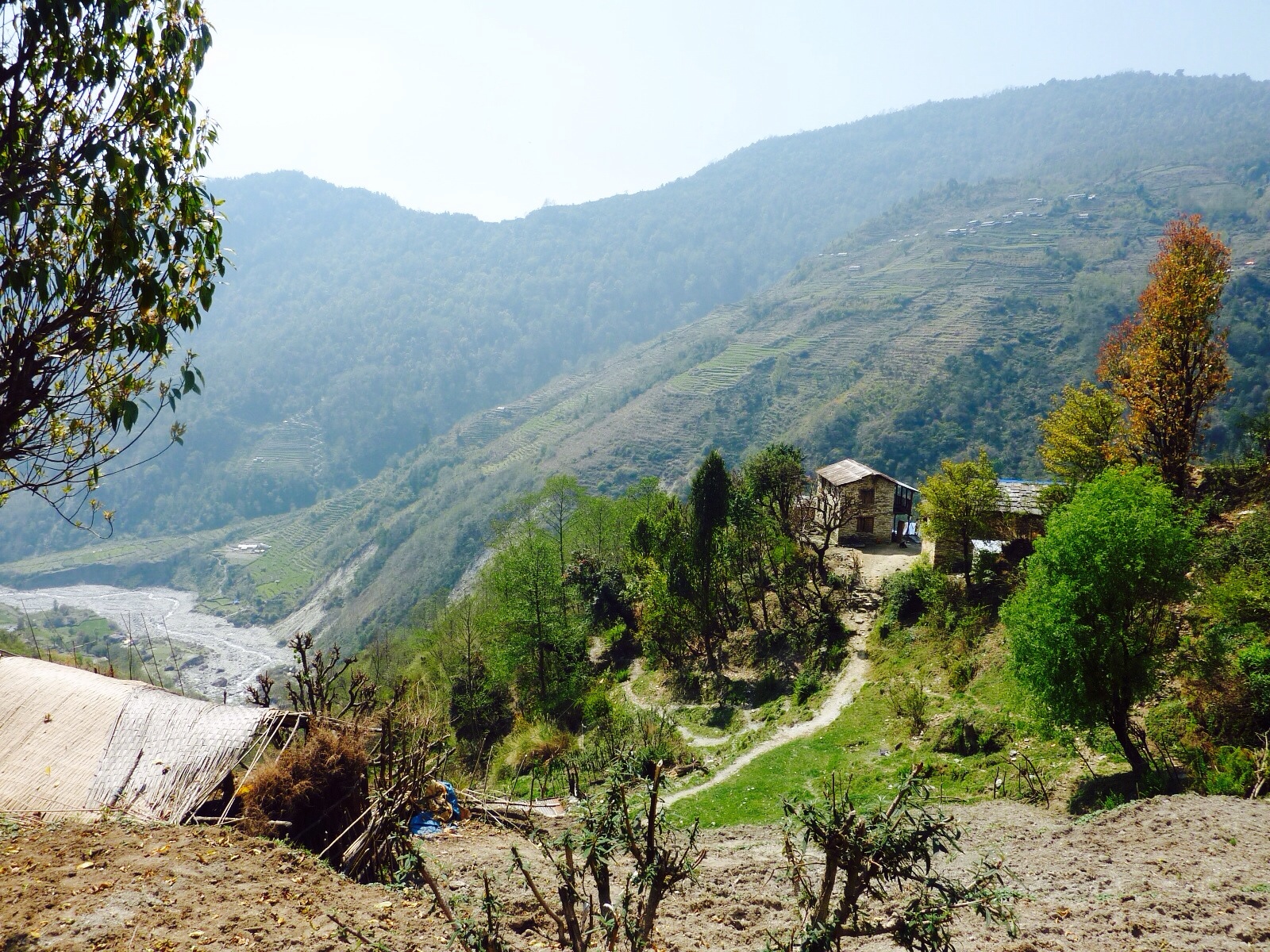
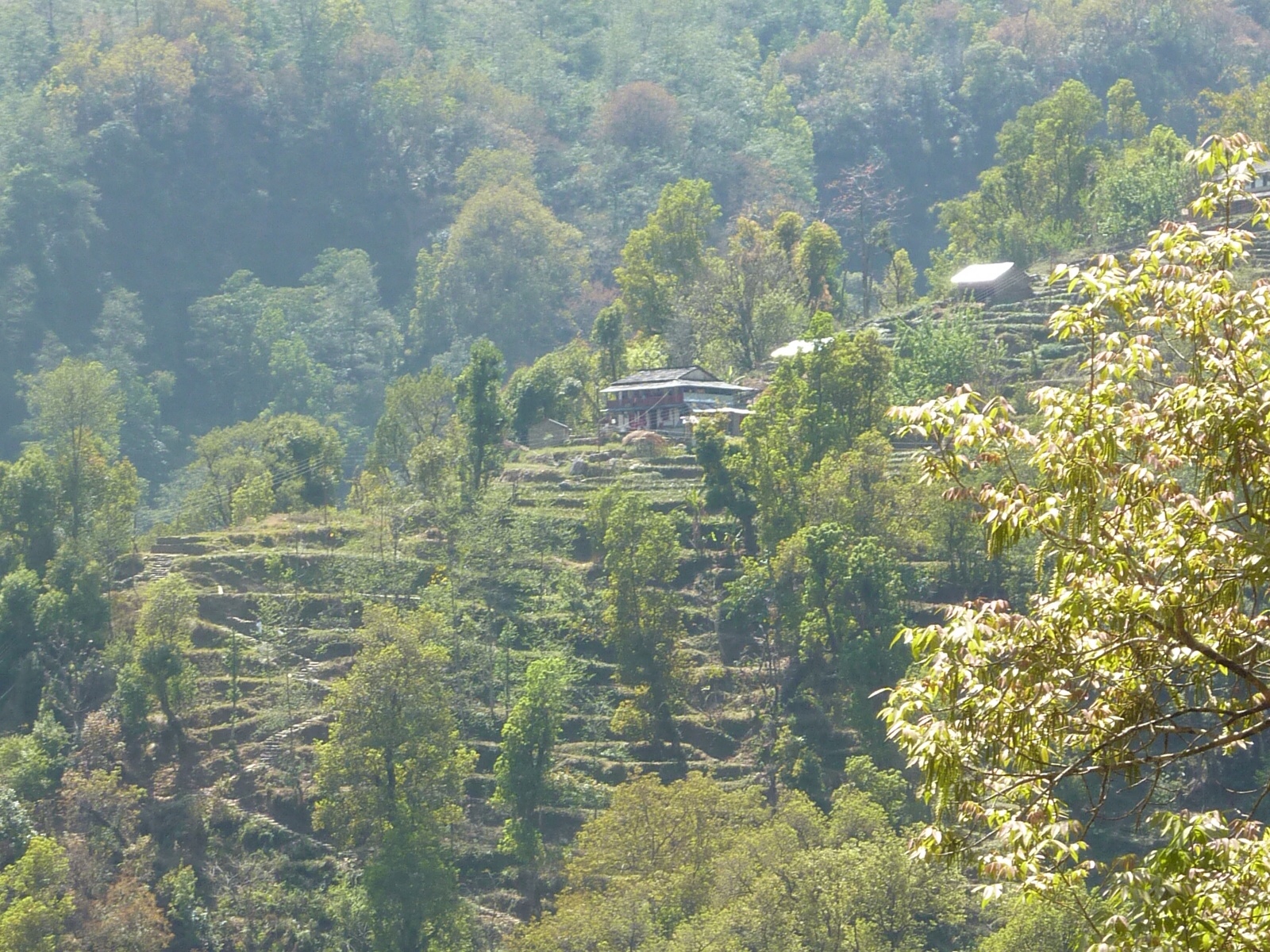
The trail wound down through vast valleys where we walked amidst crops of barley, wheat, and potatoes. Every piece of farm land is terraced here – otherwise the pitch of the land would be far to steep to farm.

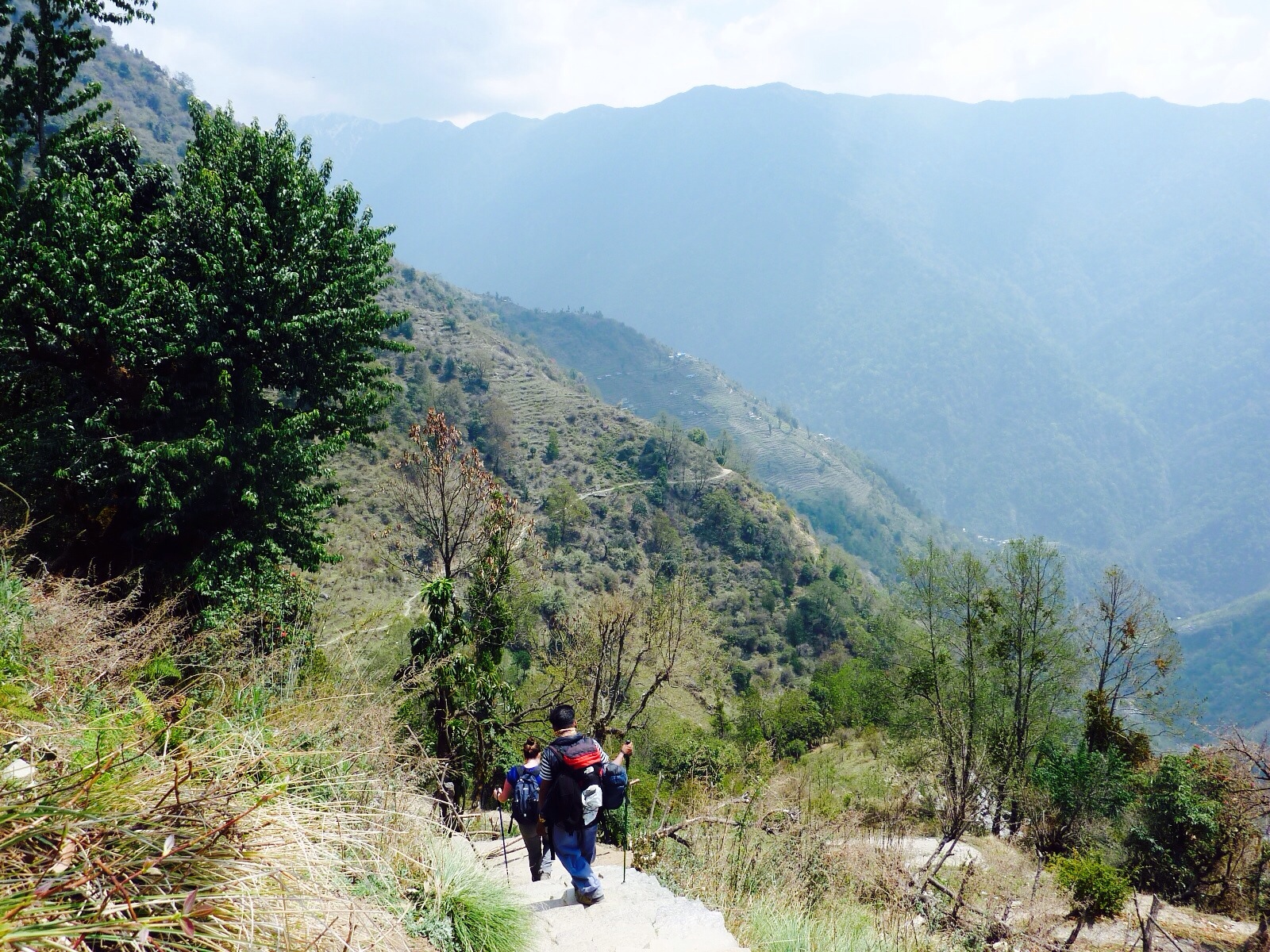
We descended thousands upon thousands of rock steps before dropping down to the river.

It seems goofy, but after walking so much each day you kind of engage autopilot mode and things just happen. It seems as though your feet put themselves where they need to be without any conscious effort or thought. Almost robotic.

I actually ask often “How many kilometres are we doing today?” and no one ever knows. Someone said to me kilometres are meaningless here because nothing is straight. Every path is zig zagging, climbing, falling – everything but straight. Instead they use hours. “4 hours to the next village”. Seems to be much more efficient.

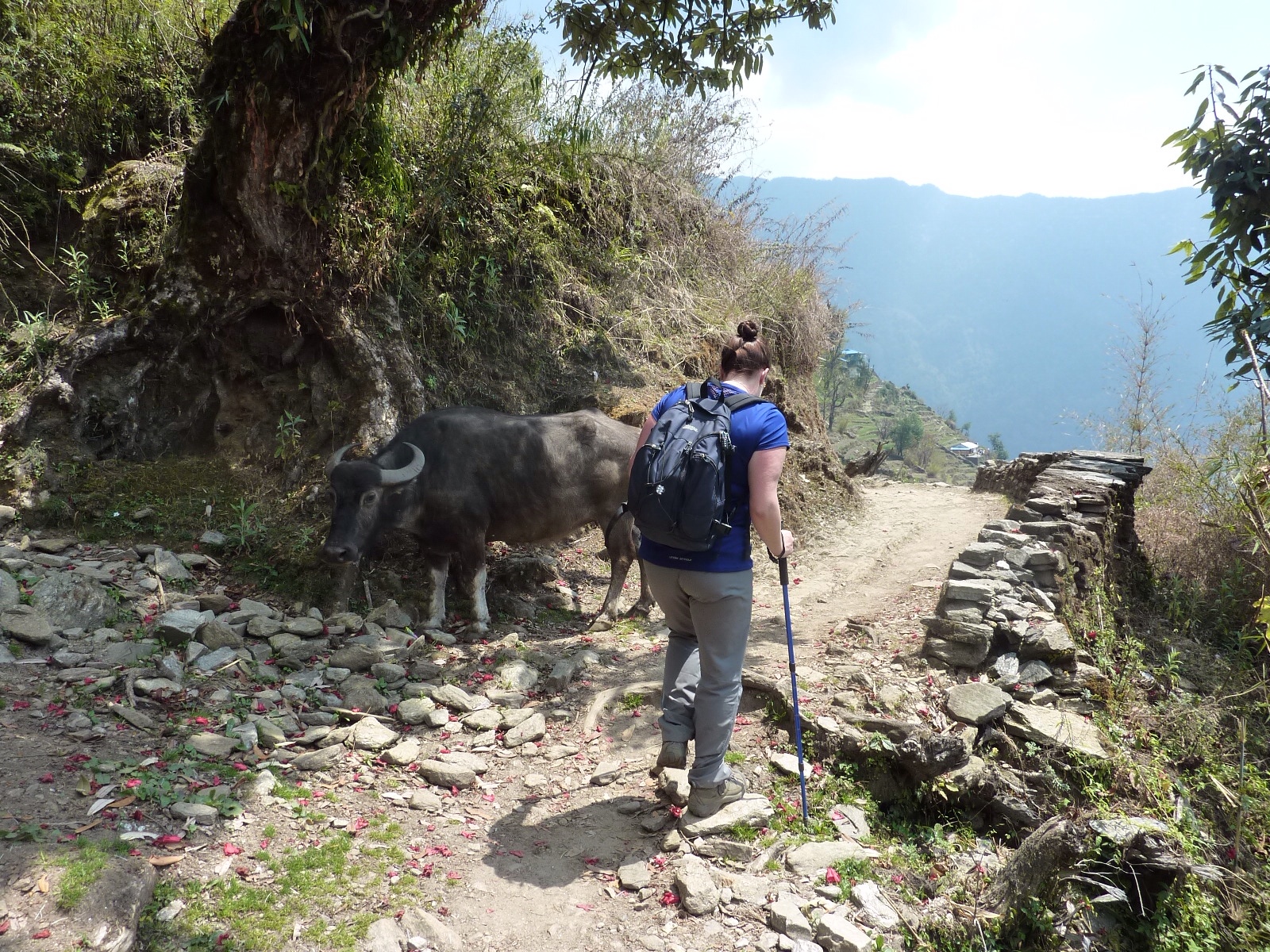
One of the things we have had to do lots of is dodging animals. Goats, donkeys, mules, horses, oxen, yak – everything uses the same path as we use so we have to share it with all sorts of animals.

After 7 hours of trekking, we arrives in lower Sinewa where we will be staying the night. We fell in love with this little place. Cozy tea house, great food, fair prices, great view:

View from our room

We spent the evening teaching our guide Lal some new card games and drinking hot drinks. Tomorrow we start to get into much higher altitude, which means colder temperatures as well. Both of us feel that we have adapted to the rigours of trekking in the Himalayas. Days are getting much easier to cope with and even though our legs feel drained, we both feel mentally stronger which is important when the gas tank is running on empty. Eye of the tiger.


Total trekking time today: 7 hours


Side note: The original title of this blog was “Sore Feet and Proud Smiles”. Megan suggested I make the adjustment.


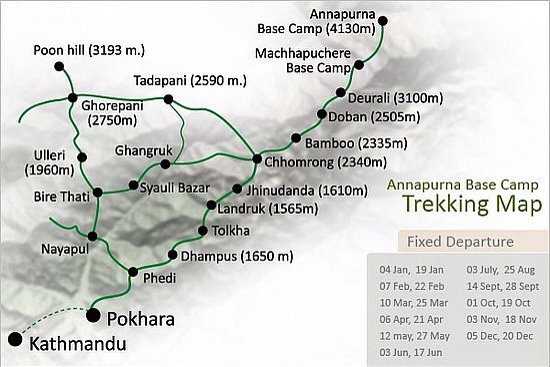
Currently we are sitting at 2860 meters above sea level in a guesthouse that is literally built into the side of a mountain. Our legs are aching, our shirts are dripping with sweat, but we are proud to be done the first two (of ten) days of the ABC trek (Annapurna Base Camp). I am typing this blog from the small village of Ghorepani and unbelievably they have wifi here. Hard to believe. Meg and I are currently enjoying a pot of post-hike hot lemon tea while checking out the view from our guesthouse: “Super View Guesthouse”.


But let's back up a minute and fill you in on how we got here….


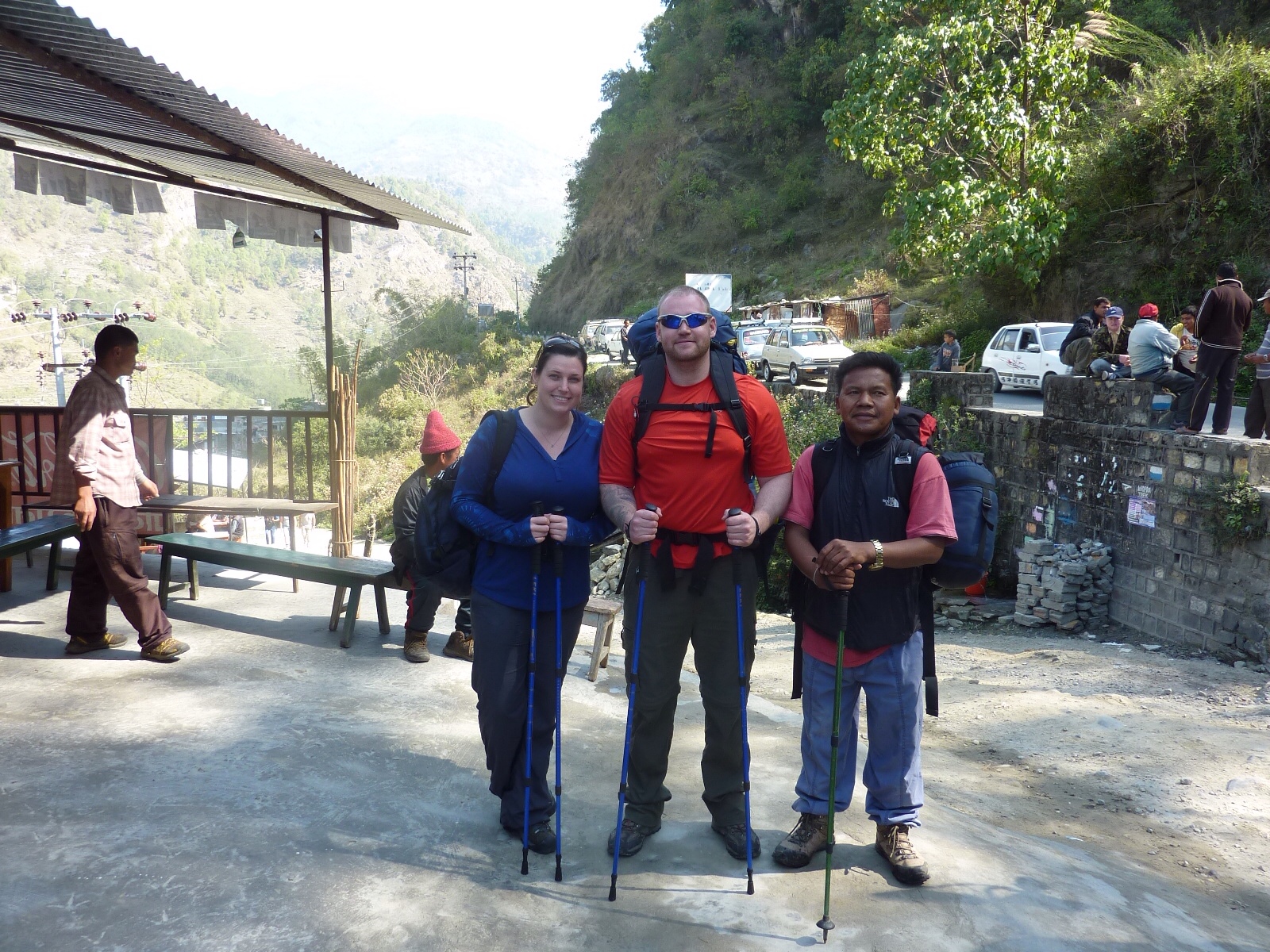
After interviewing a couple different potential trekking guides, Megan and I decided on a man named “Lal”. Lal was a true veteran of the mountains. At 44 years old he had done the 10 day ABC trek over 100 times! He was originally born in the surrounding Annapurna mountains and has been guiding and portering for 17 years. Lal stood about about 5'3″ tall, had darker skin than most Nepalis, and a big round face that revealed a huge white toothed smile. We felt comfortable with him and hired him only minutes after meeting him.


Lal


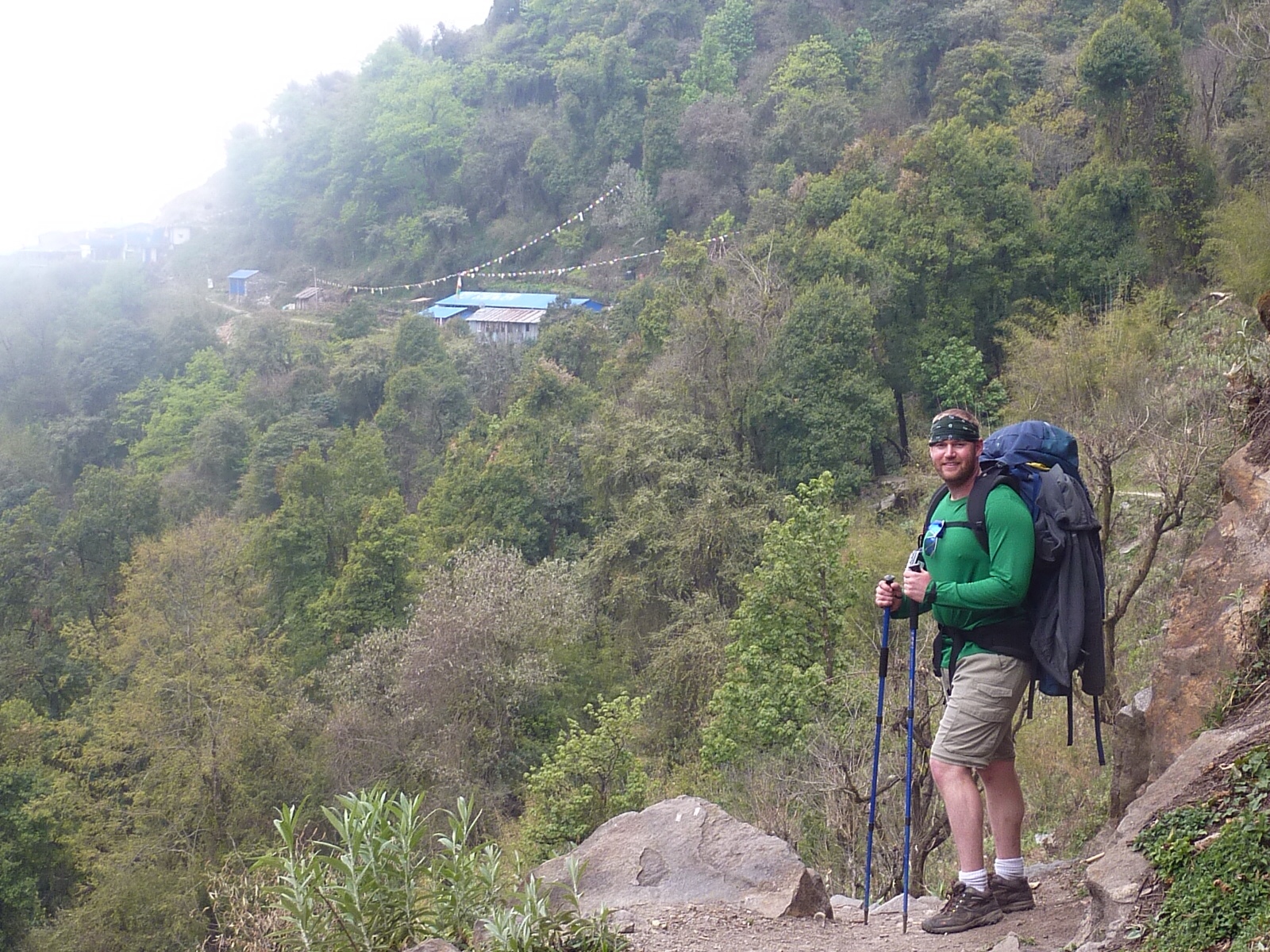
After cramming our belongings into my backpack, we were all prepped for the trip. Most people doing this trek hire a porter to pack their backpack for them. To me this is cheating. A lot of people will argue that by hiring a porter, you help the Nepali economy. That may be true but how could I let someone that is nearly a foot shorter than me and 80lbs less than me pack my backpack for me? I would feel like such a wuss. The taxi arrived early in the morning to take us to the starting point for our trek (a 1.5 hour drive). The owner of our guesthouse looked puzzled when I loaded my big 80L Arcteryx backpack into the taxi. 40 lbs was a big load on a hike like this.

In a few short minutes; Lal, Megan, and I departed in the taxi from Lakeside city of Pokhara:


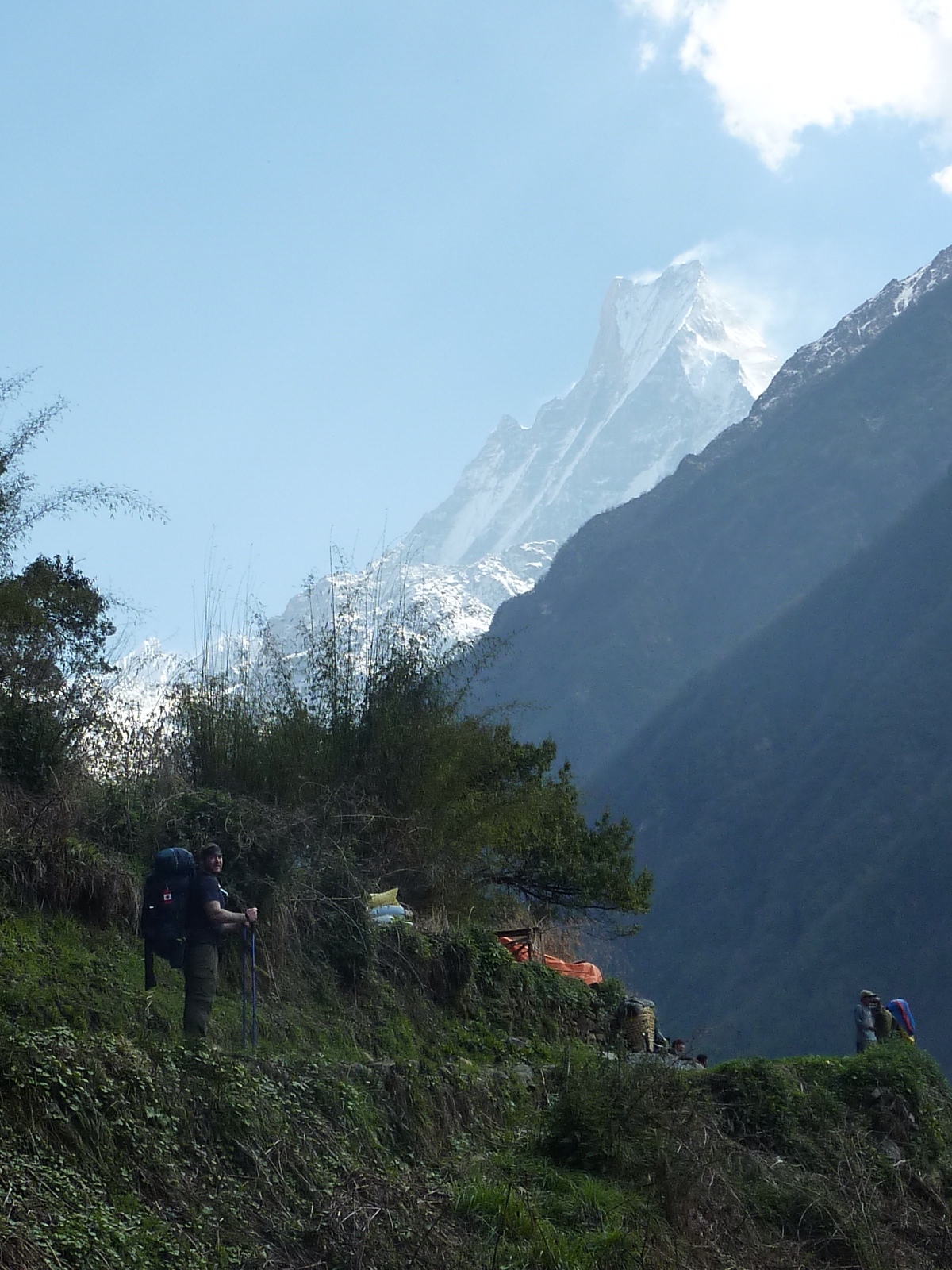
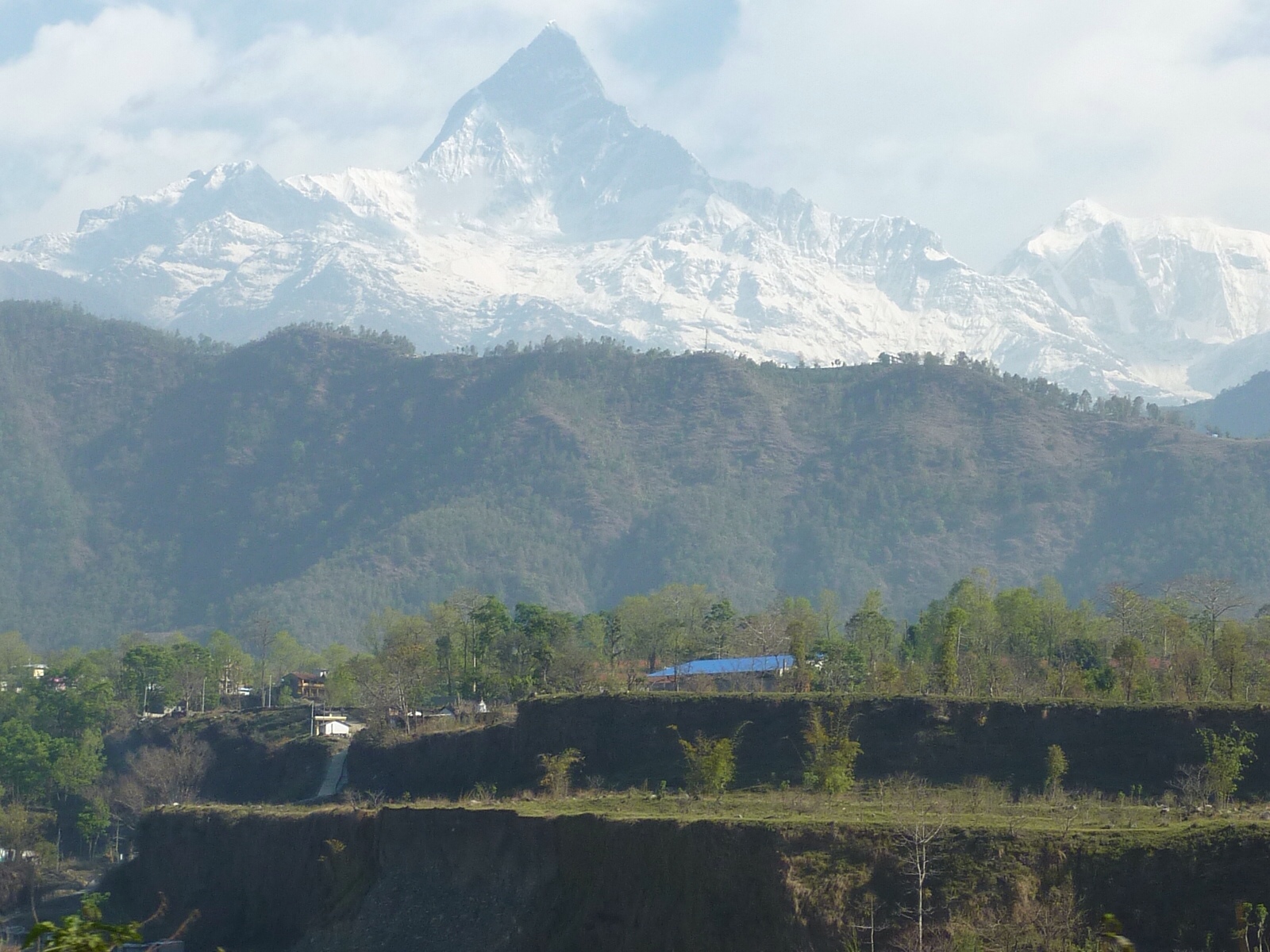
Our taxi wound through the Nepali hills revealing two snow capped Mountains in the distance. Lal leaned back from the front passengers seat and said with a smile “those mountains are called Annapurna 1 and Machhapuchhre”. Seemed impossible. How could we get to the base camp of Annapurna 1 when it seems so impossibly far away. What did we get ourselves into. At that moment, I zoomed in as far as my camera would go and snapped a picture:


Megan began to get nervous, shifting from side to side in her seat. I didn't have to ask what she was thinking at that moment. The taxi came to a stop on a dirt road near a small village called Nayapul. We opened the hatchback, grabbed our bags, paid the driver, and he sped off in a cloud of dust.

After Lal presented our trekking permits to the park authorities, we started off our trek:


Day 1 (Nayapul to Ulleri)

Starting elevation: 1070m


The start


We started our hike passing through the small village of Nayapul, then following a winding river through a green, lush valley until we reached the second village of Birethani:


After showing our permits for a second time, we continued to follow the river Northwest, losing sight of the mountains. Occasionally a Jeep would pass us kicking up dust and forcing us to the side of the road. The sun felt hotter than usual, almost to the point where it wore us down more than the actual trekking did. This forced us to drink litres and litres of water, filling up our water bottles from outdoor taps located near local villages. We passed by terraced rice fields where farmers farmed steep swathes of land:


Overall the trekking was surprisingly easy, with little altitude change. In 3 short hours we had reached our lunch destination, a few houses lumped together called “Sudame”. After a quick meal of muesli for me and veg fried rice for Meg, we continued our trek. We passed by more rice fields and over rope bridges, dodging oxen, donkeys, and goats along the way. In another 1.5 hours, we found ourselves at the village of Tikhedhungga. We had planned on staying at Tikkhedhungga for the night, but Megan insisted that we push on to the next village of Ulleri. “How far to Ulleri?” we asked Lal. He pointed to the top of the mountain across the river valley. Meg got her way. We crossed the river and started up the mountain.


This is when things changed. Big time. We had been told earlier about an area where we would have to climb 3280 rock steps – this was the start of that. My 40lb backpack began to feel heavier every 15 minutes as we trudged up the steps at a snails pace. Our quads and calves started burning more with each step. We were forced to stop for water breaks every 20 minutes. The sun compounded the exhaustion. This may seem like exaggeration, but I have done some very difficult hikes and this day was as hard as any that I have faced. I asked Megan for a piece of chocolate that she was storing in her small backpack. She refused – saying that the chocolate should only be used as a reward when we finish our hike. Ugh.


Megan


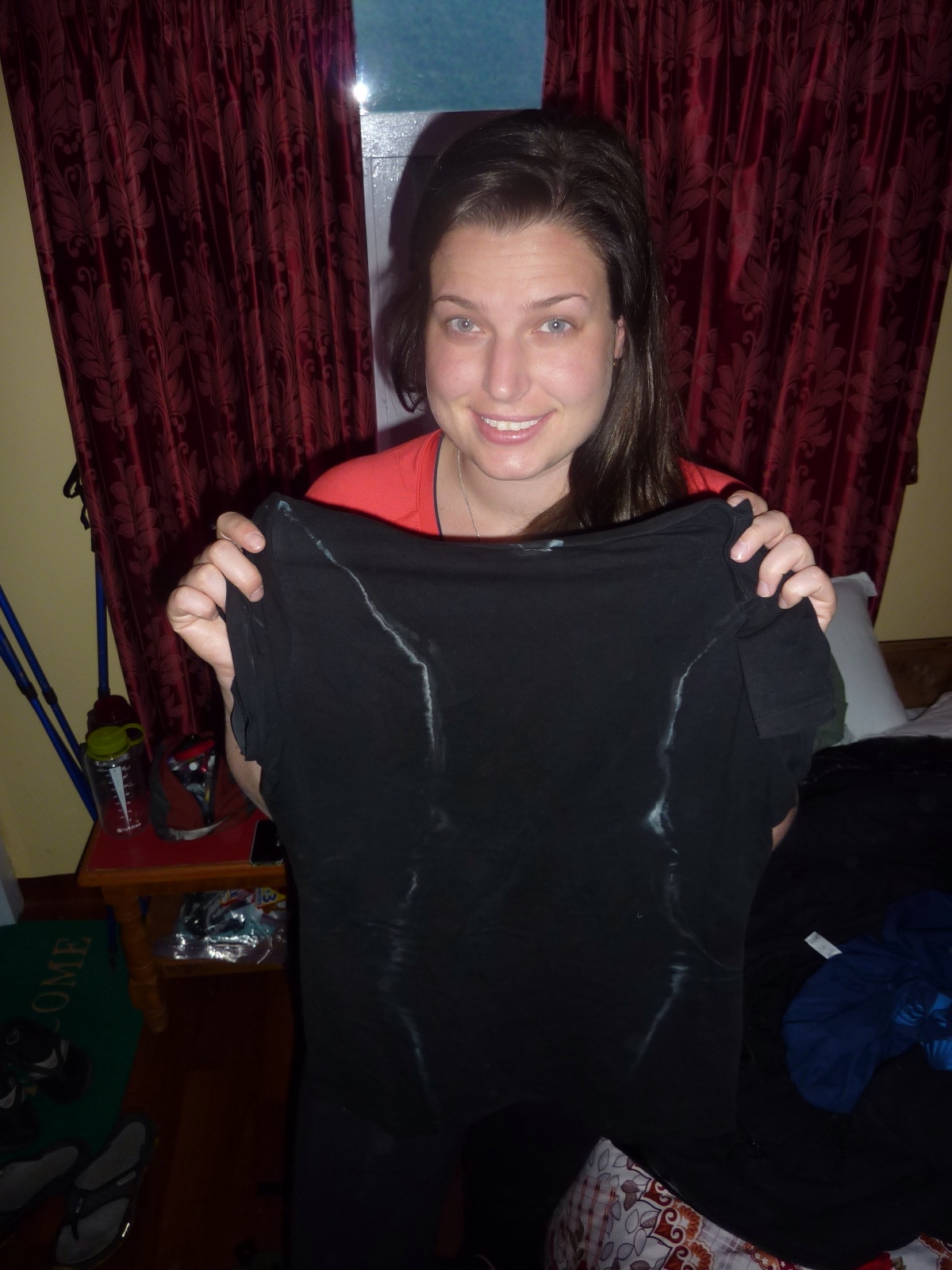
It was a brutal few hours. Megan did great – she basically willed herself up the mountain. The gas tank was empty. At one point Lal offered to switch packs to give my legs a short break (his pack weighed only 10-15 kilos). I accepted. We continued to climb in altitude until the village of Ulleri was visible. As quickly as we could, we checked into a guesthouse, showered, ate, hung up our sweat stained t-shirts, and did some quick stretches before heading to bed.

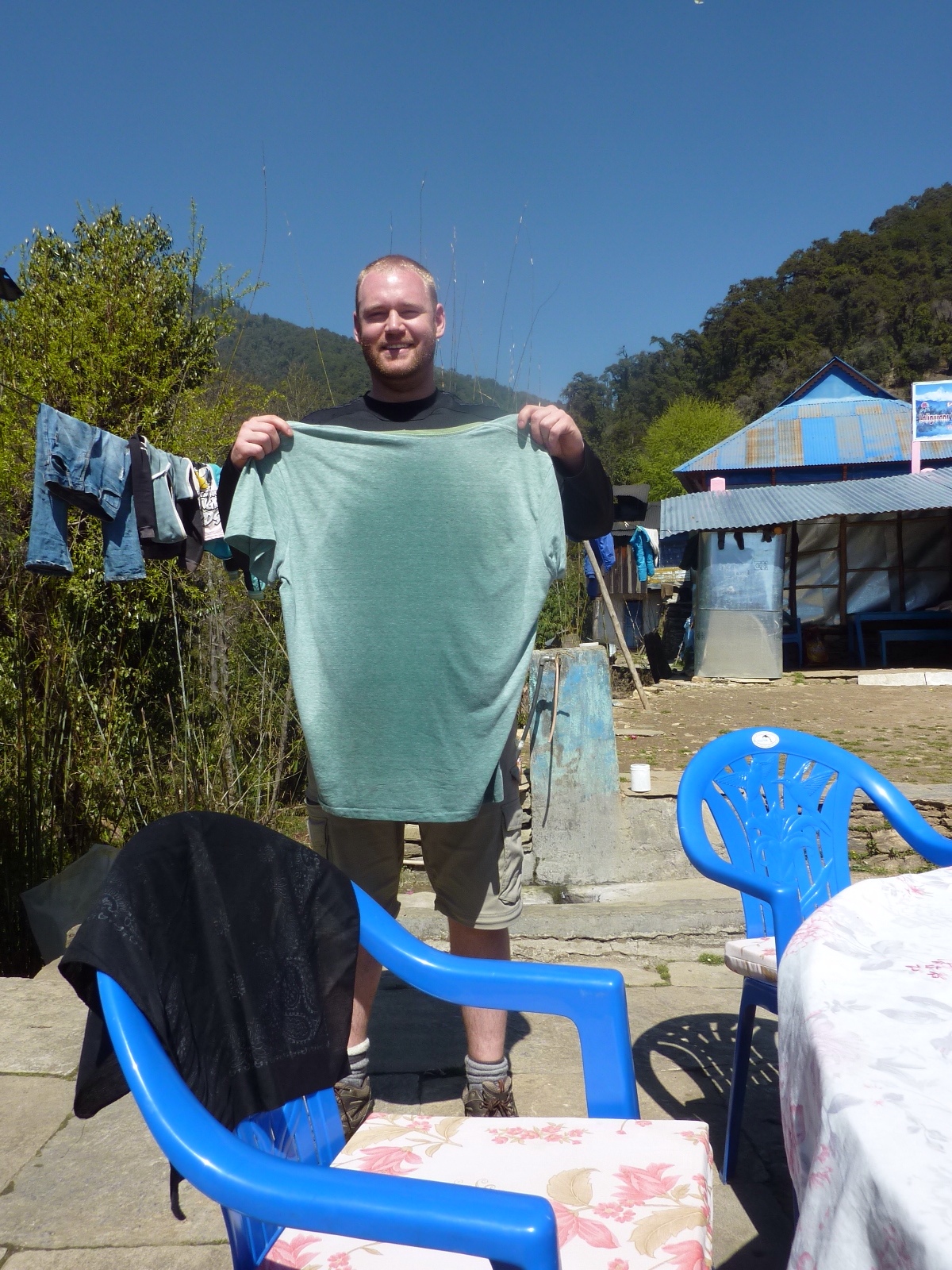
Sweaty shirt


Total hours of trekking: 6.5 hours


Day 2 (Ulleri to Ghorepani)

Starting elevation: 1960m


We woke up early the next morning to the sound of a farmer moving his donkeys through the village. Each donkey had a bell around its neck which made it sound like an awful symphony of clanging bells.


We were pleasantly surprised in the morning to find that our legs were not completely seized up from the beating they took the day before. We paid our bill at the guesthouse, had a hot breakfast, and set out at 7:45am.

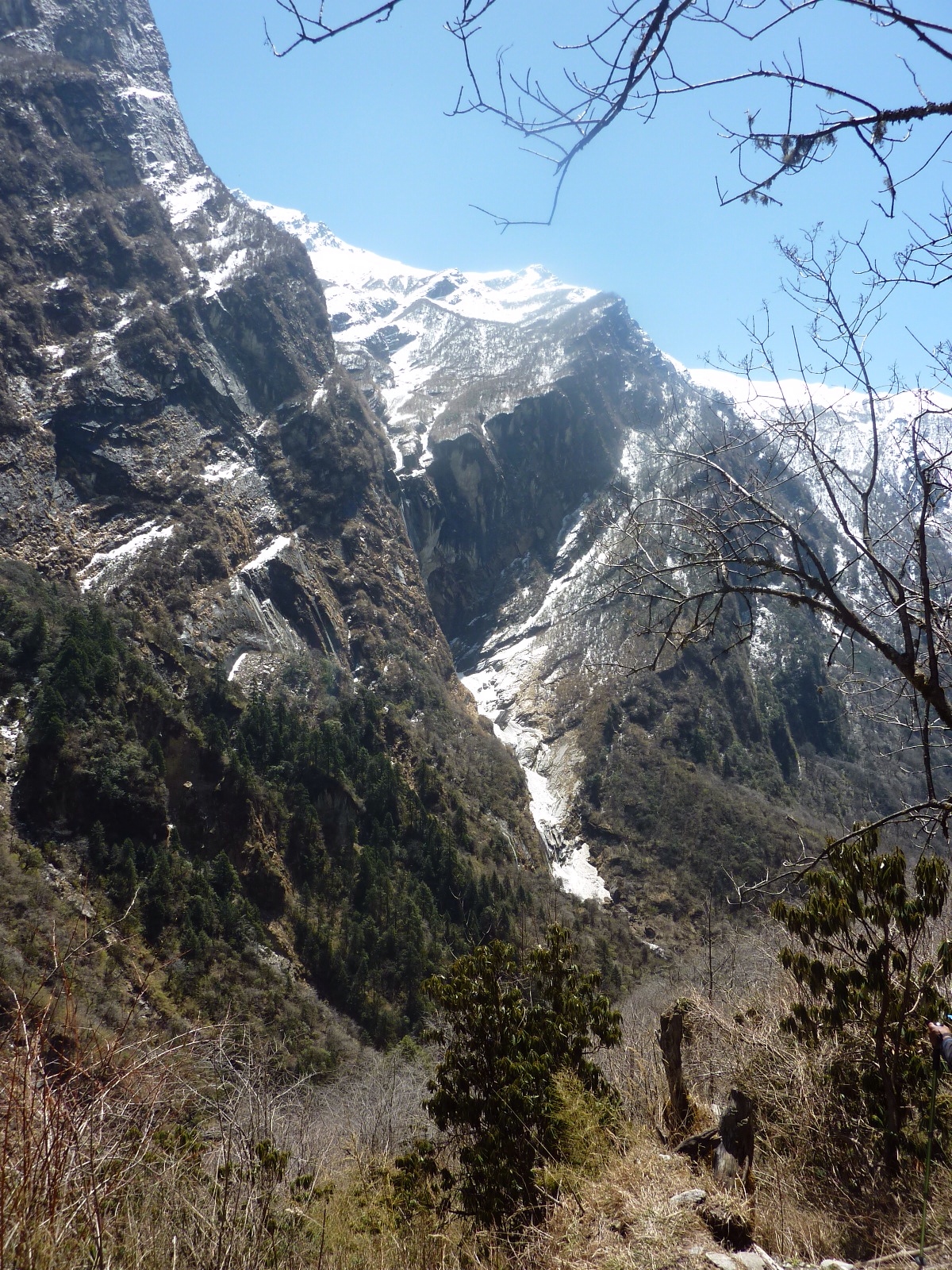
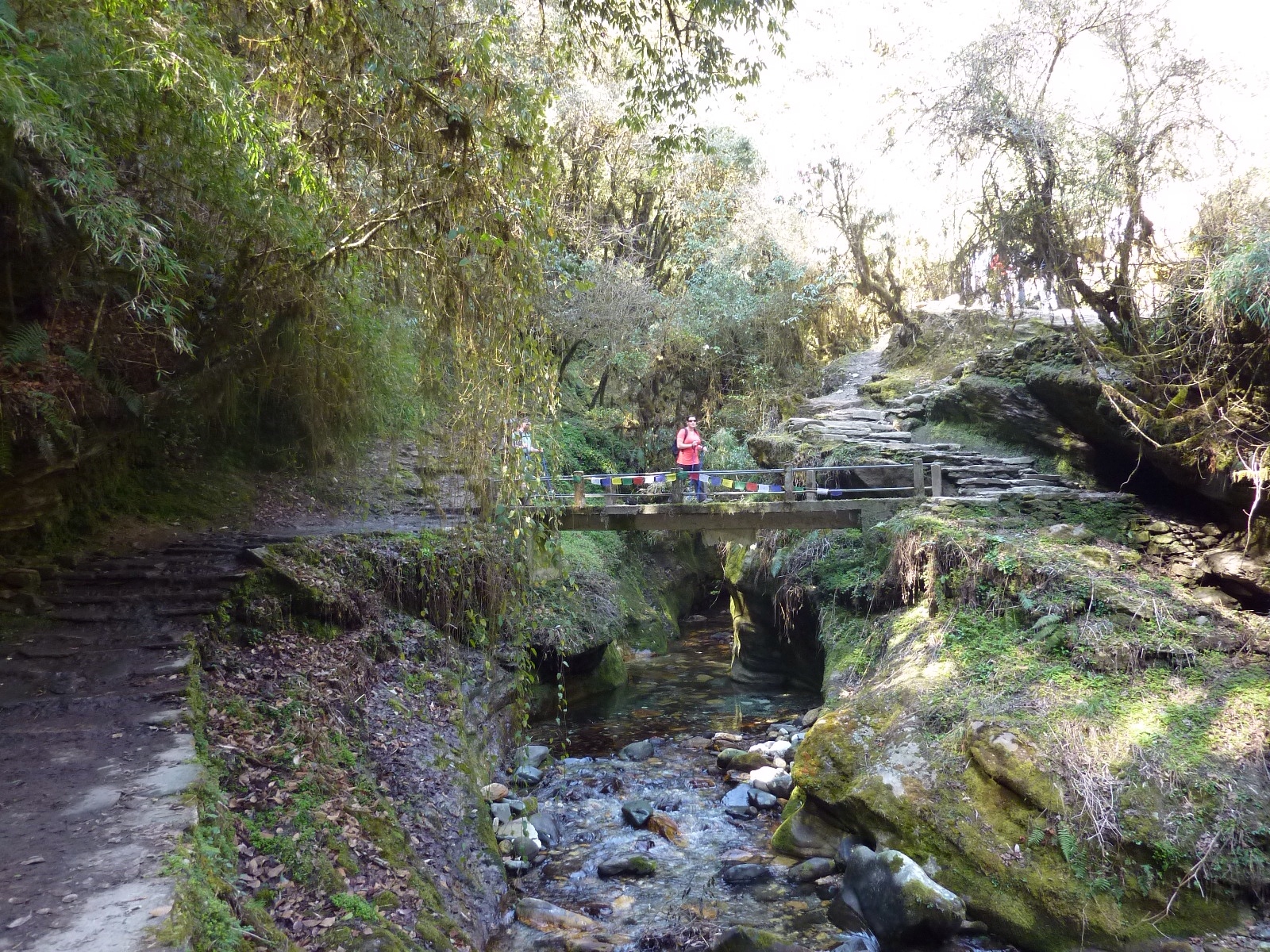
The rock steps continued upwards, zig zagging up the mountain and revealing some excellent views of snow capped mountains. Before long, the scenery changed and we found ourselves walking through a beautiful green forest passing over bridges.


At one point we passed a couple of porters packing a cages of chickens on their backs.


A couple of hours later we reached a village called Naya Thanti where stopped to have a quick bite to eat and to air out our sweaty t-shirts.


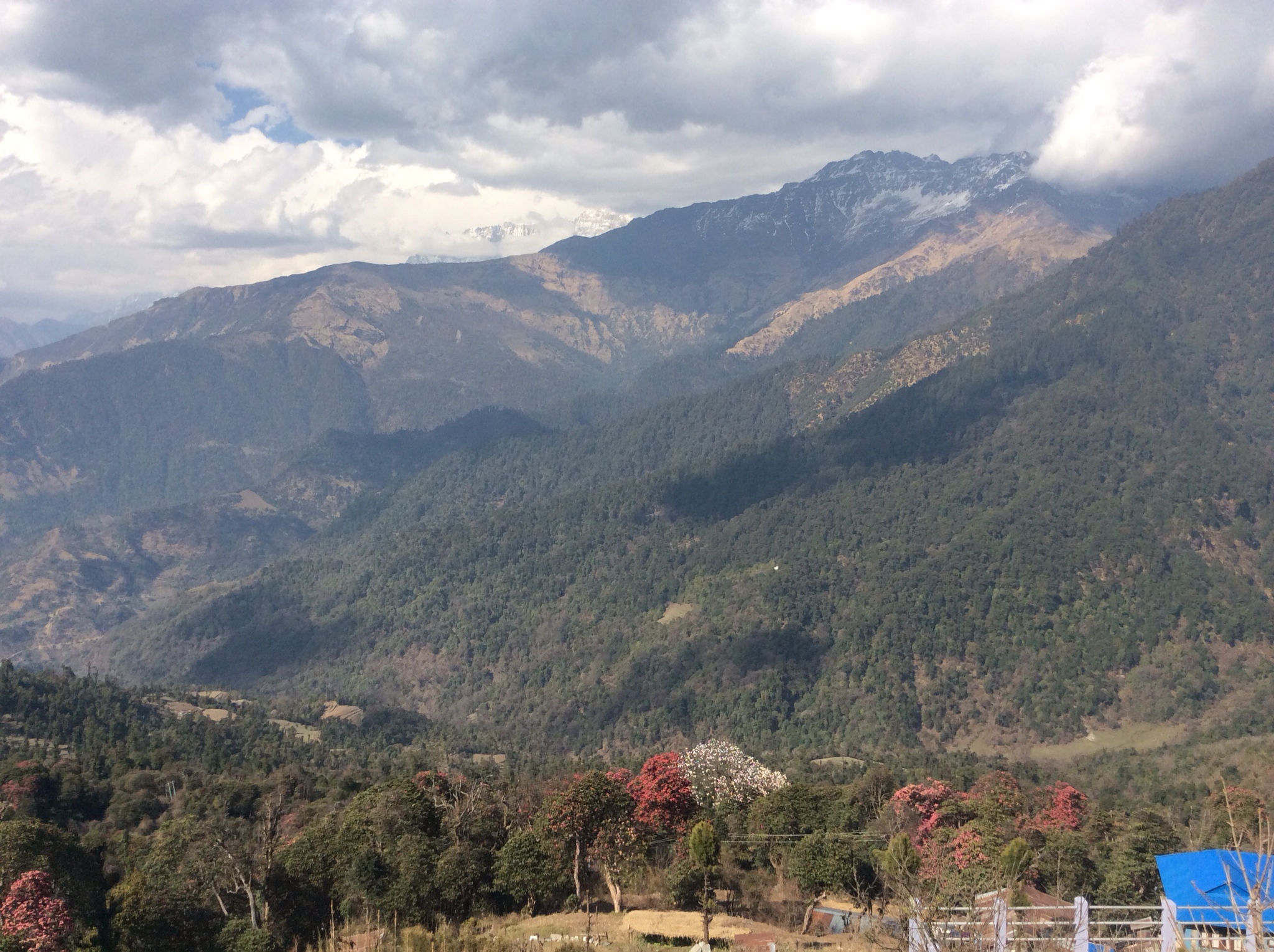
After lunch, the path became considerably easier. Blooming rhododendron flowers began to appear, scattered out along the trail.


Again, we started climbing sharply, gaining altitude with every step. Those damn rock steps appeared again making our legs ache with each step. After another hour or so, we reached our destination of Ghorepani where we were blown away by the view of the valley and surrounding mountains.


This was a difficult day but it didn't compare to the first day.


Total hours of trekking: 5 hours


That pretty much catches you up on what we've been doing. And now you know


The rest of the story


Again, how insane is it that we have wifi here in the middle of nowhere?


KKKKKKKKKK Kathmandu!

Posted: March 28, 2014 in Nepal
 

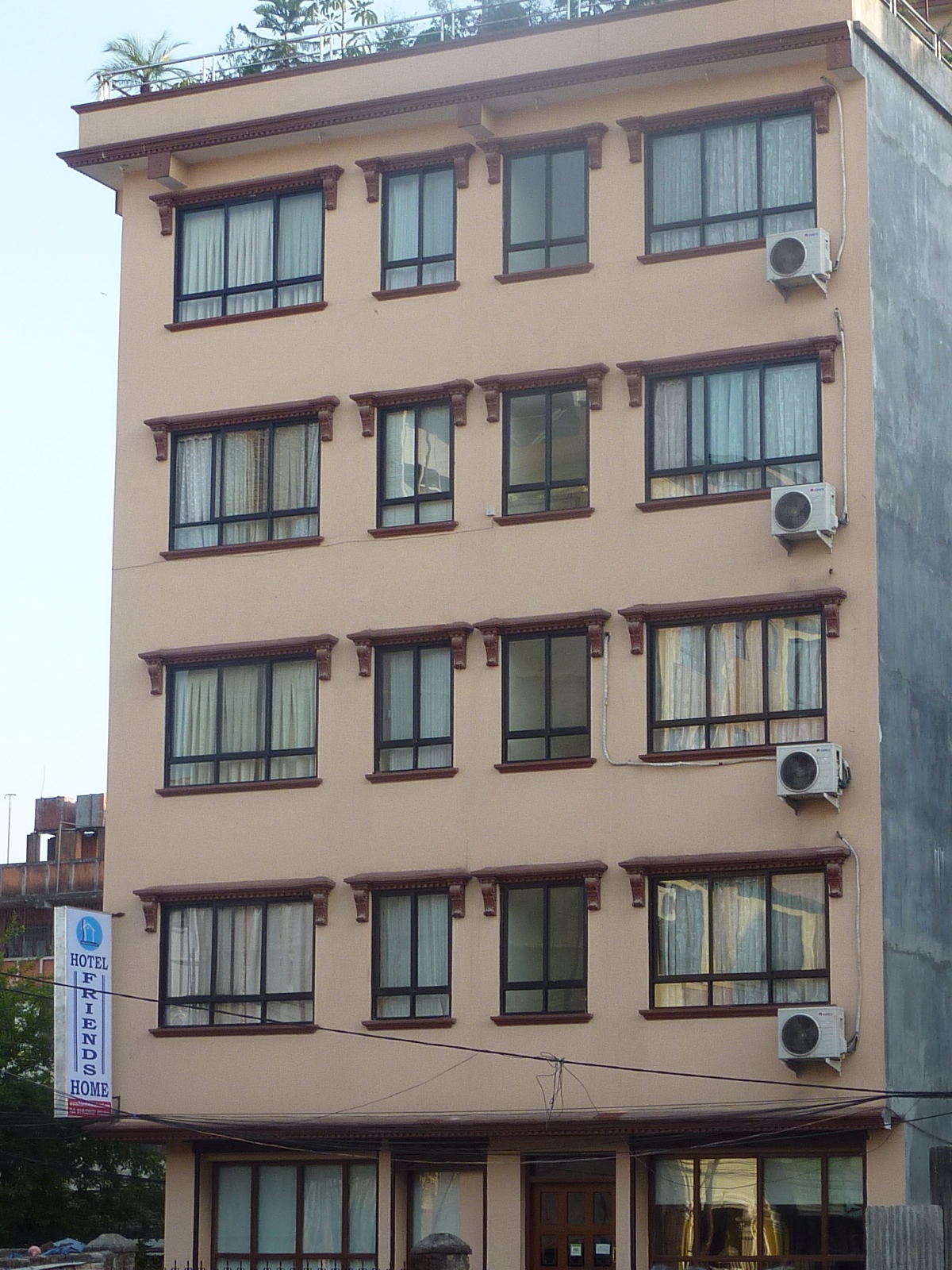
We have arrived in Kathmandu and so far life is pretty dang good. Our guesthouse “Hotel Friends Home” has been outstanding. Great service, hot showers (rare in Asia), and a great breakfast (fruit, yogurt, museli, eggs). I'm kind of feeling a bit pampered to be honest. It's a bit more than Meg and I usually like to pay for a room but after two solid days of traveling – I'll pay the extra money to get a good sleep.

We didn't get one.

Hotel Friends Home

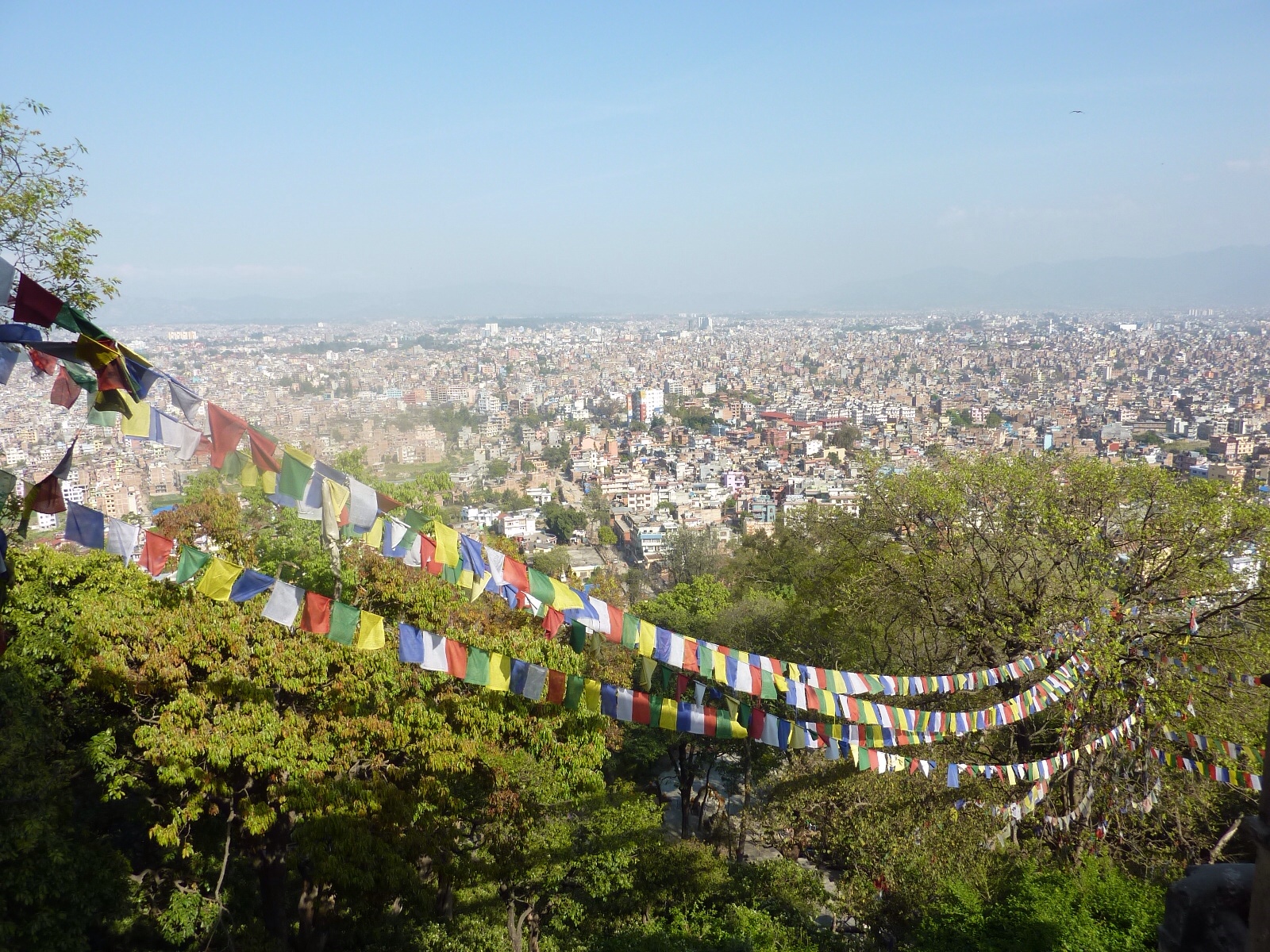
Not because the guesthouse isn't great. But because I can never sleep in when I arrive in a new country. I'm just too excited to see what's out there. I feel like a little kid on Christmas morning (and Megan says she is the parent who wants two more hours sleep). So at 6 AM I was up on the roof of our 5 story guesthouse looking out over the sprawling concrete jungle that is Kathmandu.

After breakfast we ventured out of our guesthouse for the first time. It was like stepping into a bee hive. Rickshaws, taxis, and motorbikes honked their horns while trying to dodge pedestrians on narrow, poorly paved streets. People dressed in colourful garments scurried around the streets in a hurry going wherever they were going. Taxi drivers hollered at us every few seconds trying to sell us a ride and electrical wiring hung in large tangled balls everywhere you look.

All the while, dozens of stray dogs watched all this mayhem unfold while trying to make sense of the whole thing.

An old man sees a stray piece of food (bread I think) laying on the ground in front of Megan and I and rushes over to pick it up and cram it in his mouth. We walk past the man and look at each other as if to say “Did you see that”. It kind of made me a little ill to be honest. Or maybe guilty for being so privileged.

We pass by a Hindu ceremony on the side of the street where a couple dozen people are praying to a statue of one of the Hindu Gods. Incense is burning and everyone has a red powdered dot on their forehead. A man is walking around splashing water on everyone. Pedestrians stop their day to take part in the ceremony before rushing away. We have no idea what's going on but we stop and take in this event for a while.


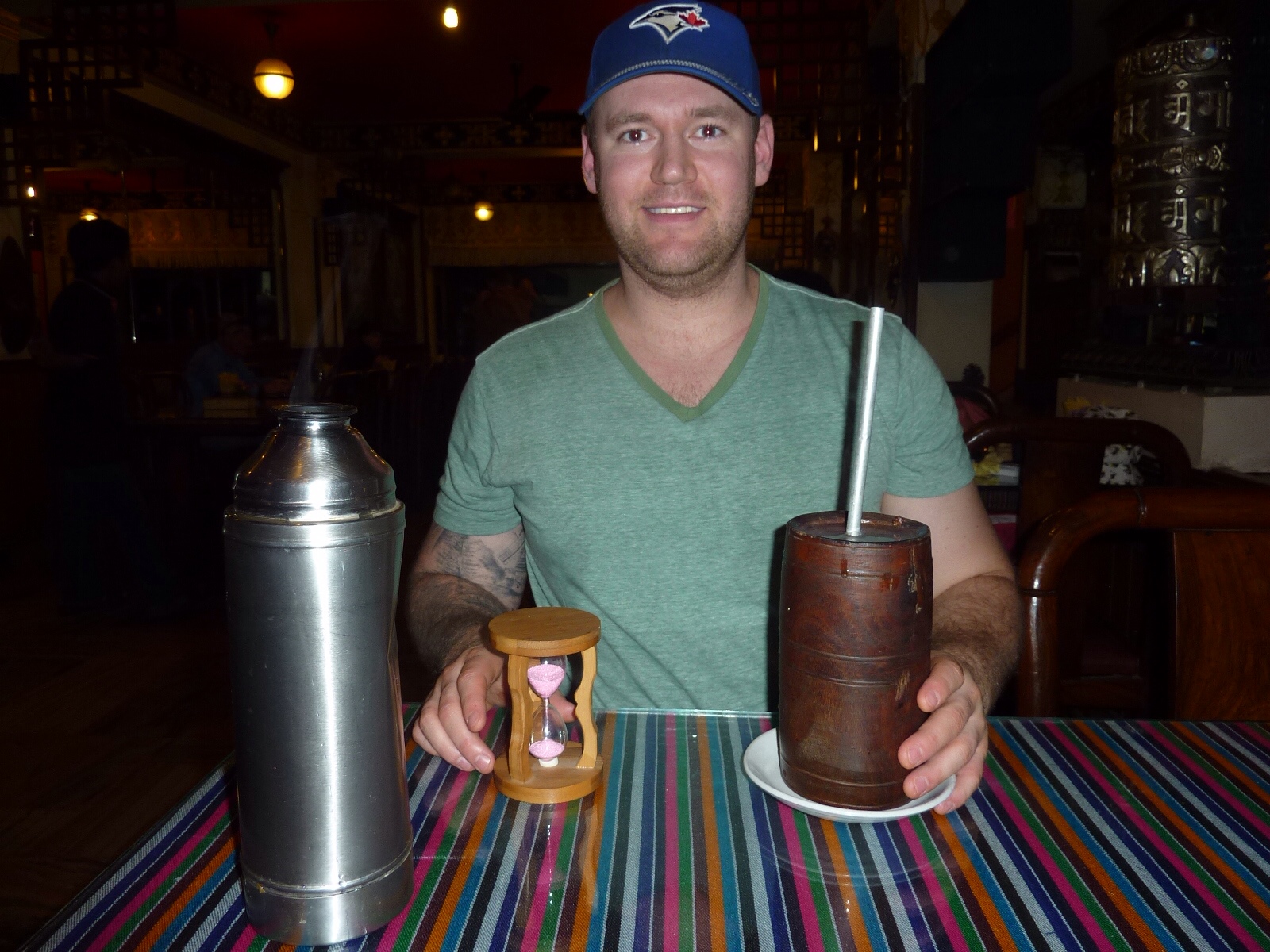
After walking around the chaotic city streets for several hours we duck into a small restaurant for some sanctuary. The restaurant is called 'Utse' and is ran by friendly Tibetan owners who claim to have opened the first restaurant in Kathmandu in 1971.

I ordered 'Tongba' off the menu which is described as (and I quote): 'NECTOR OF THE GODS – Tibetan finger millet hot beer'. This is what came:


We were instructed to pour the thermos of boiling water over top of the large wooden cup of fermented millet. Then we were given an hourglass to time how long we were to wait before we should drink the concoction. This stuff was strong – seriously strong. Tasted somewhere in between Japanese sake and a Guinness-type beer. It took over an hour before we had emptied all of the hot water out of the thermos and finished the drink. Well worth the $1.50 it costed us.

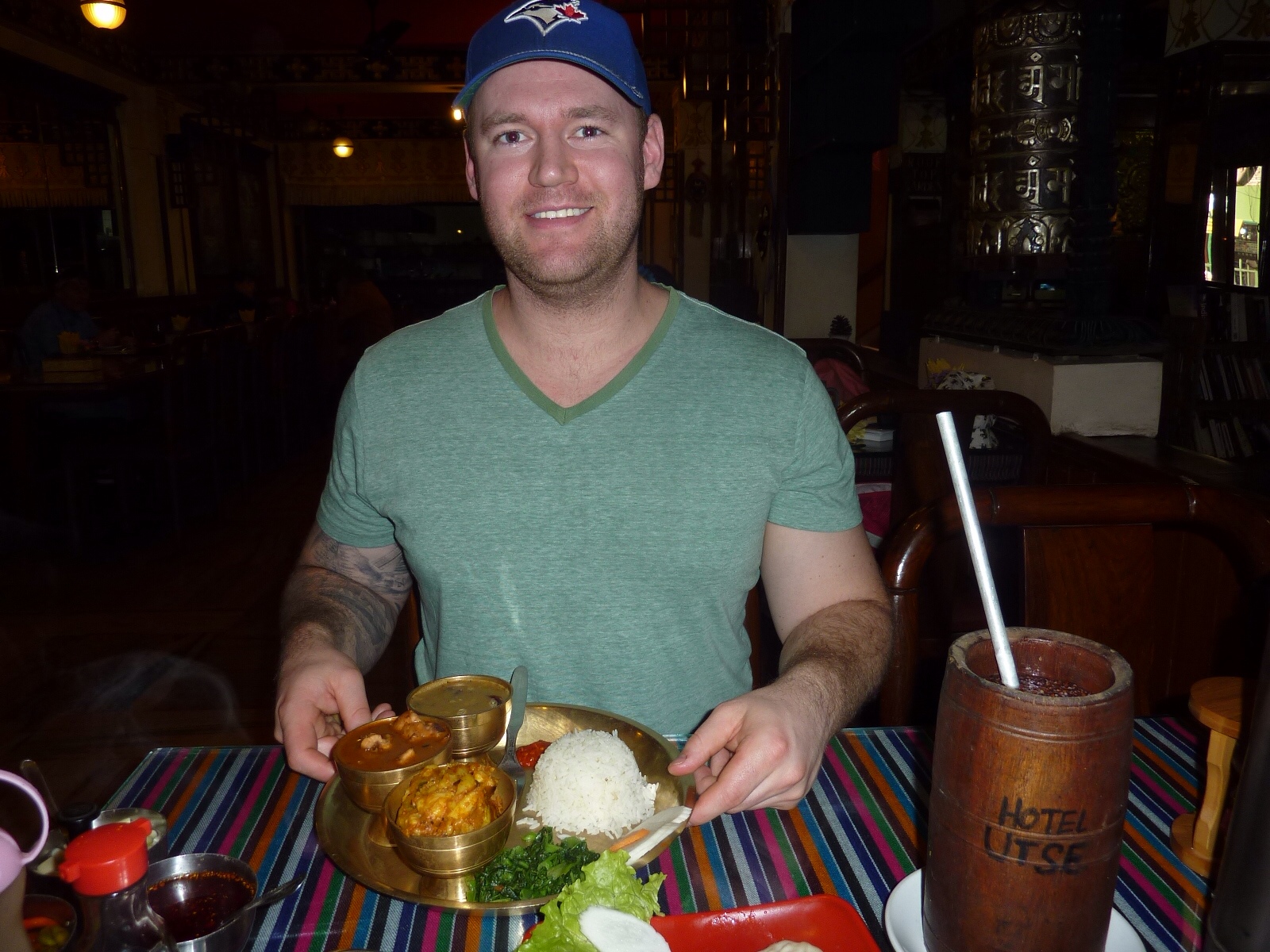
The food so far has been excellent. I would have to say I prefer it to Thai food (which was the former benchmark for outstanding food). A typical dish would look like this:

White rice, chicken/veg curry, alu, cauliflower, daal, achar, and garlic spinach.


Nom nom nom………


The 2nd day we hired a guide called “Badri”. Usually I'm not a big fan of hiring guides but it would be impossible for Meg and I to makes sense of Kathmandu without one. Badri took us around to numerous important sites around Kathmandu. I'll touch on the two coolest sites we went to.


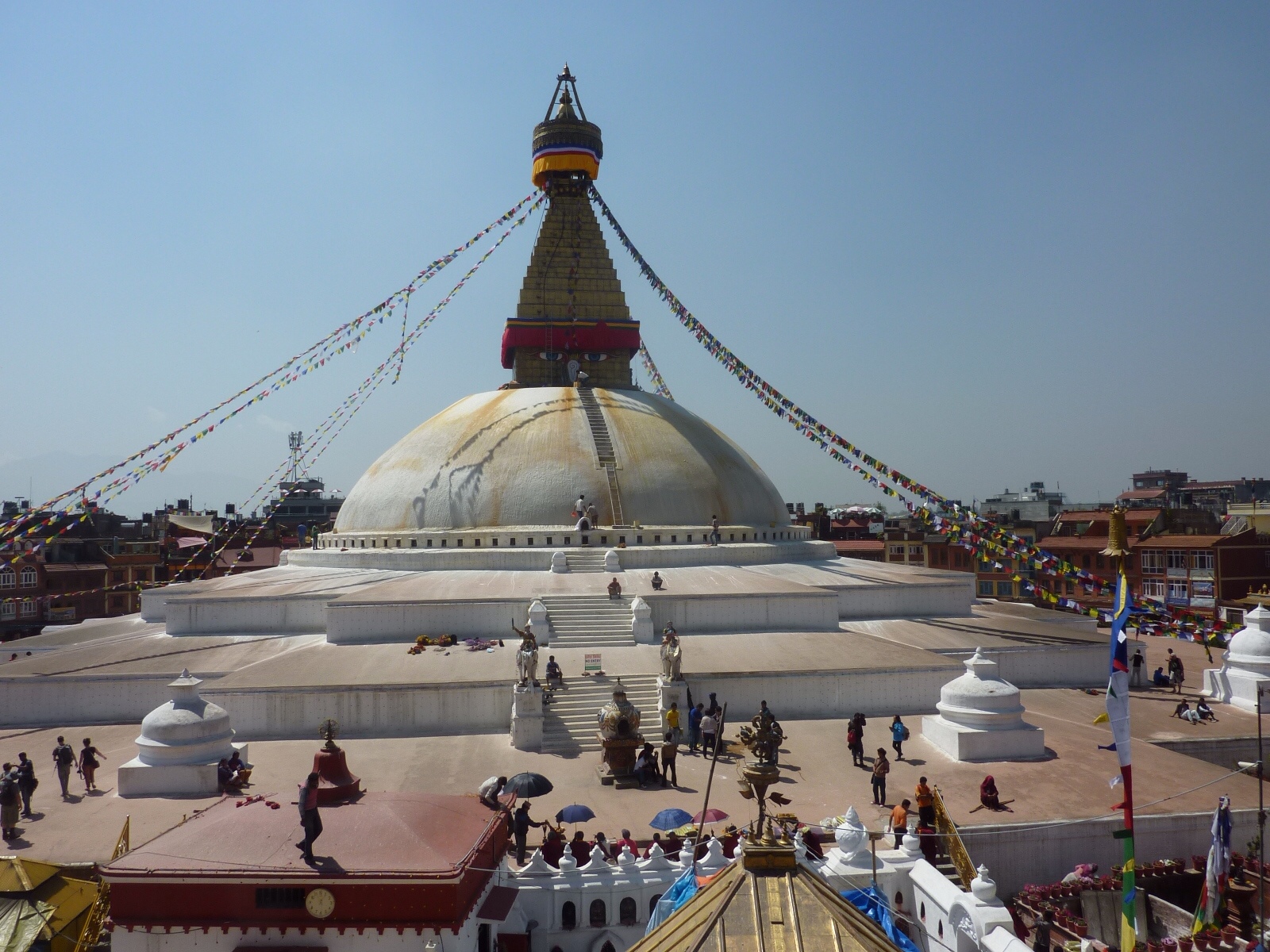
Megans favourite place was called Boudanath Stupa.


Originally built in the 5th century, this stupa is the largest in Nepal (maybe the world) and an important place to Buddhists around the globe. The interesting part about this site is not the stupa itself but the surrounding Monasteries where monks can be seen chanting and praying. We kind of felt like intruders stepping into these monasteries, but our guide assured us it was ok. It was actually really interesting.


I've never actually witnessed 20 monks chanting at the same time but it was almost eerie. Sometimes as a tourist, you don't get to see the real thing. You get taken to these BS shows where they tell you it's the real thing but it's only a facade to make money. This was the real deal. I actually have a video of this that I shot from the hip so no one could see me:


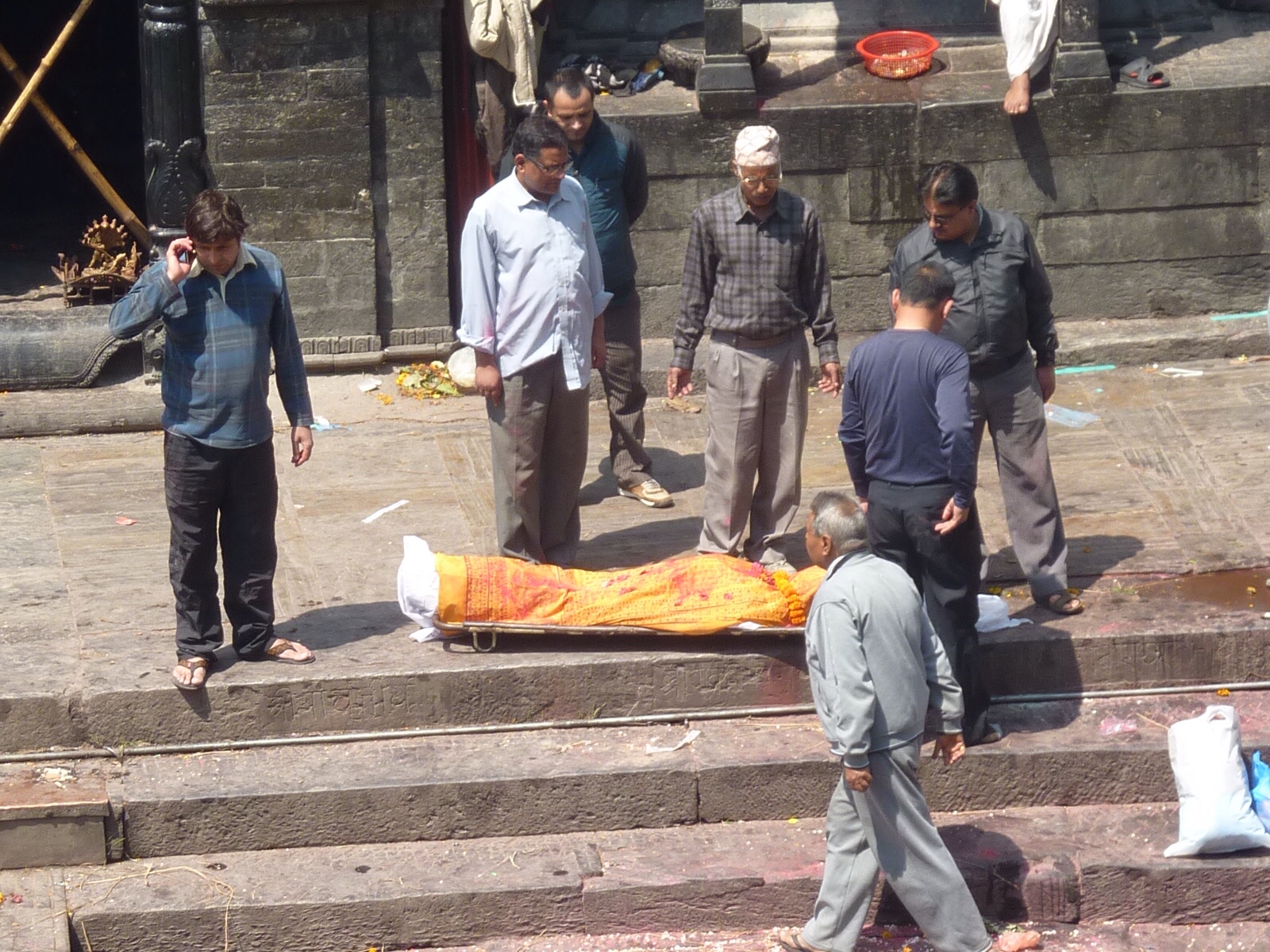
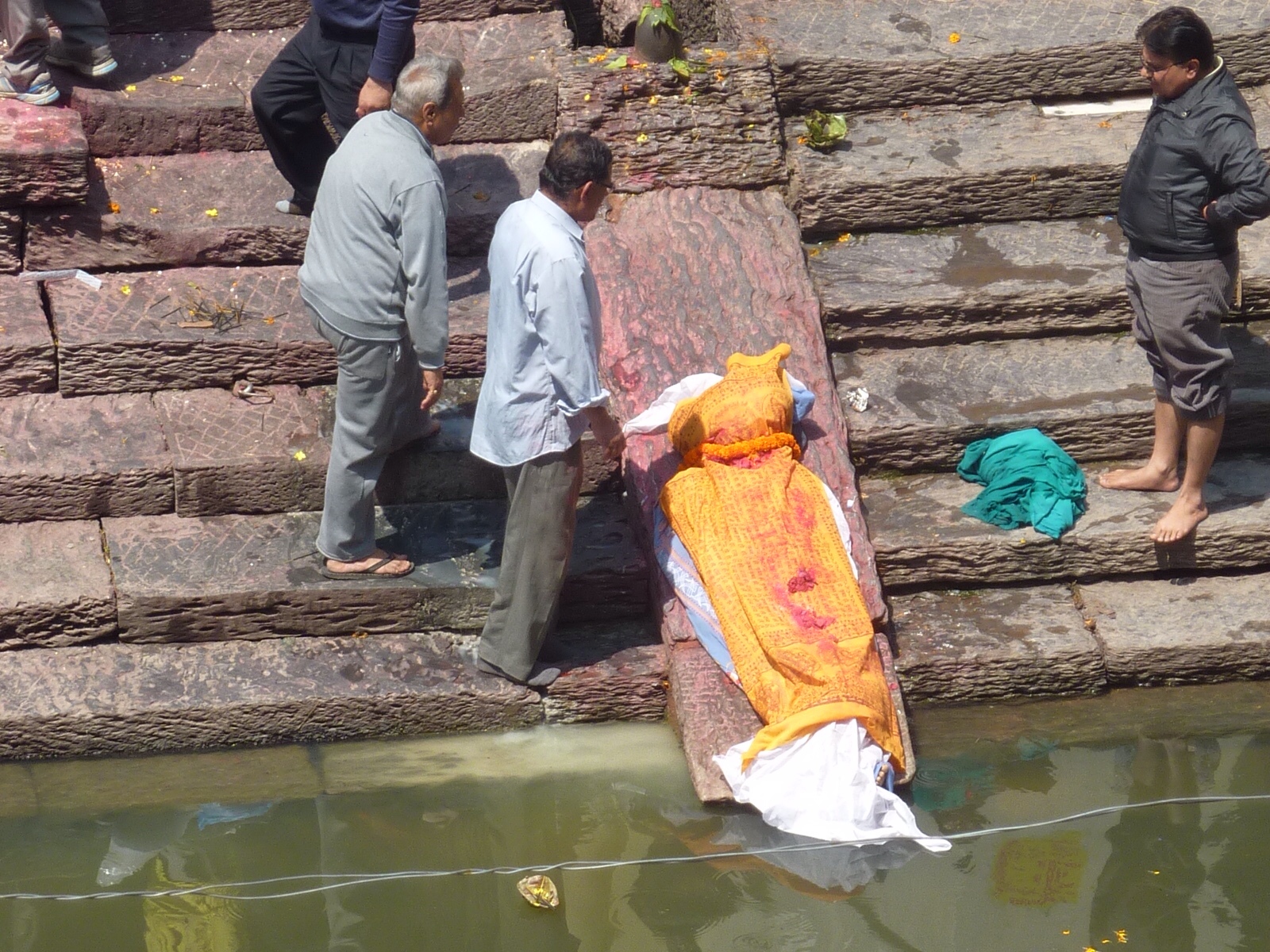
The second place we went was by far my favourite. Pashupatinath Temple – The Nepalese version of the river Ganges in India. We watched the Hindu process of cremation outside the temple in front of the river that flows past it. I'll try to do my best to explain the events although I may miss the odd detail. I swear I'm not making this up.


A father had died so his family had literally carried him to the temple wrapped in orange cloth:


The family layed the body near the river where they burned incense near the body and scooped water from the river into his mouth. Our guide called this the purification part of the ceremony.


Then they packed the body over to a large cement pad with wood and straw stacked upon it. The family then packed the body around the wood/straw stack three times in a clockwise direction before placing the body on top of it. The oldest son then took a burning stick and walked around the body three times again before lighting the cloth nearest to the mouth of the body on fire.


All this time, family members are crying loudly. Hysterically I might even say. Just watching the body burn. The whole thing was so real that I will not be posting the more graphic pictures on this blog. It may have been the most interesting I have seen during any of my travels. After the body had been burnt, they scraped the ashes into the river.


One of the most bizarre parts was that there were two men standing in the river while the ashes floated by.


I'm tired and my beer is empty so I'm going to hit the hay (great beer here by the way).


Sorry Milton.


We just arrived from an 8 hour bus right to Pokhara where we are starting to prepare for our hike so I'll update again soon. Here are some other pictures we've taken over the past few days:


Patan durbur square


Man at stupa


We Are Off To Nepal!

Posted: March 19, 2014 in Nepal


In a few short days, Meg and I will once again be jetsetting to the wonderful continent of Asia. This time our destination is the trekking mecca of Nepal.

What can you tell me about Nepal, Bert?


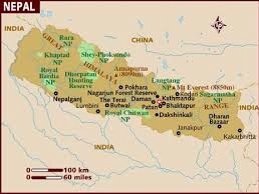
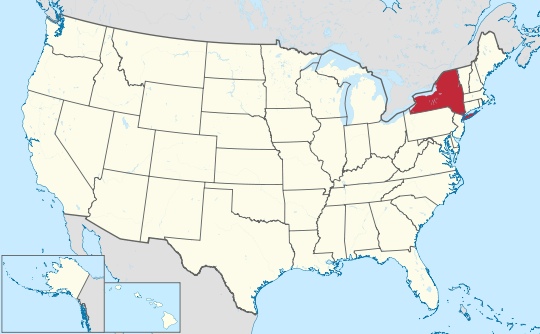
Nepal is about the size of the state of New York and has approximately the same population as Canada.

Nepal

New York


Nepal is home to 8 of the tallest 10 mountains in the world. Our hike will center around #10 Annapurna.


Nepal is the only country in the world to have a non-quadrilateral flag.

Nepal is the birthplace of Buddha. Yes, Buddha was an actual person. Born circa 500 B.C.. Despite Buddha being born in Nepal, 82% of Nepal's population is Hindu (Buddhism is the second most popular religion at around 11%.)

Nepal is home to the famed “Sherpas” . An ethnic group from high in the Eastern Mountains of Nepal. Due to genetics and upbringing, Sherpas do not suffer the negative affects of altitude like others due – Hence why they are mostly employed as porters in Nepal.

We will be flying into the capital city of Kathmandu (3 million people) on March 23rd and spending a few days taking in the sights before taking a bus East to Pokhara where we will be preparing for a 10 day hike in the Himalayas.


Well, I think that about does it.

This blog post is as finished as Alison Redfords run as Premier.


Sorry. Low blow.