As our last blog featured our favourite pictures from Ghana, this one will show a few short videos we have taken of what it’s like to be a traveller in Ghana.
The start of another tro tro journey. I liked to buy these sweet, baked dough balls at the tro tro stations. Megan caught me on one such occasion.
Kejetia Market in Kumasi. This video is a short clip of the market shot from the hip. I tried to conceal the camera because filming the locals is not always appreciated.
Megan shot this video from the window of a taxi in Takoradi, Ghana. It shows the everyday happenings on a quiet street.
She didn’t want me to post this picture. That’s why I posted it.
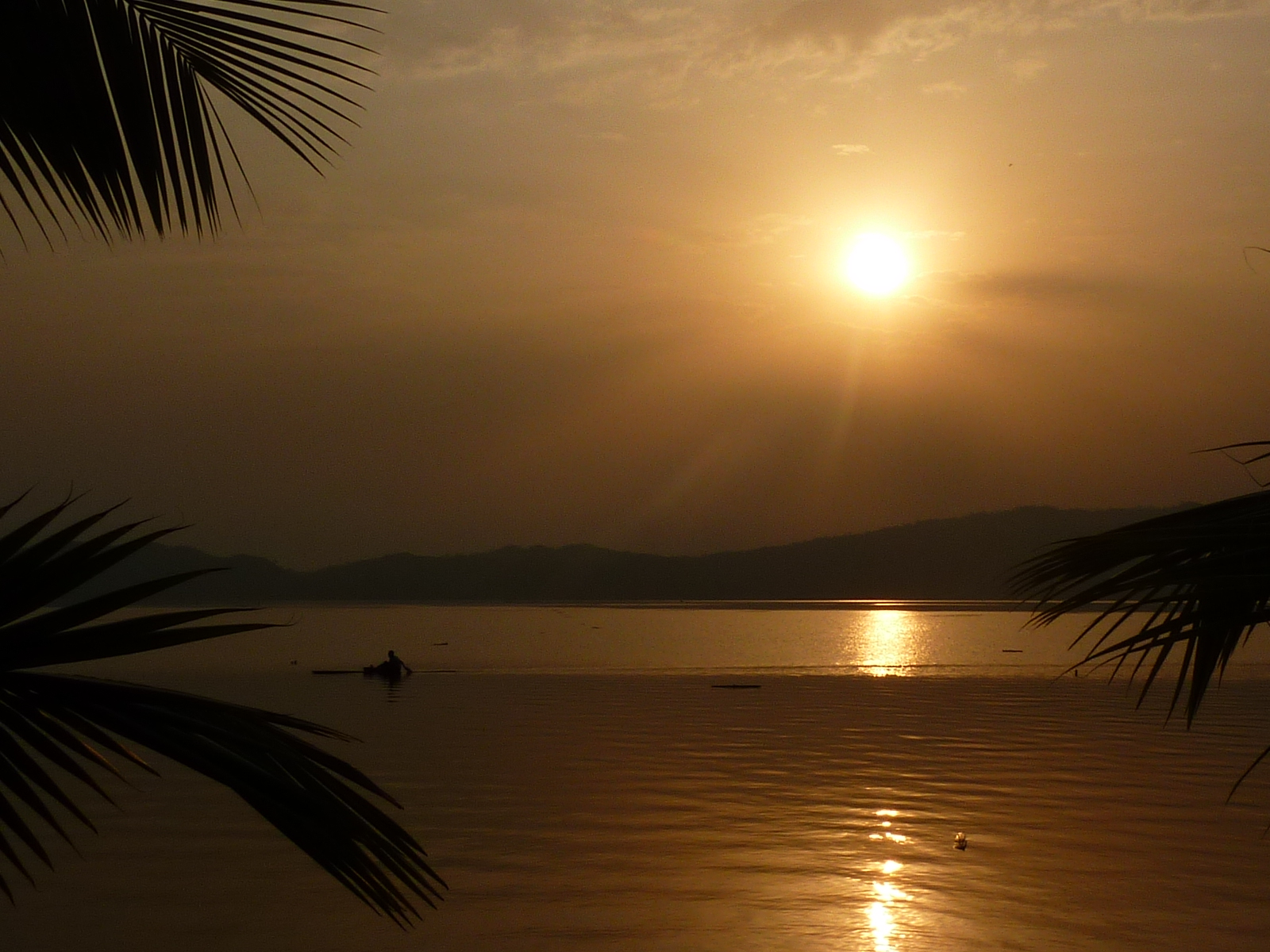
The sun is setting as a fisherman checks his nets for the last time in the day. (Lake Bosumtwi, Ghana)
The fishermen checked their nets 4 times per day. They mostly caught tiny fish (2 inches long) which they ate. If they caught a bigger fish they sold it in the market. We went swimming in the lake but kind of felt guilty that we could be scaring the fish away from their nets.
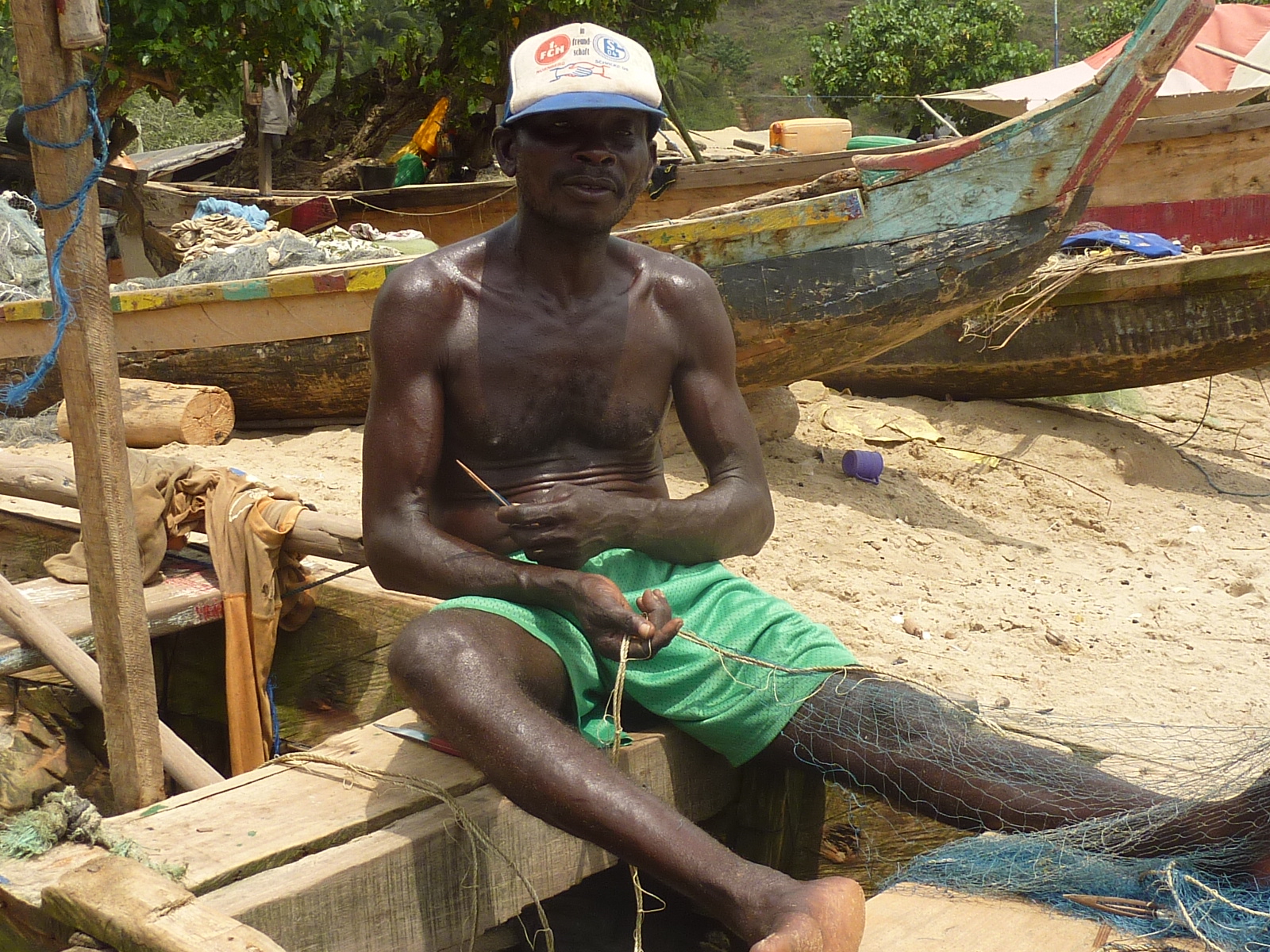
A fisherman repairs his nets after a large boat drove over them. (Butre, Ghana)
This man and his two sons were sitting in the sweltering heat, fixing their nets. He said that he had caught 3 big sharks the night before (but who knows… the language barrier often muddles communication).
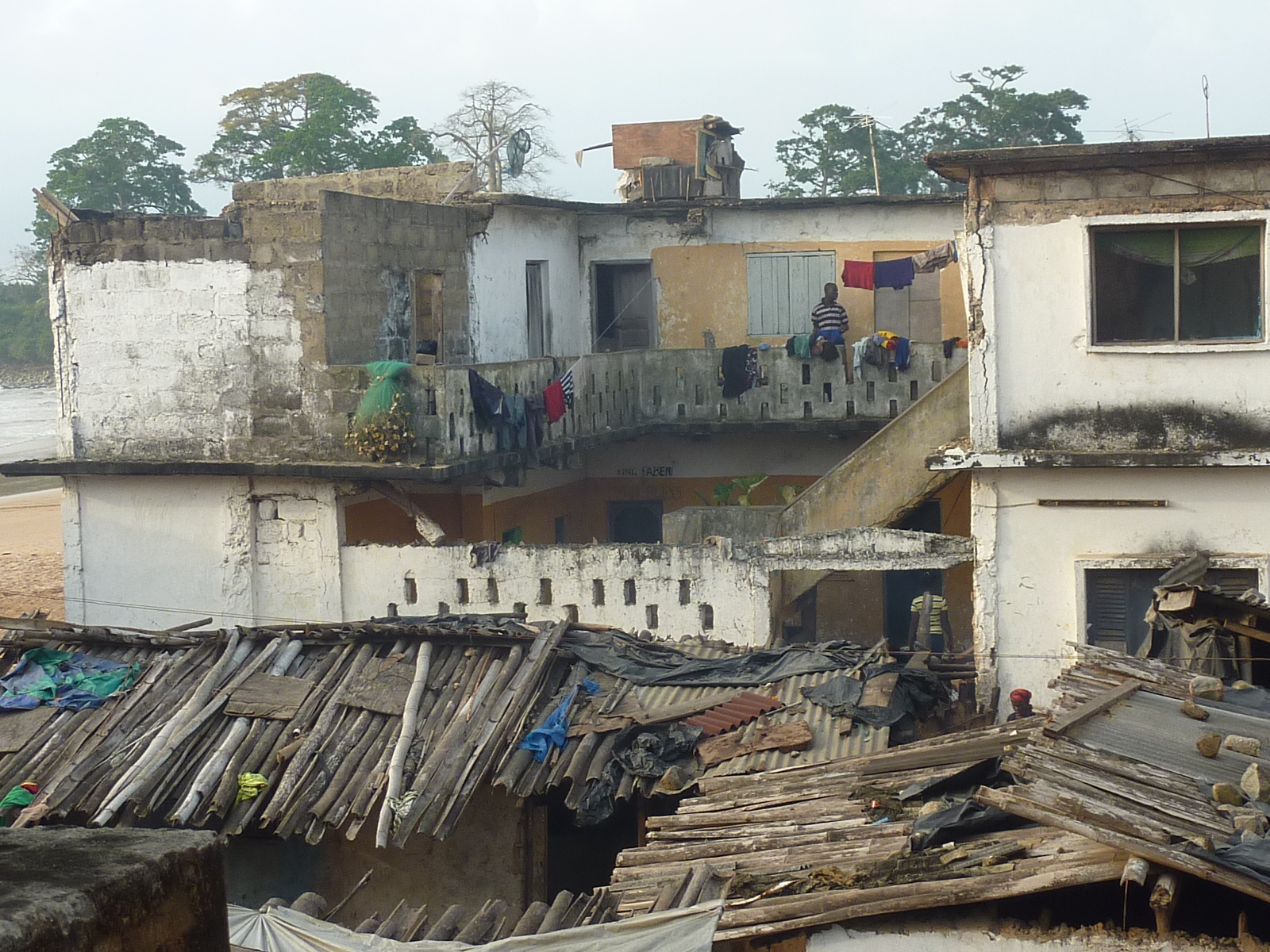
A man hangs his laundry to dry (Busua, Ghana)
This was the view from the window of our guesthouse. Poverty beside affluence was everywhere.
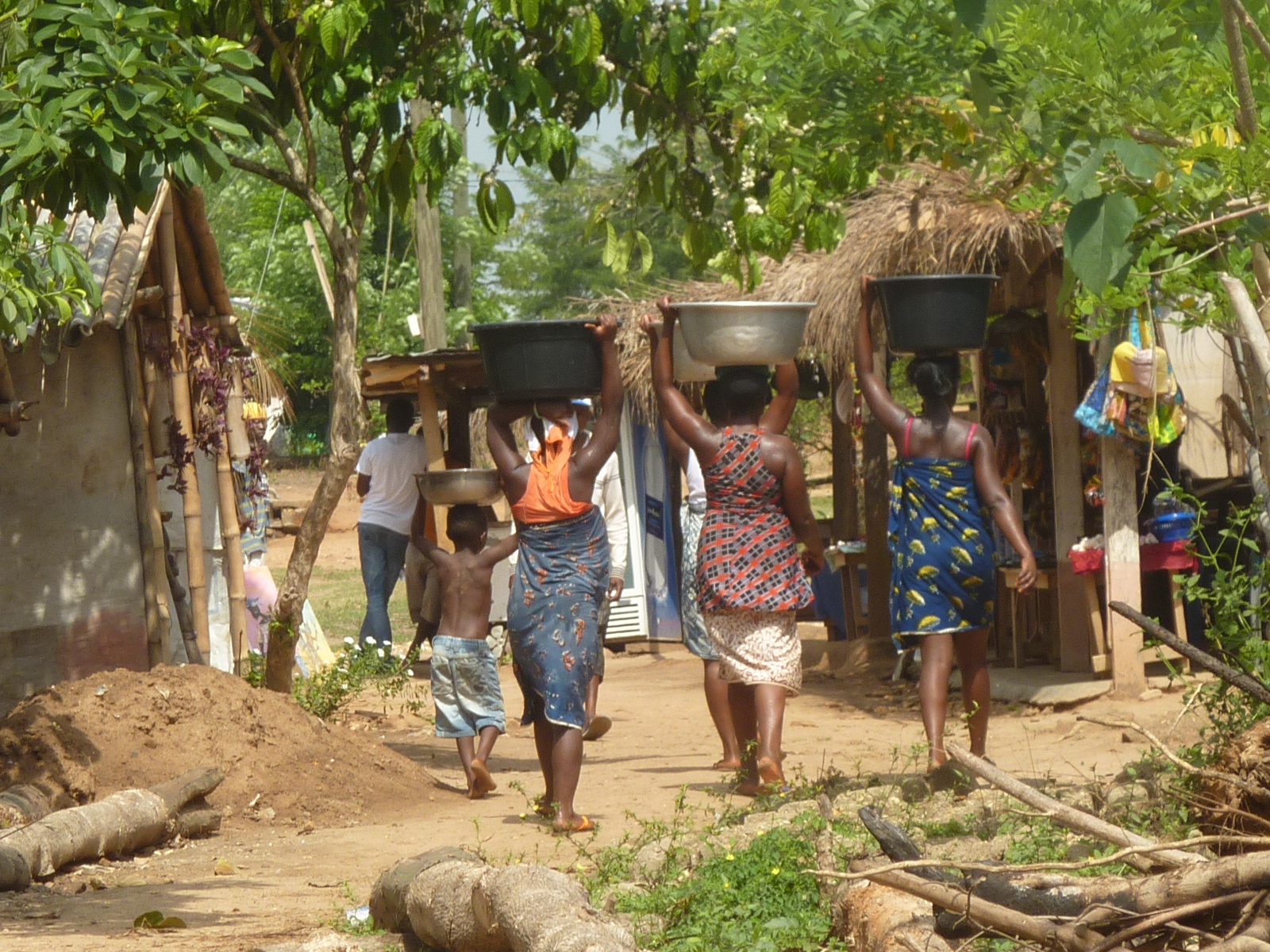
Women fetching water from the river (Wli, Ghana)
It’s sometimes difficult to take pictures here because many of the people don’t understand the concept of taking pictures for personal use. They think that you must be working for a magazine and therefore may decline to have their picture taken. I snuck this shot from behind to avoid asking permission – I know it’s not right but I couldn’t resist getting this great picture.
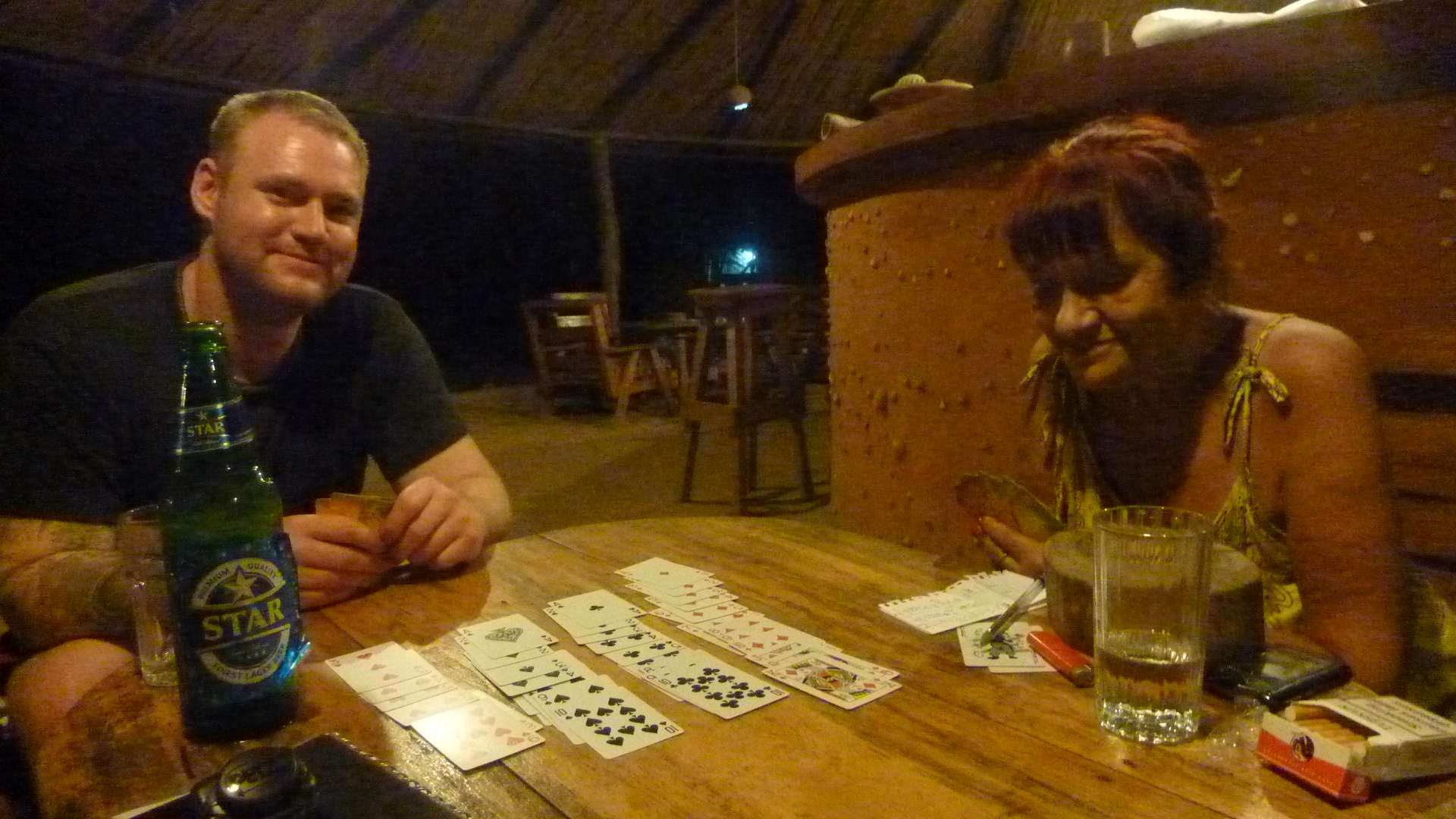
Megan and Jennifer (Stumble Inn, Elmina, Ghana)
The staff at our guesthouses were fantastic. Megan was particularly fond of Jennifer who played card games with us for two days.
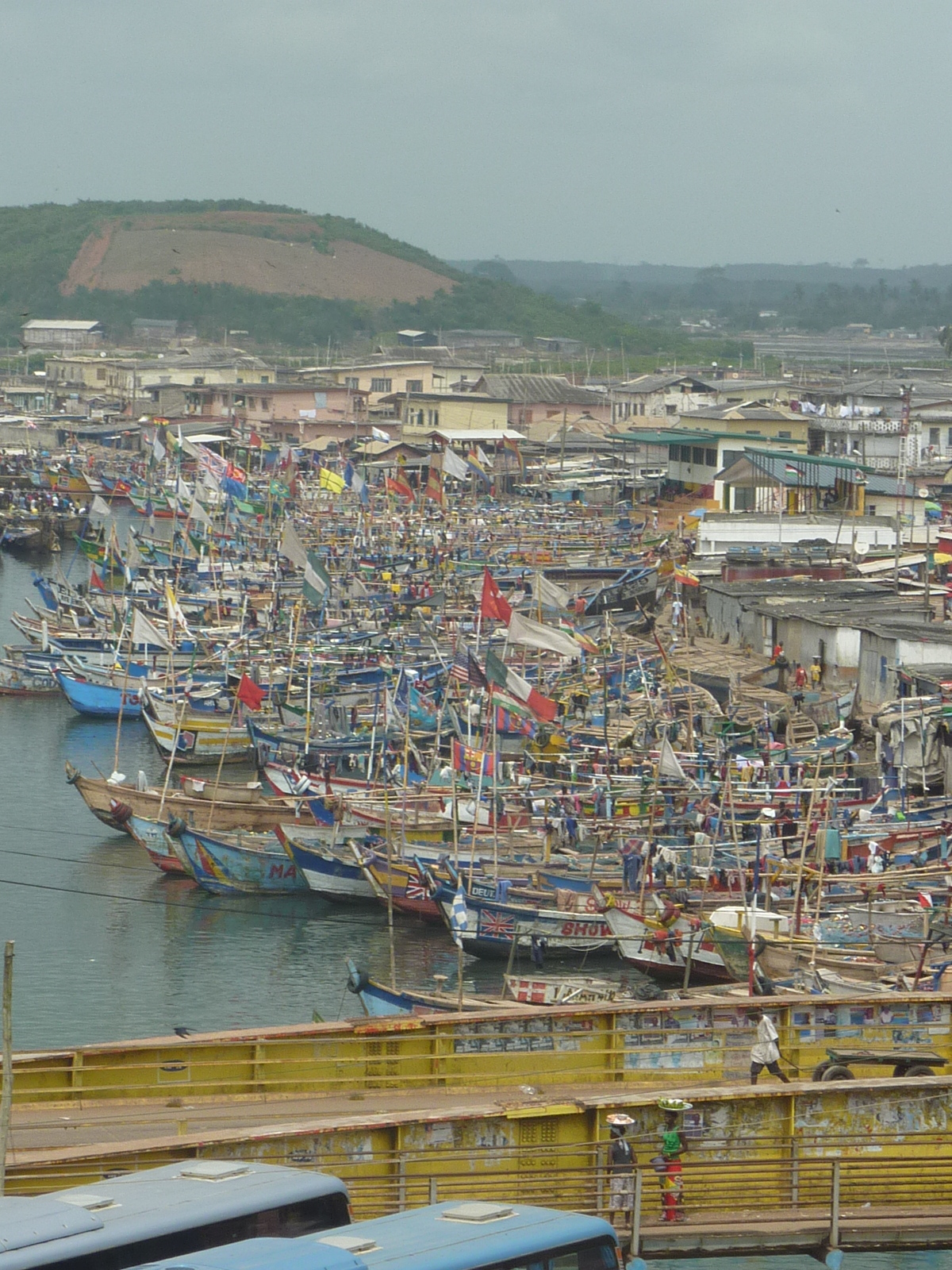
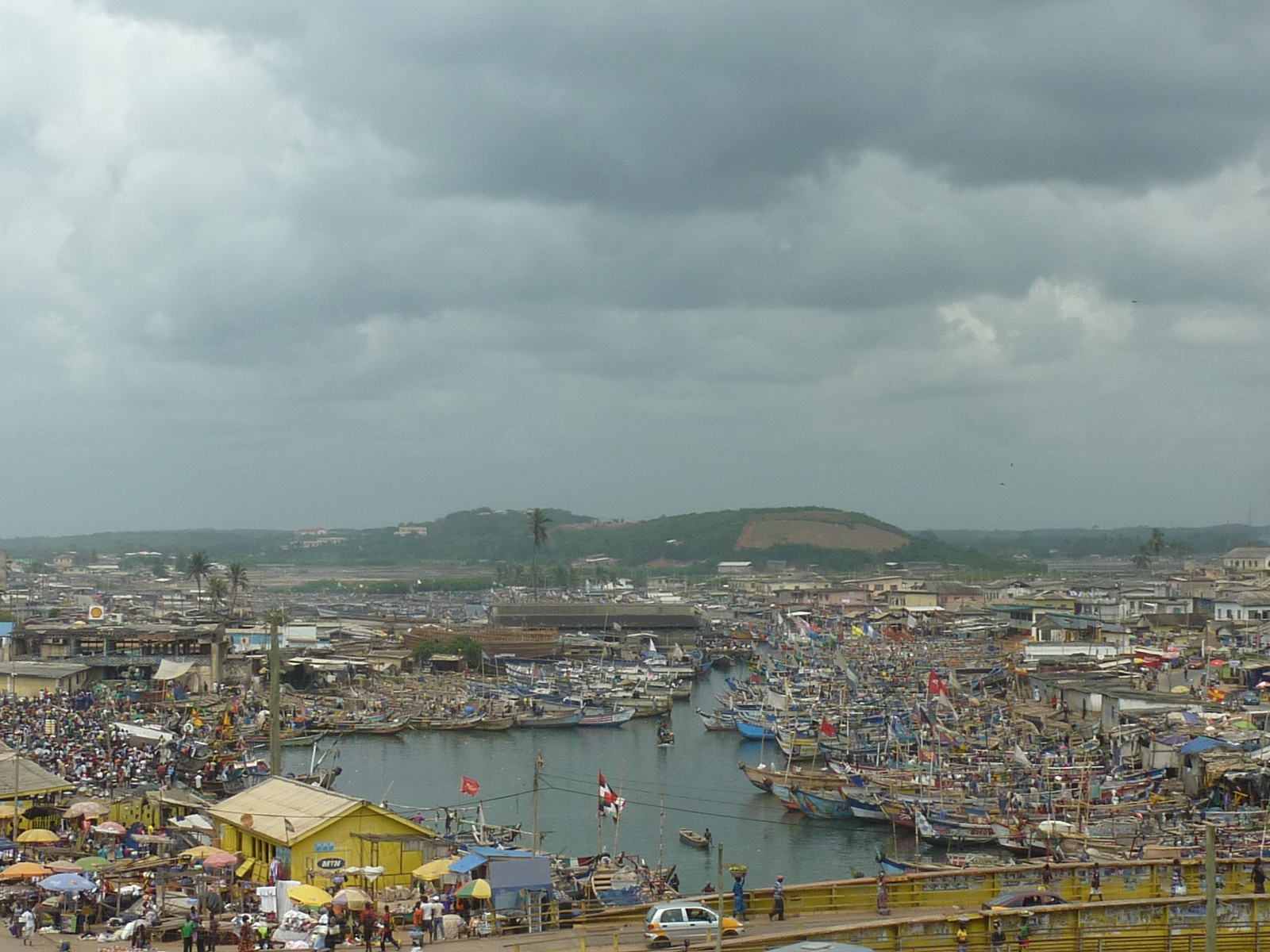
Bustling fishing harbour (Elmina, Ghana)
This colourful harbour was packed with boats displaying flags of different countries (although I didn’t see Canada) as a way of distinguishing the boats.
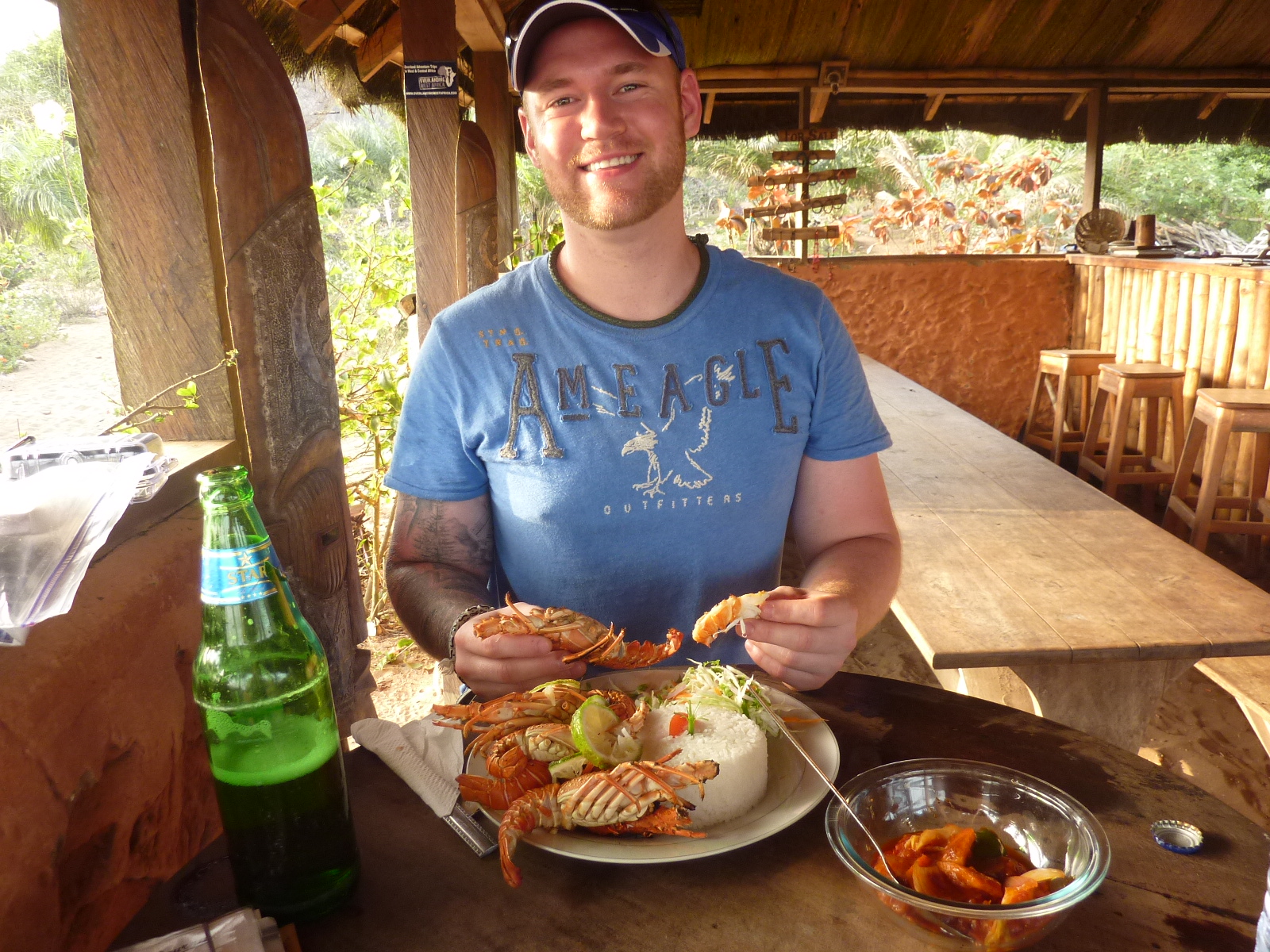
Can’t beat a huge portion of lobster and beer for $12 (Stumble Inn, Elmina, Ghana)
Ghana (being a coastal country) had cheap seafood everywhere. This dish costed 20 Cedi ($10) while the large 750ml beer costed 3.80 Cedi ($1.90). I would have to say this was the best meal I ate in Ghana…..
“Looks better than that bloody Fufu stuff”
Men pull in their fishing nets at sunrise (Cape Coast, Ghana)
We watched men and children pull in fishing nets every day. Sometimes this grueling task would take upwards of 2 or 3 hours. One man at the back shouts out a rhythm that signals when the others should pull.
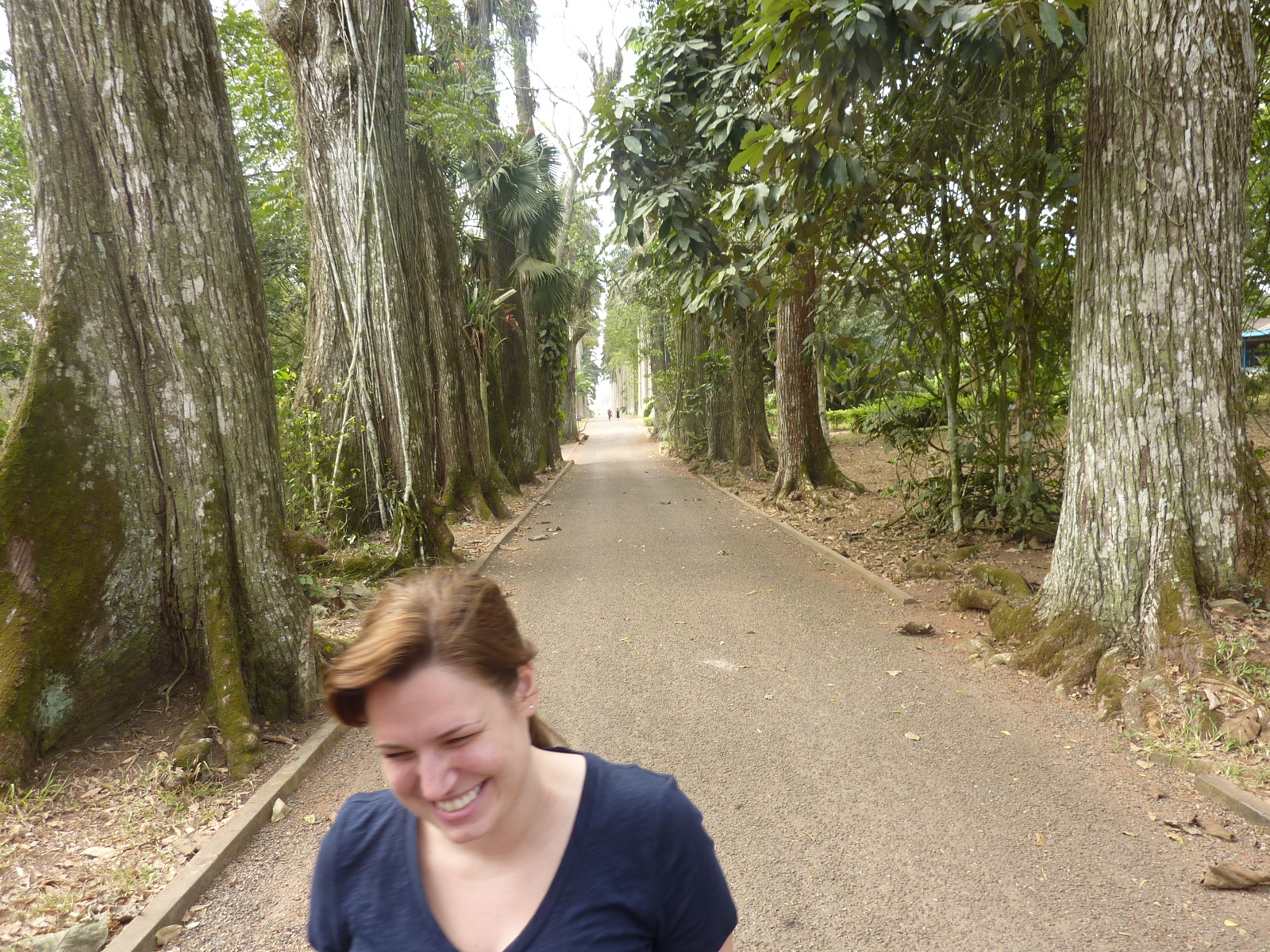
Megan laughs during a walk through Aburi Botanical Gardens (Aburi, Ghana)
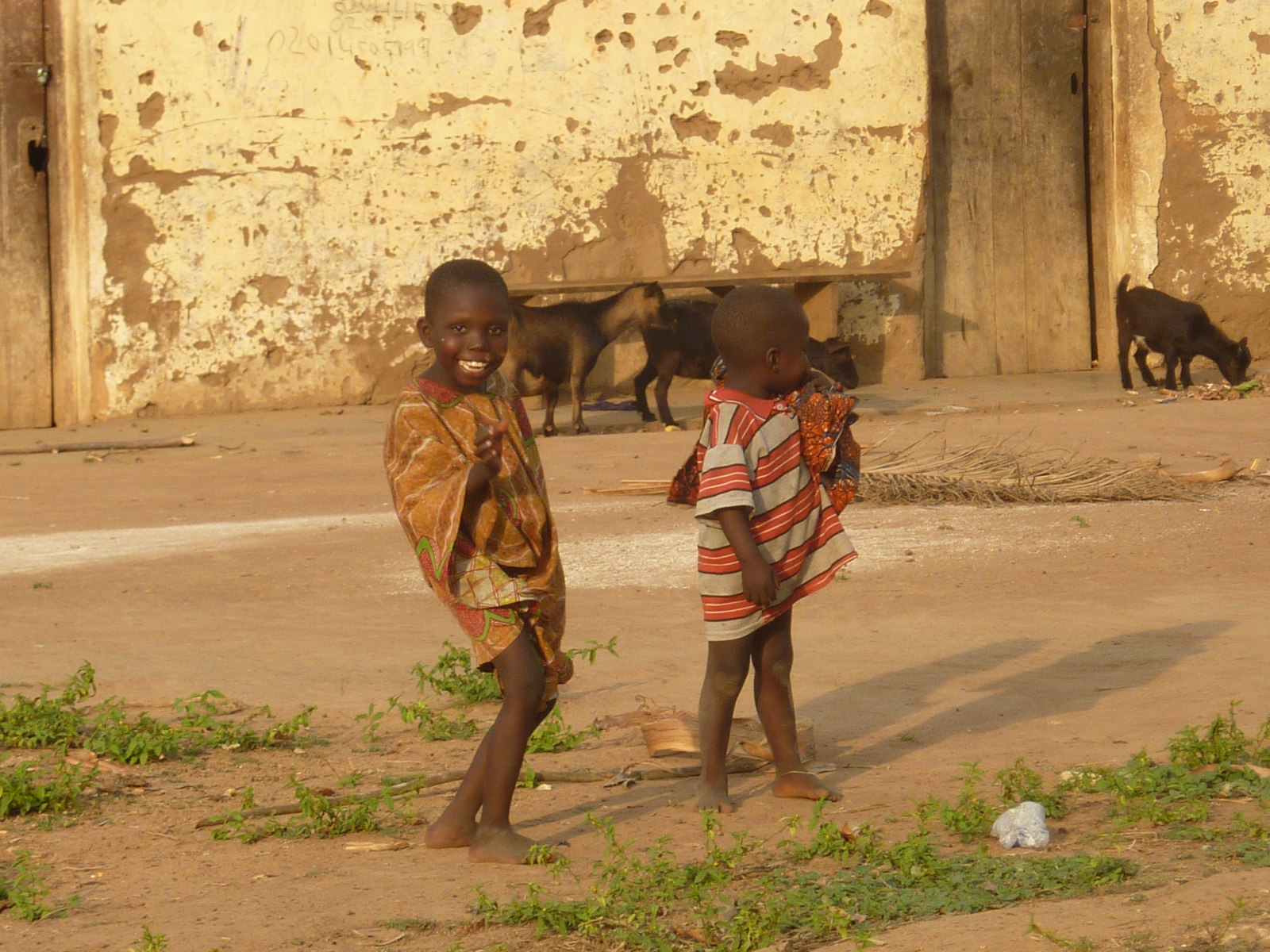
Curious children stare at the funny looking white people (Somanya, Ghana)
These kids came to investigate what we were doing watching their families make beads.
The fascinating centuries old family tradition of bead making (Somanya, Ghana)
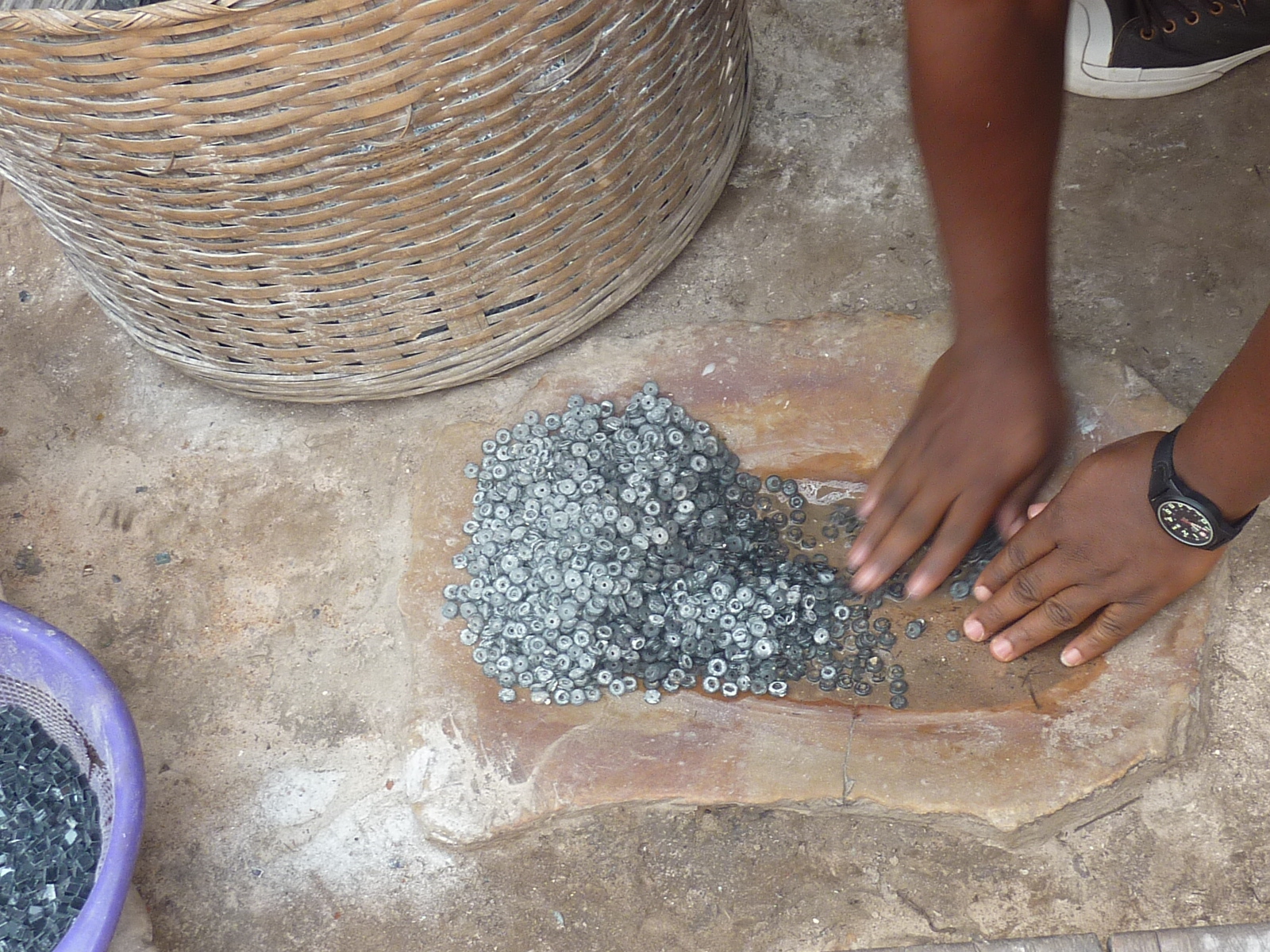
Unfortunately I didn’t get a chance to blog more about our visit to the bead making village. It really is an astounding process that has been around for hundreds of years. In fact, when the first European explorers came to this land, the locals would trade beads to them in return for other goods. I’ll give a quick rundown of the process:
1. Firstly the family goes out and collects glass bottles and firewood.
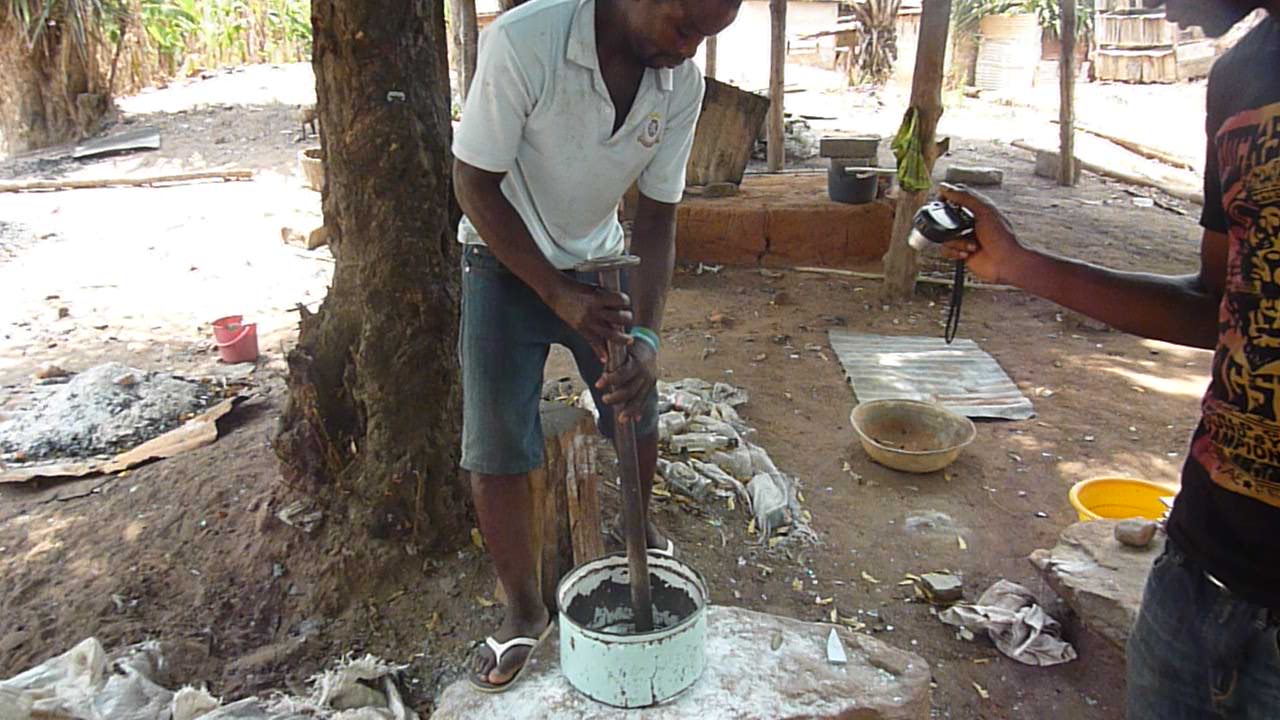
2. They mash it all up in a clay container until it become a fine glass dust.
Crushing the glass.
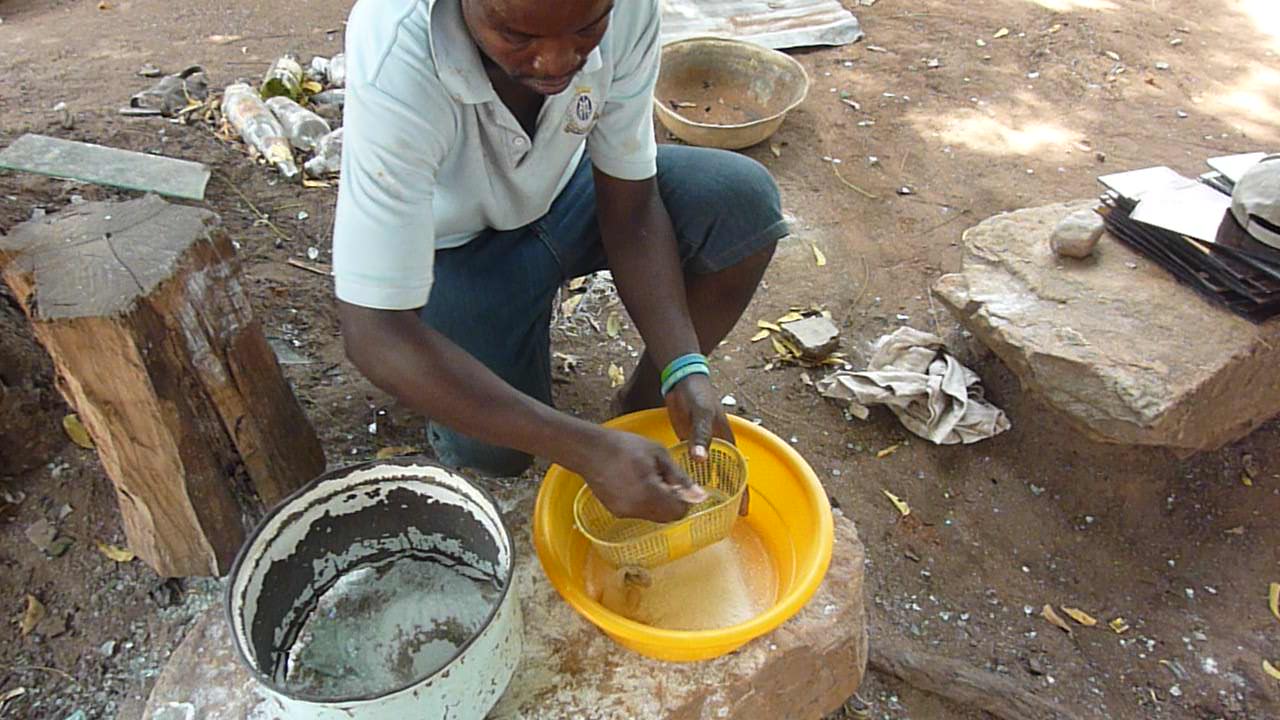
3. The glass dust is filtered to clean it of any debris
Filtering the glass dust
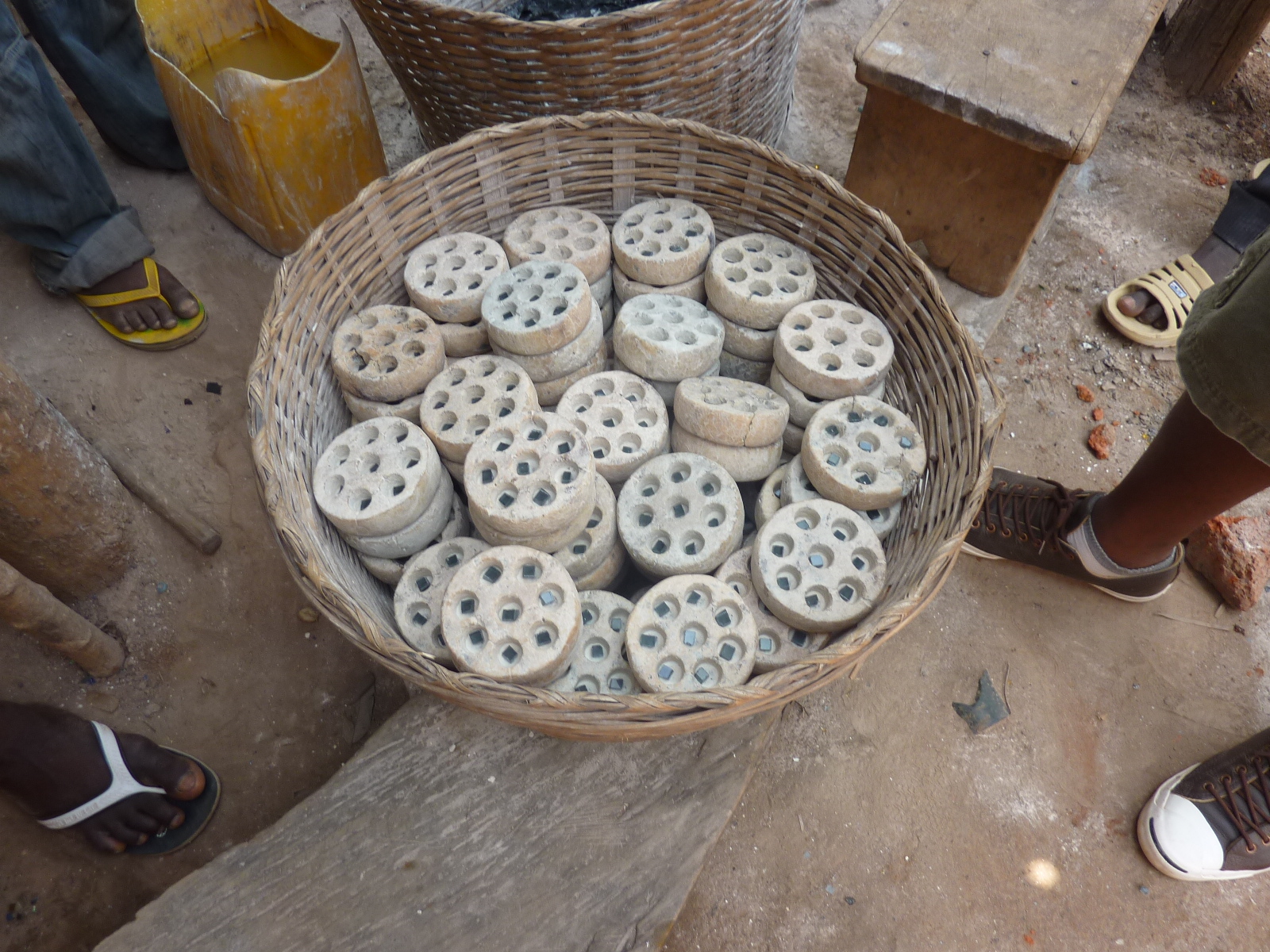
4. The dust is poured into a round clay mold (which is dunked in a solution to keep it from breaking from the heat of the kiln)
Clay moulds.
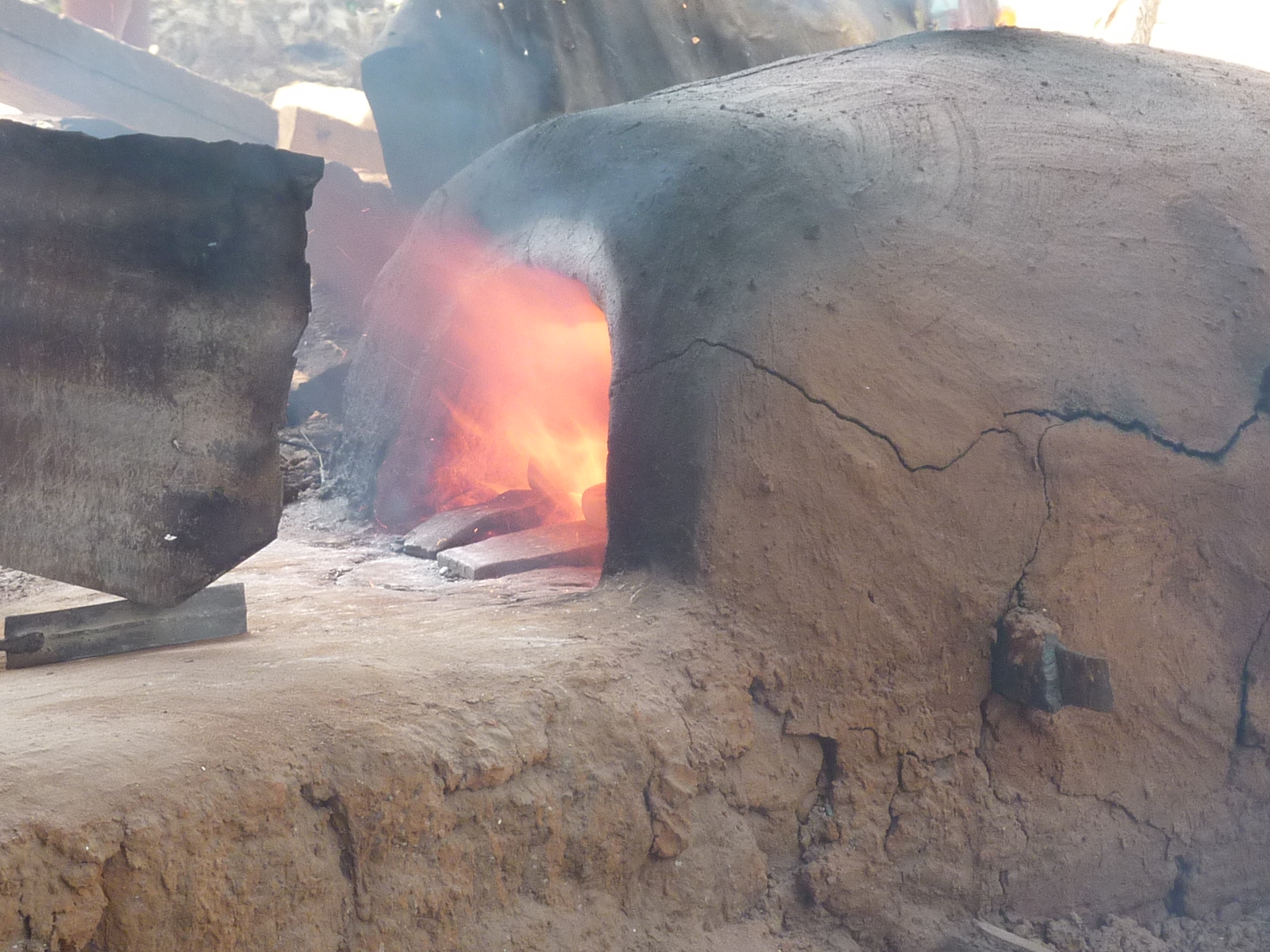
5. The mold is placed into a wood fired kiln made of clay and used spare vehicle parts.
Wood fired kiln (made of spare vehicle parts moulded together with clay)
6. It is removed after 15-20 minutes and each bead is then cleaned with a sandy solution.
Washing the beads.
Cleaned beads
7. After cleaning, each bead is painted and baked again before being strung on a string as a necklace/bracelet/etc.
The finished product!
8. Repeat steps 1-7. They do this 12 hours a day/7 days a week. They told us how much they make from selling these beads and I won’t say the exact number but it is not very much above the poverty line.
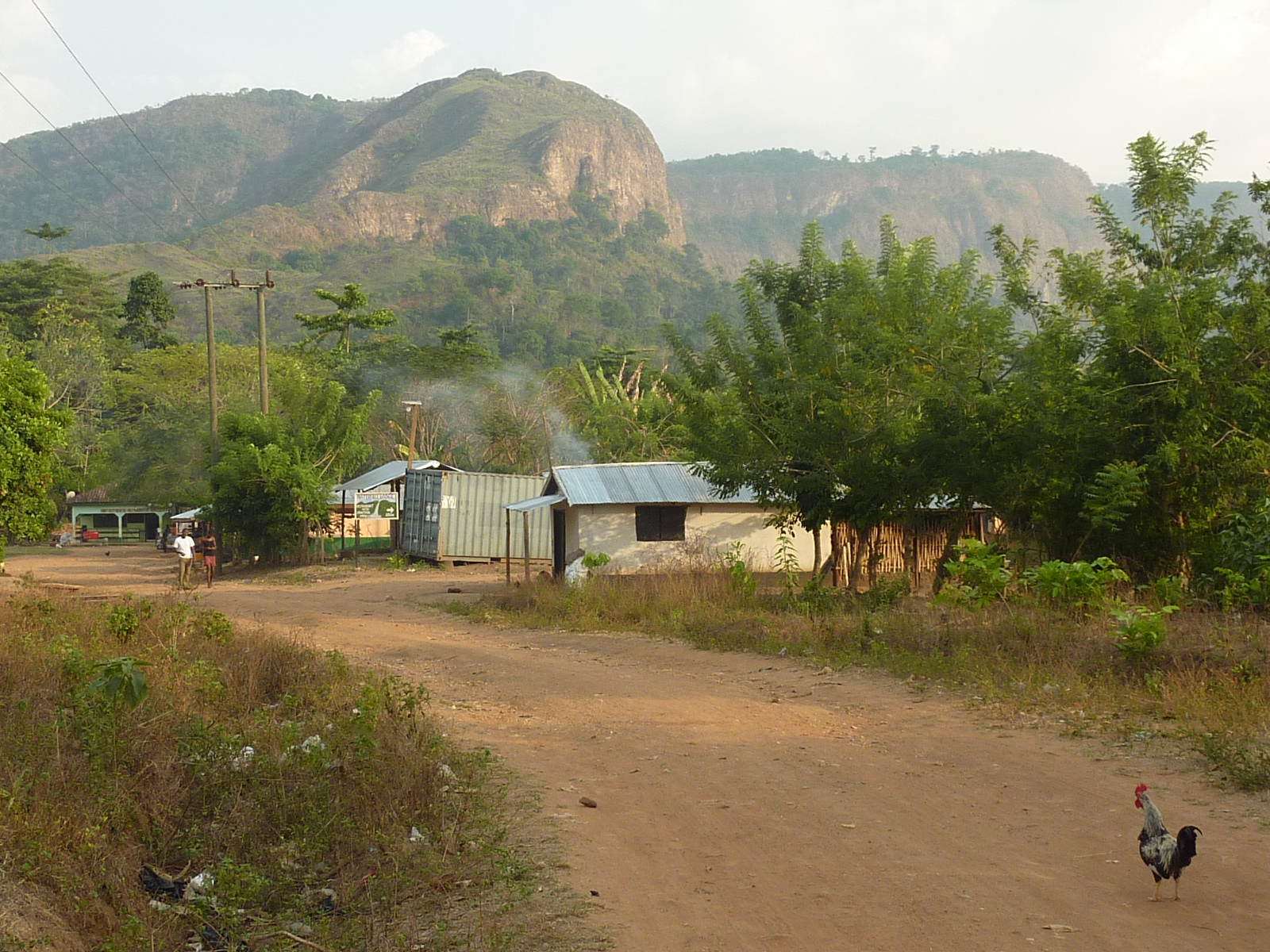
After another long, dusty, journey in which the potholes are neverending we arrived in Wli – A lovely, small, sleepy village near the border of Togo in East Ghana.
Wli, Ghana (Apparently the hills on the left are Togo, the ones on the right are Ghana)
Children laugh at the “Obrunis” with their big backpacks.
As a side note: Children here have a little game where they walk up to you and laughingly say “Give me your water”. To which my response is “Sure. Give me your shoes”. It’s funny how tongue tied this leaves them.
It seems the churches are always the nicest buildings in town.
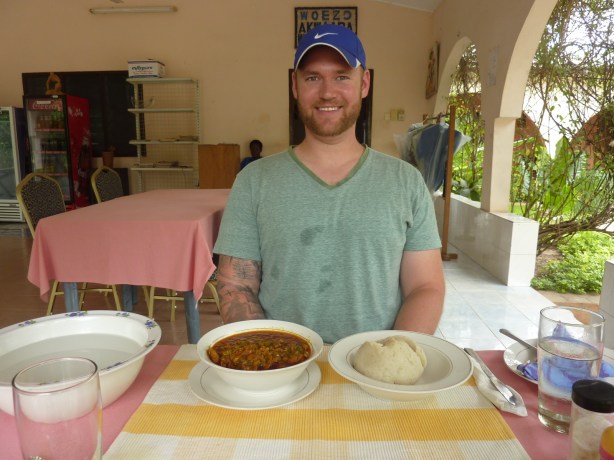
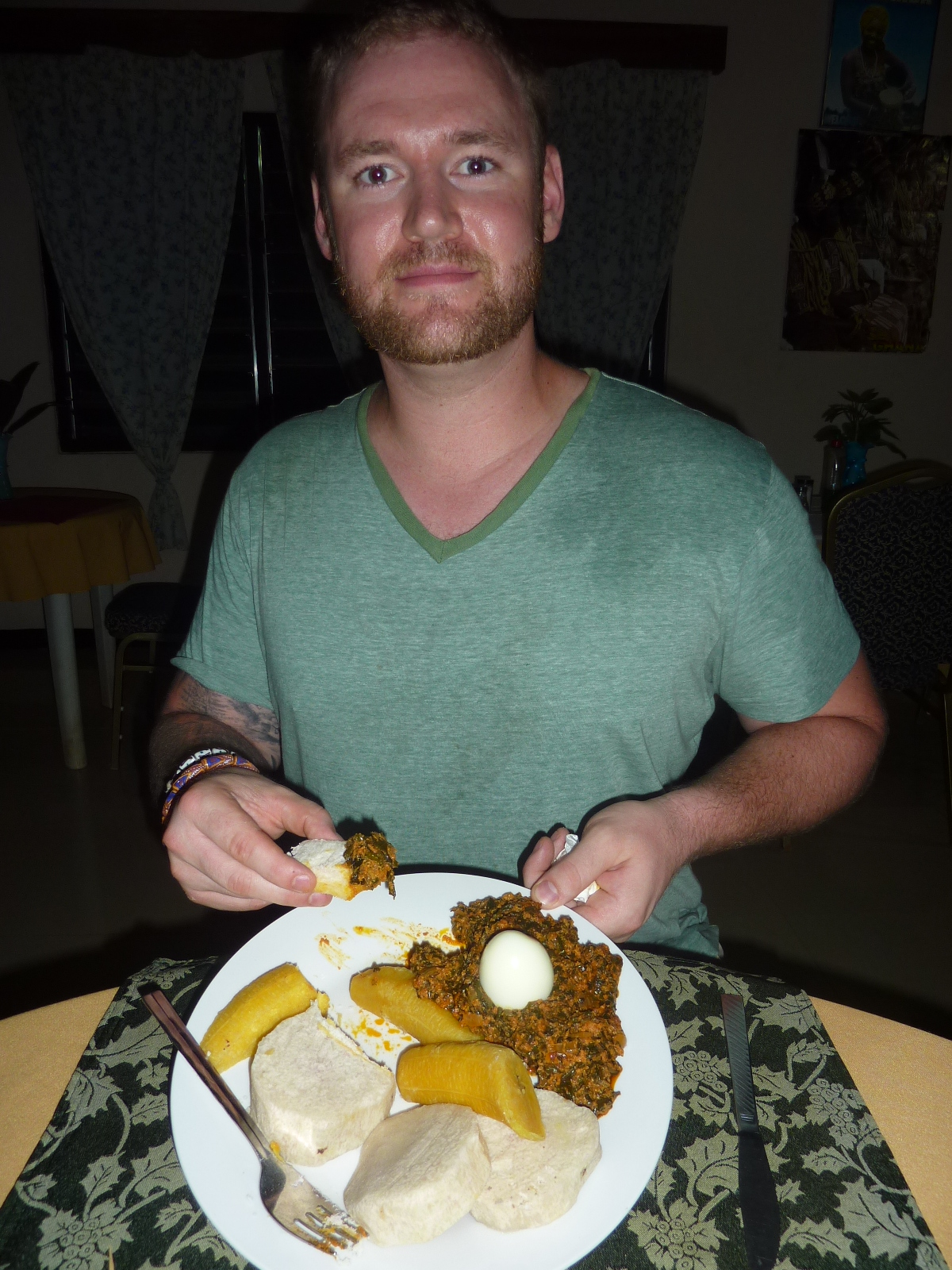
I’ve tried two new meals in Ghana which I feel I should briefly touch on. One I liked, the other I did not. The first is Banku.
Banku (and yes that is sweat. Its 35 degrees here – don’t judge)
Banku is similar to Fufu in the regard that it’s a doughy substance that is cut with the fingers and used to scoop up a stew sort of substance. The dough part is fermented corn and cassava mixed proportionally and cooked in hot water into a smooth, whitish, sour paste. The stew is a spicy mix of finely diced vegetables, palm oil (it’s in everything here), shredded beef, and other unknown spices.
The second meal is Palaver. To be truthful, I don’t know what it is. The paste is leaves of some sort, cassava, palm oil, and meat. This is served with boiled yam and plantain. When you google “palaver” it says that it is a Portuguese word meaning “to have a lengthy debate or quarrel”. If I was eating this meal all the time I would want to quarrel too.
For anyone that knows me, I will finish every bite of what’s served to me whether I like it or not – particularily when I’m in a country where people are going hungry. But with every bite of this meal I grew more defeated. Each bite seeming to be dryer and less palatable than the last. Until I eventually slumped over in my chair and put up the white flag of surrender. This was a surprise as I have generally loved the local foods up until this point.
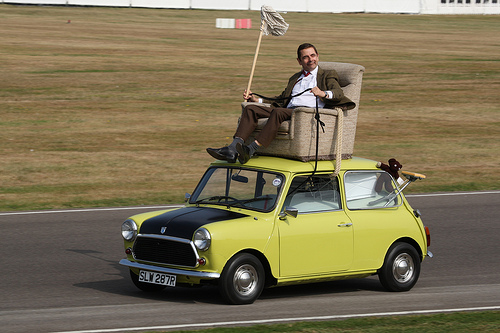
There was a point when I thought about hiding the food or feeding it to a pet to avoid the embarrassment of handing the waiter an unfinished meal to dispose of. Much like Mr. Bean did:
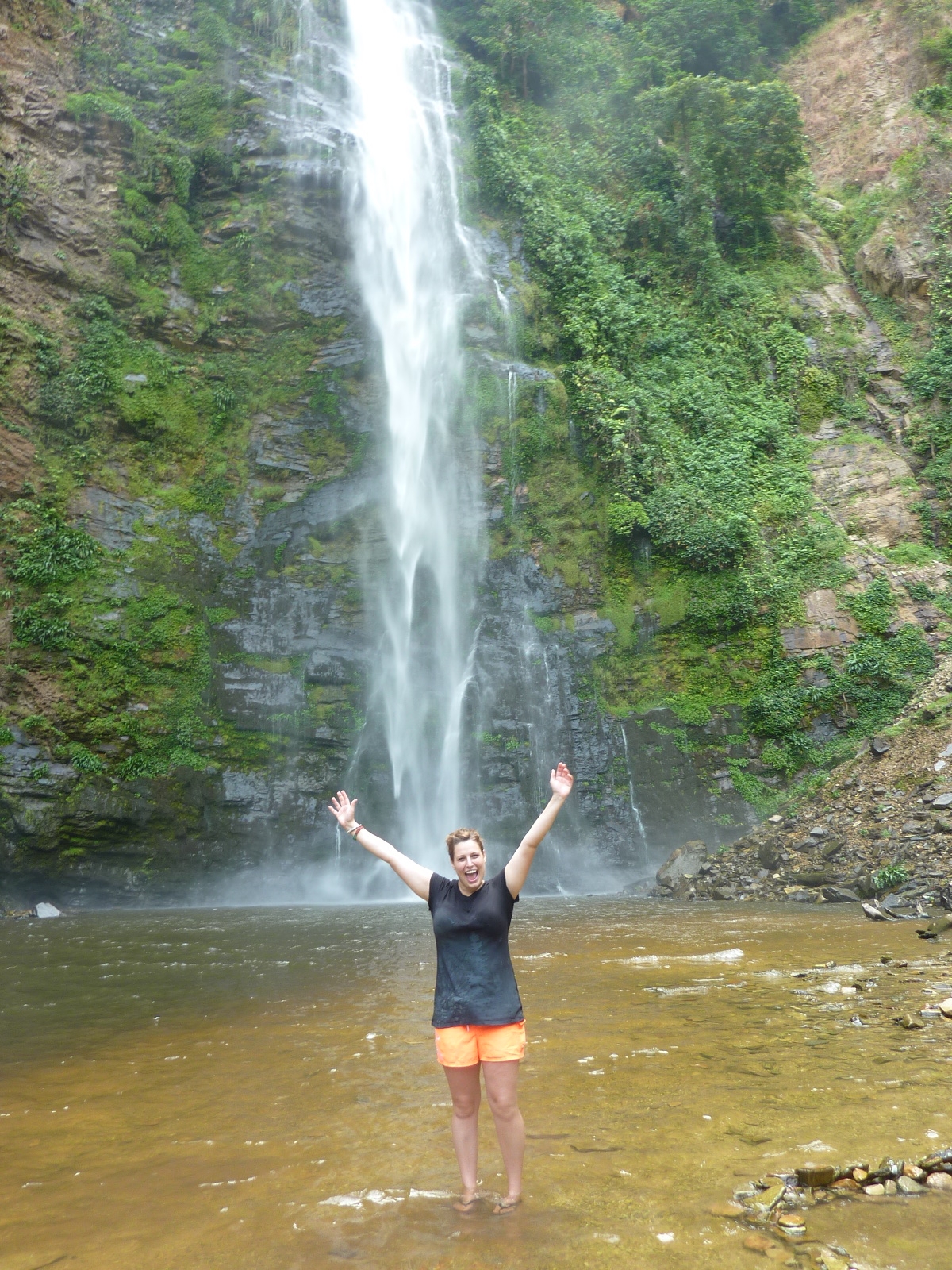
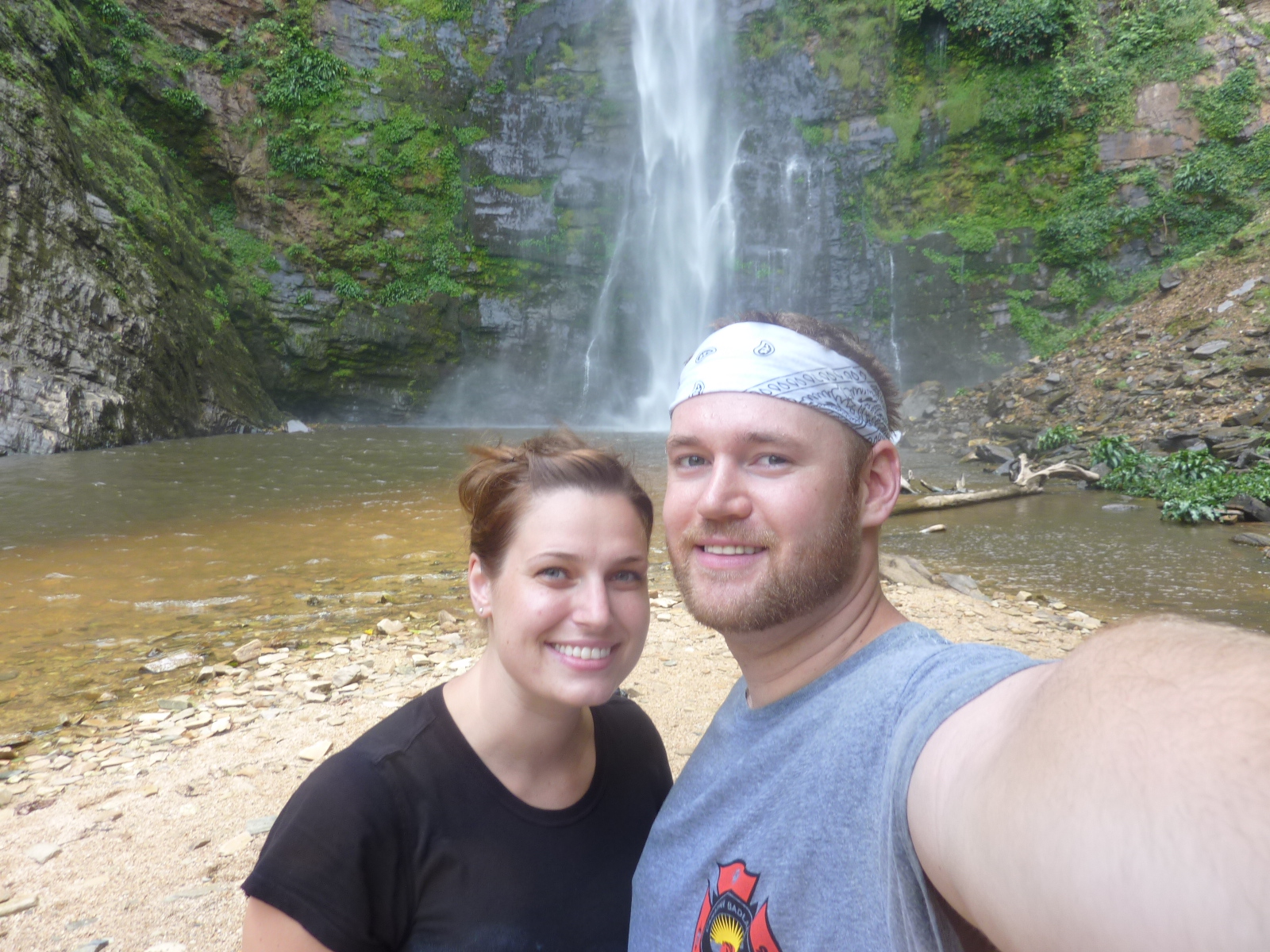
The next day we set out on a 45 minute walk to view the largest waterfall in West Africa: Wli Falls.
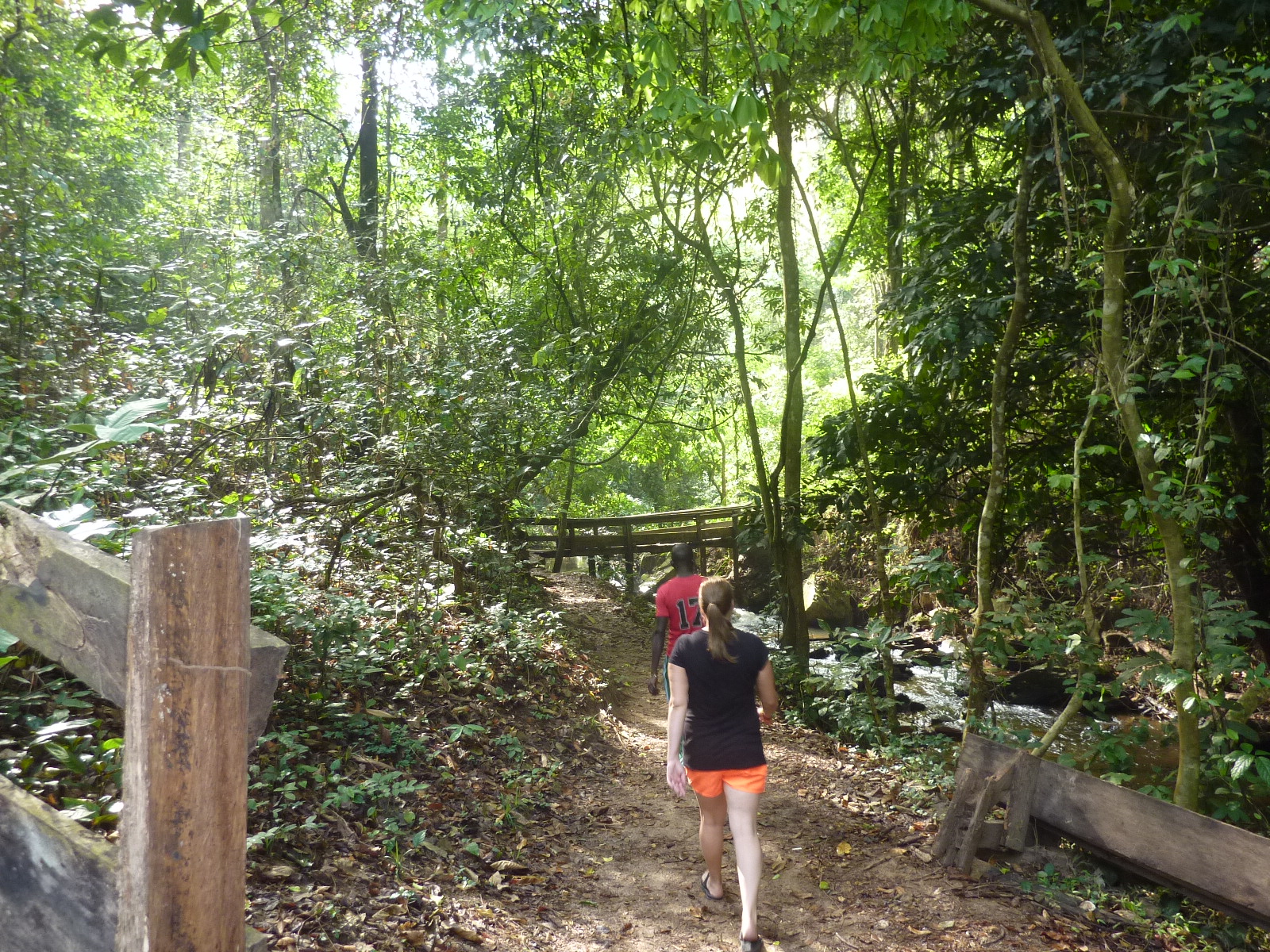
The walk was a beautiful short trek through the forest, crossing rivers and streams nine times in total.
To give you an idea of the size of the waterfall, spot me in the next picture.
Spot Jason
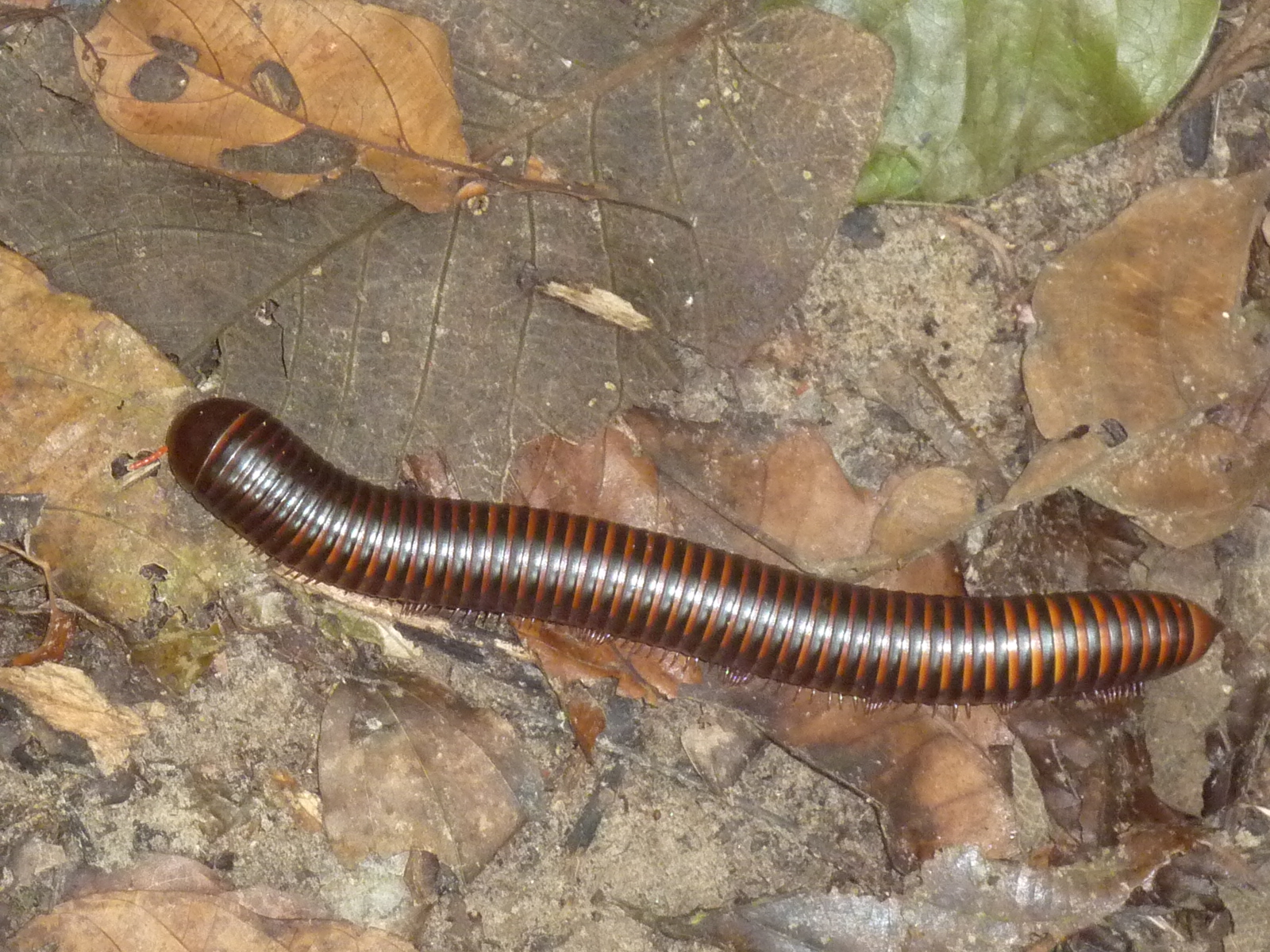
We ran into this 6-7 inch millipede on the way back from the falls. Apparently it’s very poisonous – we had no idea.
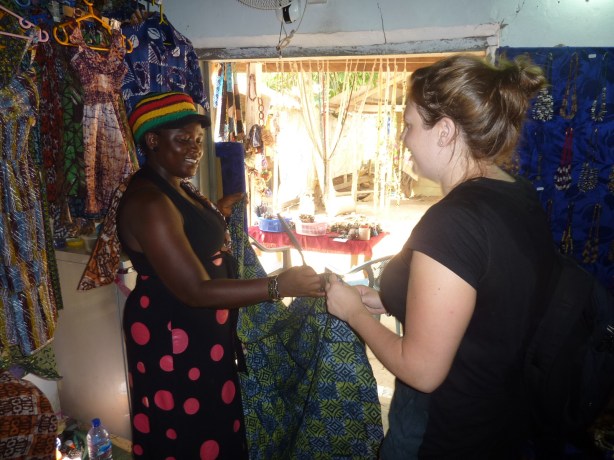
Before retiring at our hotel for the night, Megan bought another 2 yards of fabric from a local woman for sewing blankets at home.
Tomorrow is our last day in Ghana and I’ve been purposefully withholding my best pictures from the blog so that I could do a post showing all of our favourite pictures taken by either Meg or I.
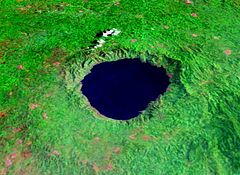
After a couple days lazing around the beach town of Busua, we headed inland to a place called Lake Bosumtwi. Lake Bosumtwi was created by a meteor crash and is about 10 km in diameter.
Google Earth image of Lake Bosumtwi.
The lake is surrounded by 20-some villages each having distinct customs and culture. Its calm, serene atmosphere causes you to forget that only 30 km’s away is the busiest (althought not biggest) city in Ghana; Kumasi (population 1.8 million).
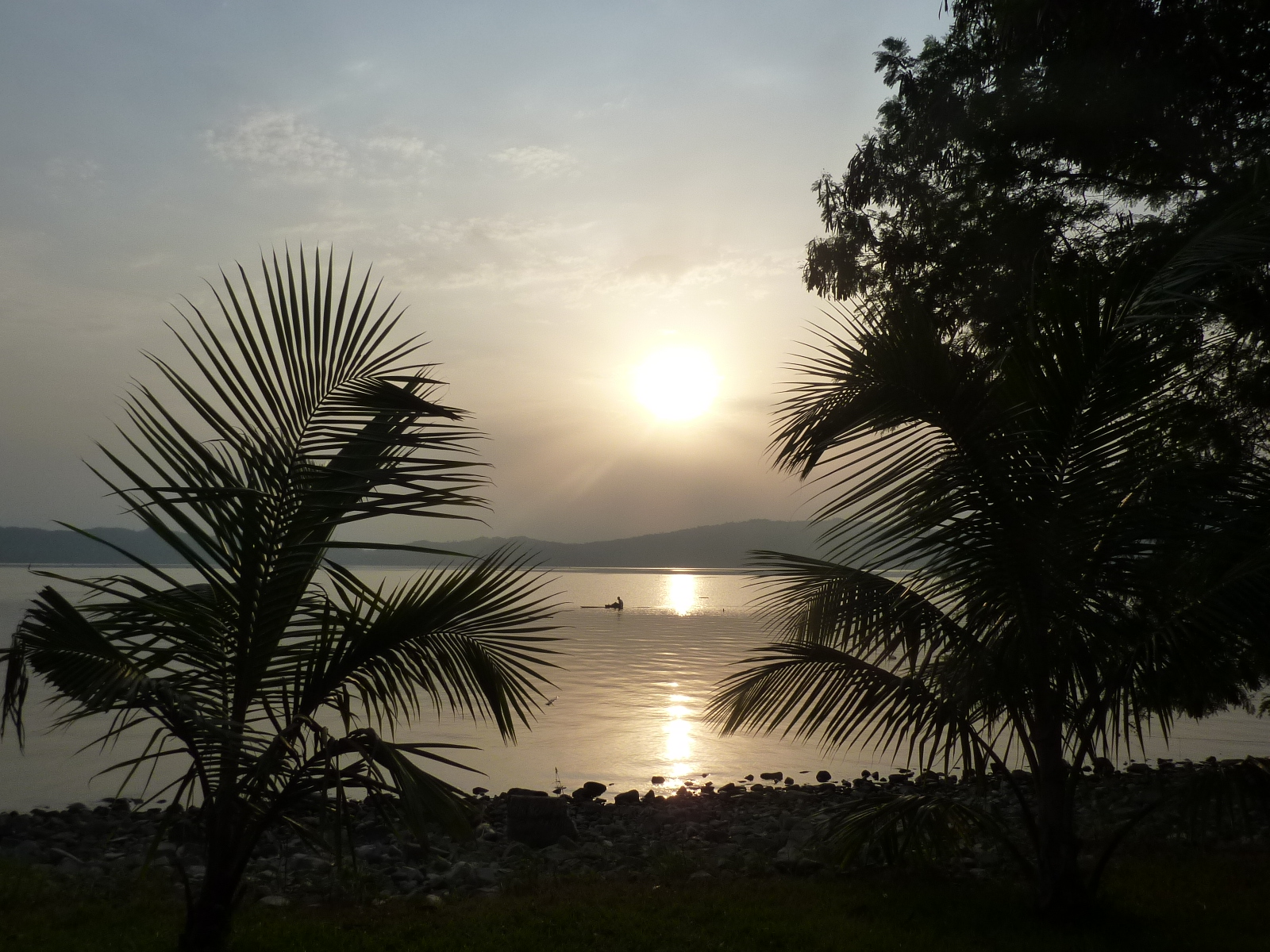
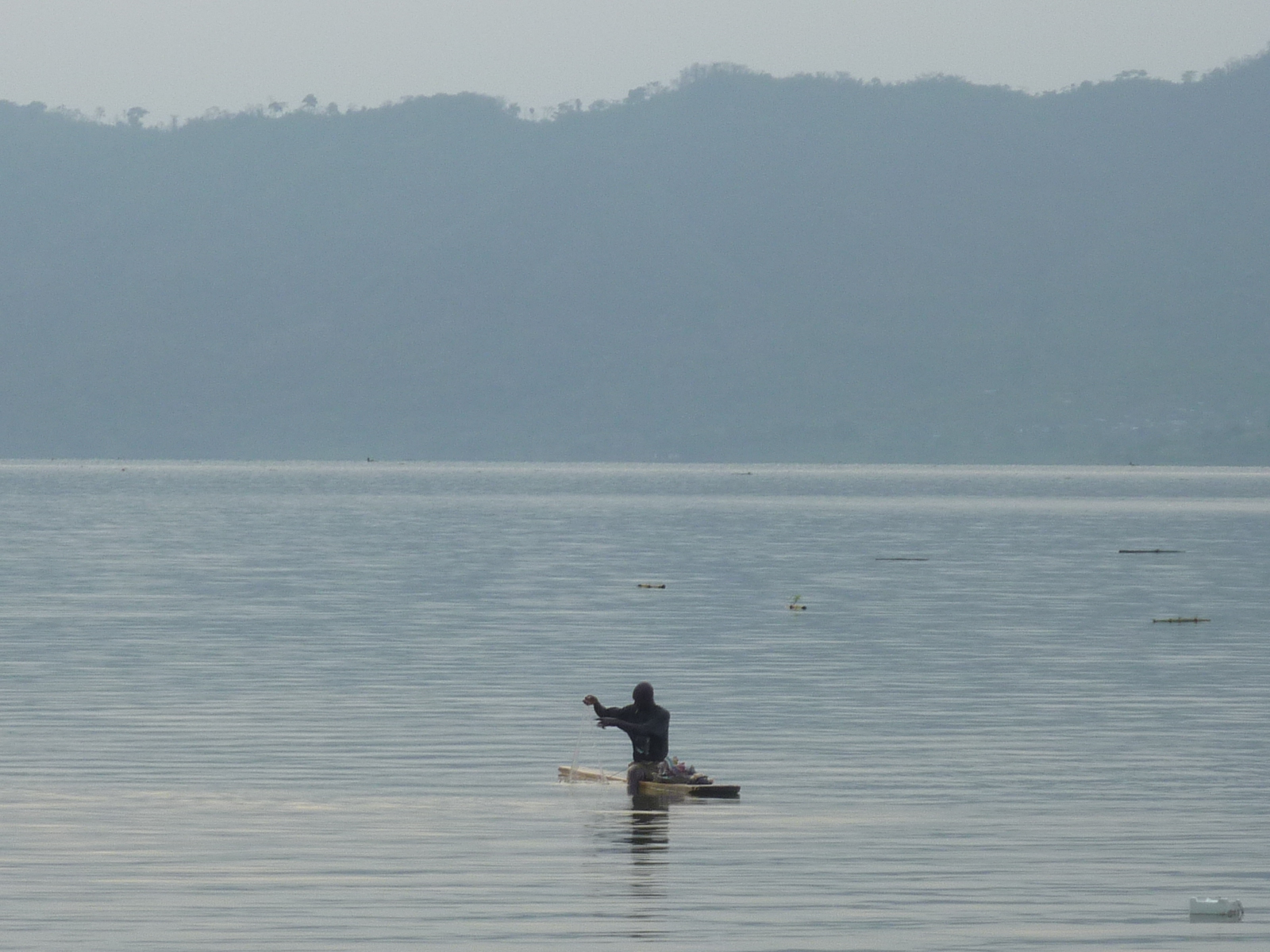
A fisherman checks his nets with the sun rising behind him. Lake Bosumtwi, Ghana.
We woke up early every morning and watched the fisherman scatter throughout the lake without making a sound, checking their nets.
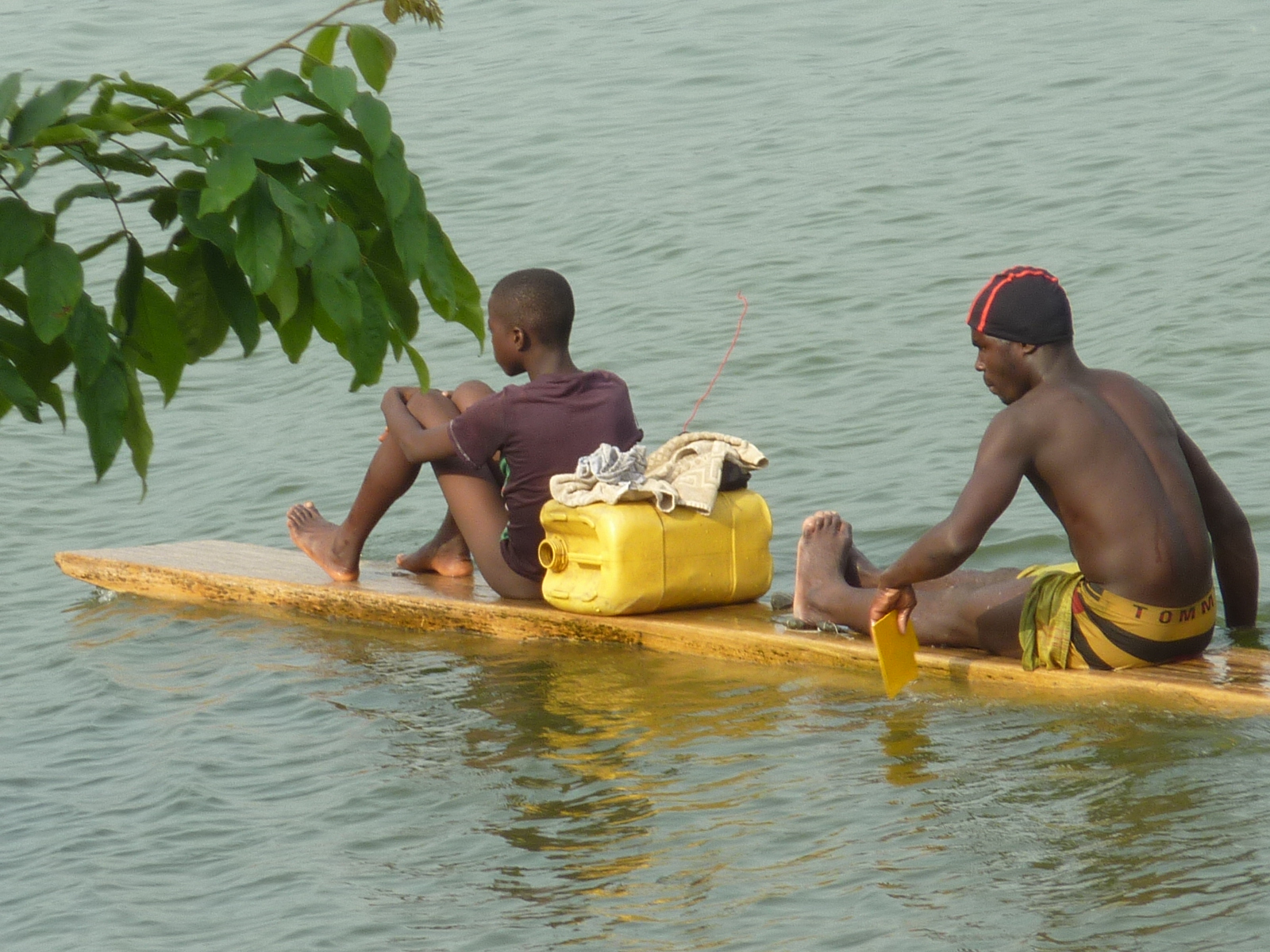
No one is sure why, but no boats are used on the lake. Instead, small logs are modified to sit on and small, dinner plate sized paddles are held by the fishermen who propel themselves manually throughout the lake. (see below)
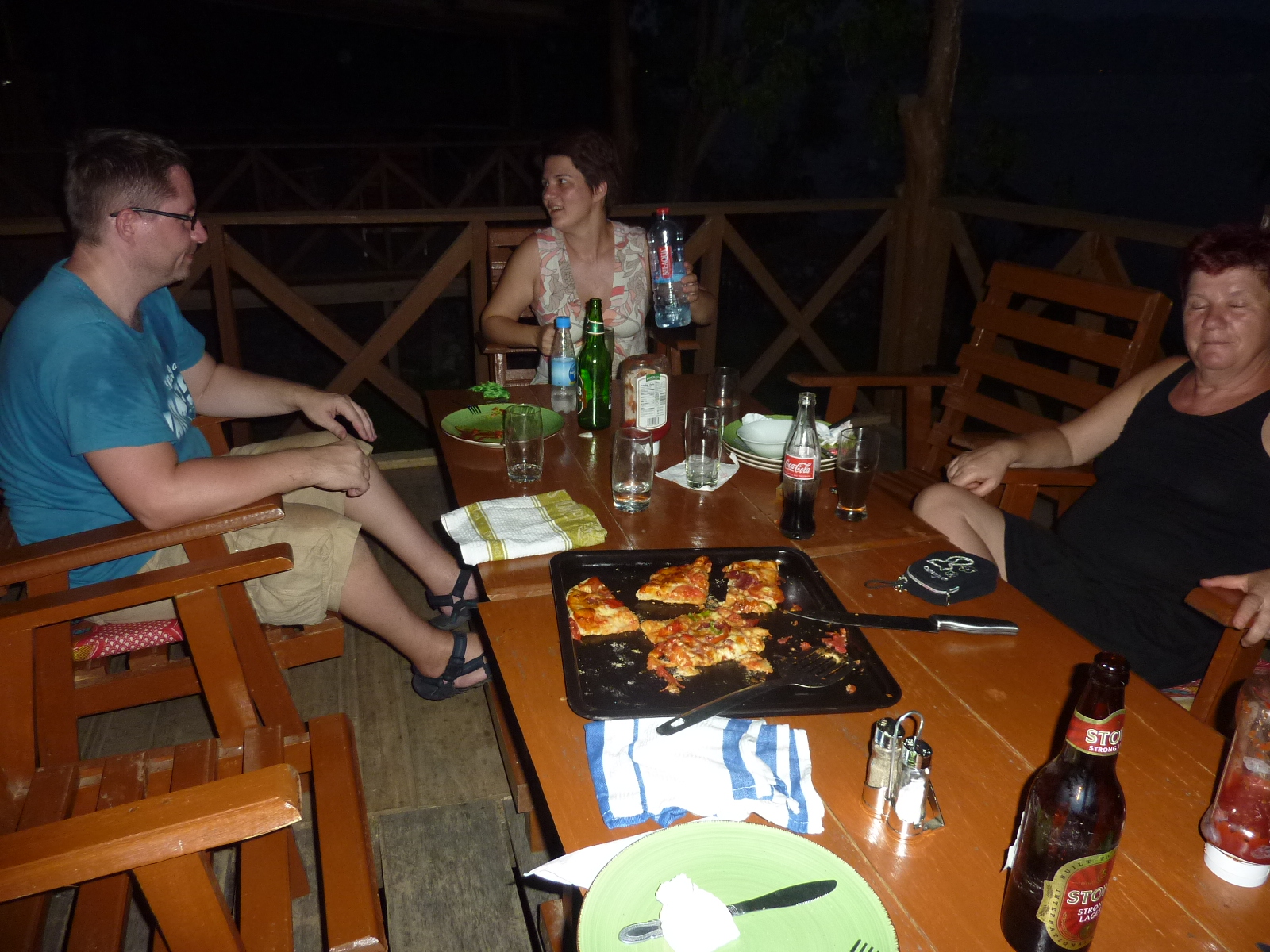
The Slovenian manager of the guesthouse, Joseph, had relatives visiting from Slovenia who cooked us Slovenian foods and made great company for downing a few wobbly pops as the sun was going down.
Slovenian friends from Cocoa Village
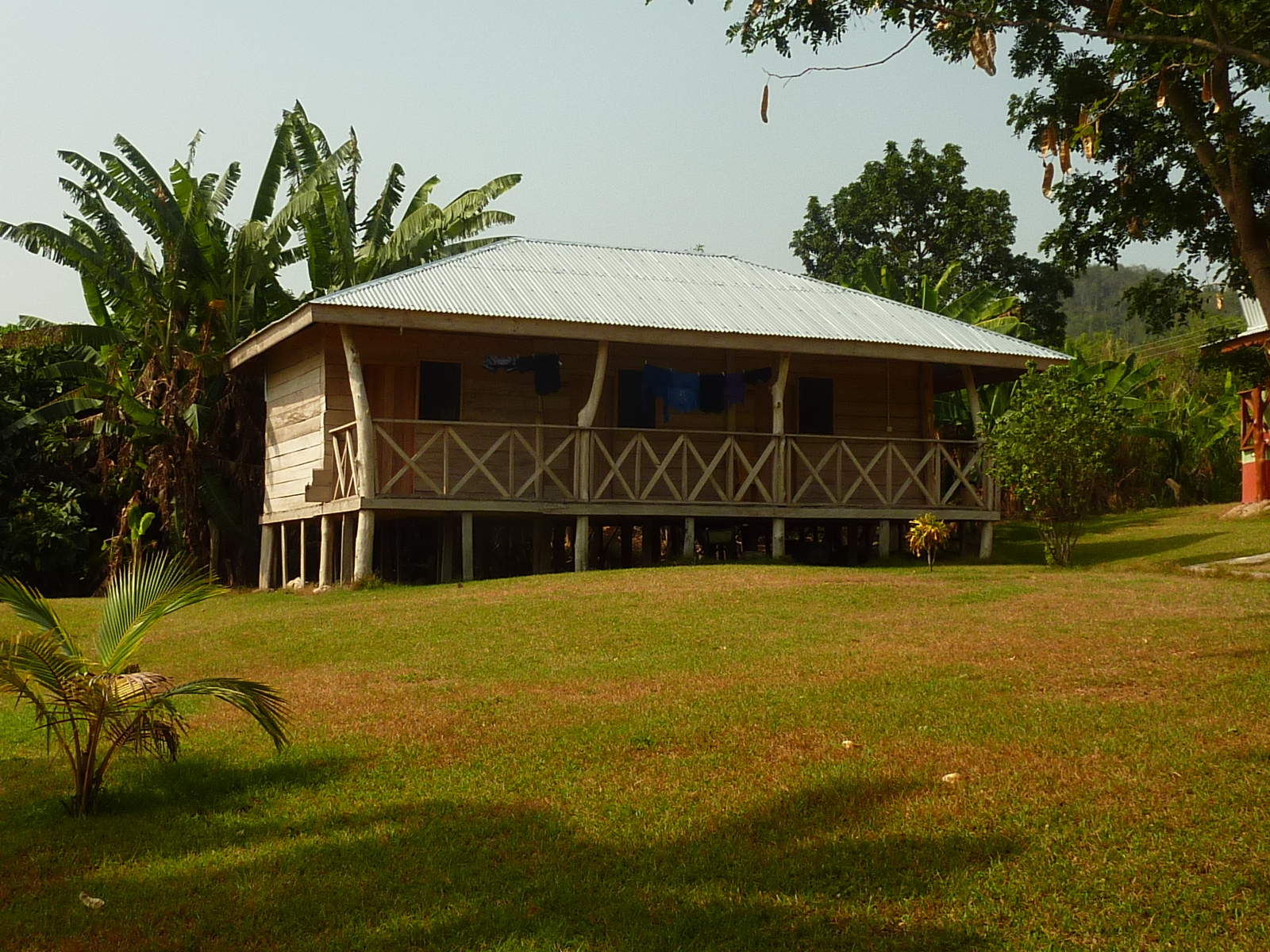
Our dorm room at Cocoa Village, Lake Bosumtwi.
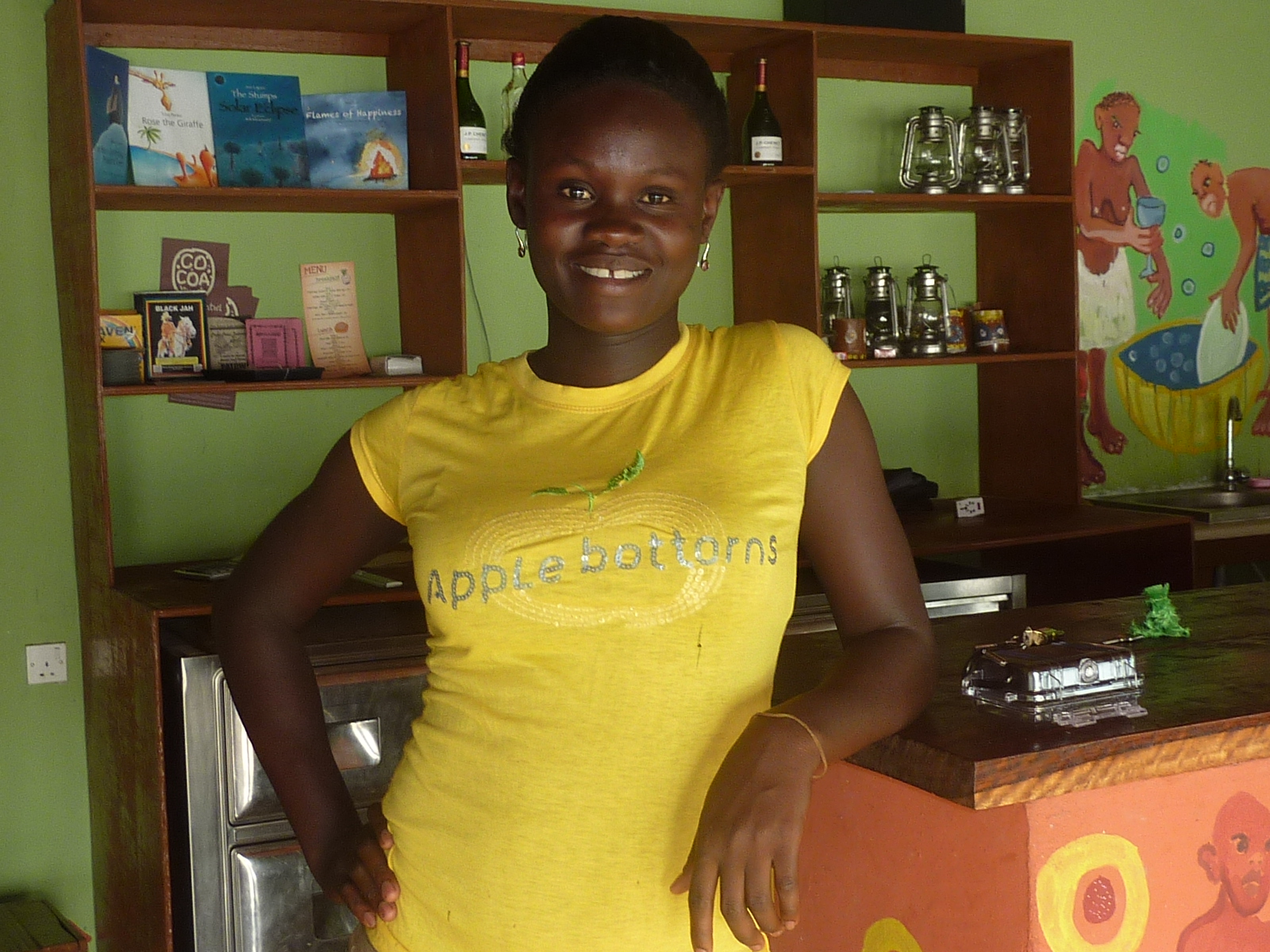
Agusia, staff at Cocoa Village Guesthouse.
Chilling out on the deck with a beer.
Joseph asked Meg and I if we wanted to go into Kumasi with him for supplies. He took us to the largest market in West Africa called “Kejetia”. This time I had to take my camera because this was not to be missed.
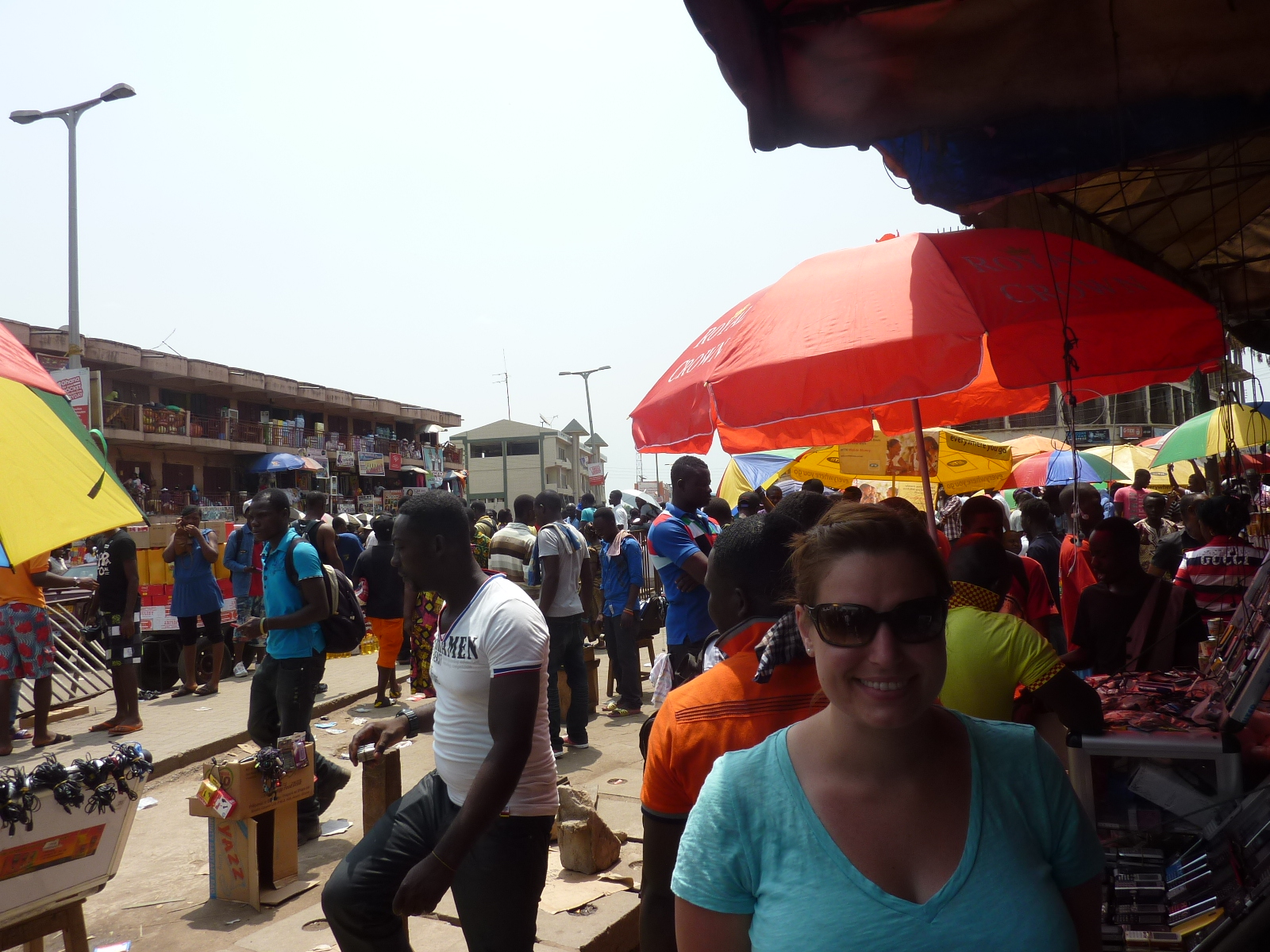
Kejetia Market, Kumasi
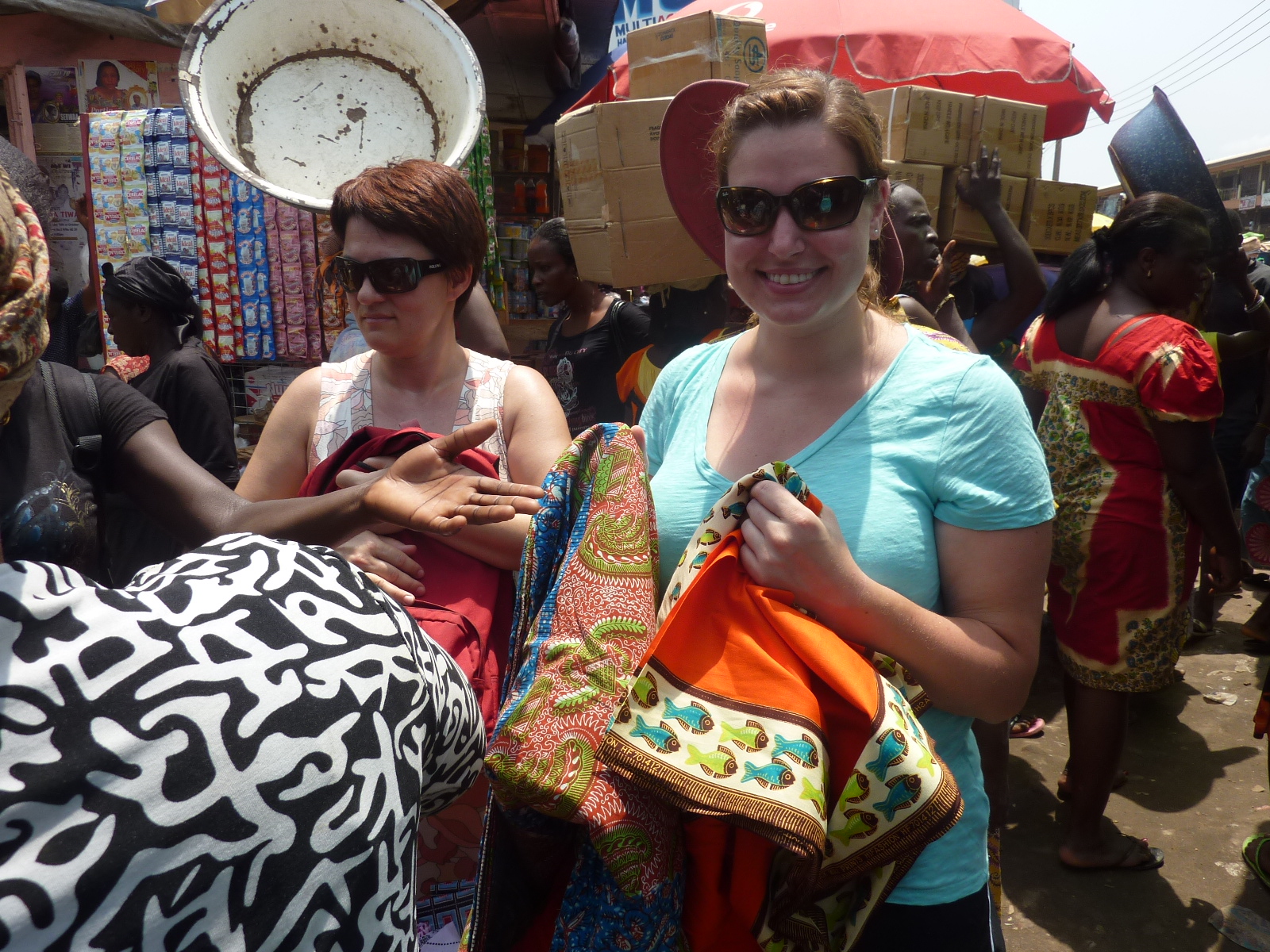
Megan bargaining over some fabric
Merchants packing heavy loads on their heads walk single file like ants through the narrow isles of the outdoor market yelling out the name of their products. I can hear men hollering “big man!” as I pass by, trying to get my attention. We follow Joseph and Agusia thorughout the winding market as they bargain for flour, fruit, bread, beer, and other supplies. Joseph uses Agusia for bargaining at the market since the merchants will give a local woman a better price than a white skinned person. Some of the merchants appear to be pissed off that Agusia is doing our bidding for us (because it cuts down on their profit of course). At one point a stampede of 5 women breaks out and the baskets on their heads go flying. One woman looks at me and yells “WHY WHY WHY!”. I am puzzled as to what the hell just happened.
Man, I really want to upload a video of this market but these Ghanaian computers are just too damn slow.
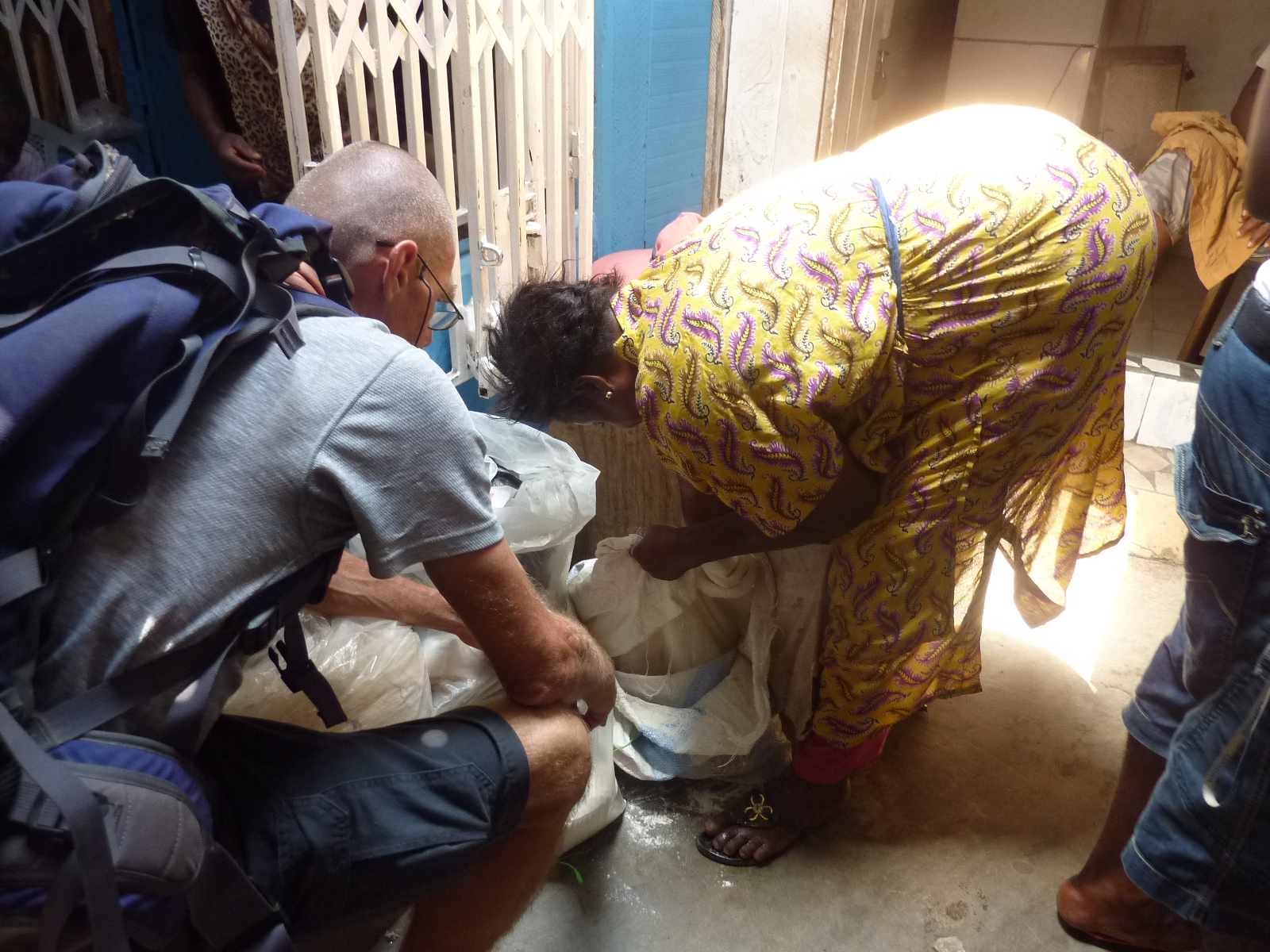
A woman called “Big Mama” scoops out some flour for Joseph
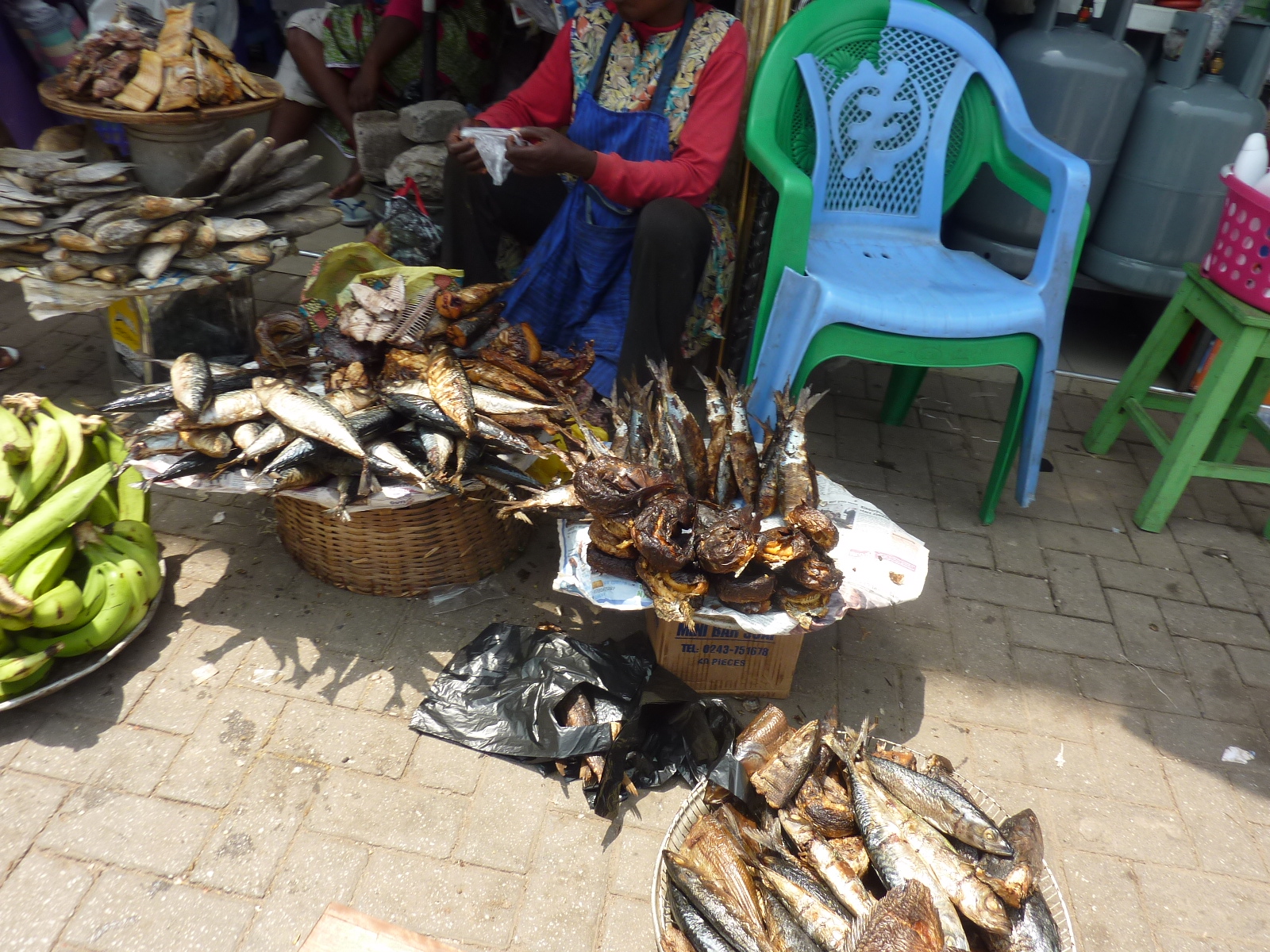
Fish and other meats sit out in the sun all day waiting for a buyer.
Billboard at the market. Just a friendly reminder…
After the market we returned to the lake and and went for a swim before we visited the local Rastafarian complex near the guesthouse. The leader of the rastas is a man called Anche who is a very good friend of Joseph.
Megan looks like she’s leaving me for the rasta man in this pic. I don’t blame her.
I have to admit. This guy had a presence about him that I can’t explain. An aura almost. Anche was extremely well educated and filled us in on exactly what it means to be a Rastafarian. I had no idea about the foundations of the religion or the strict rules involved. Strictly vegetarian, Absolutely no harm to any human or animal, no alcohol, no cutting of hair or beards, etc. It was a fascinating talk. What a guy.
After ending our stay at Cocoa Village, we took a tro tro to Koforidua.
I snapped this pic of the dash of our tro tro
The dash is torn out/melted, no cover on the fuse box, no gas pedal (just a metal rod instead). They literally drive vehicles here until they die. I’m pretty sure this scene was filmed in Ghana:
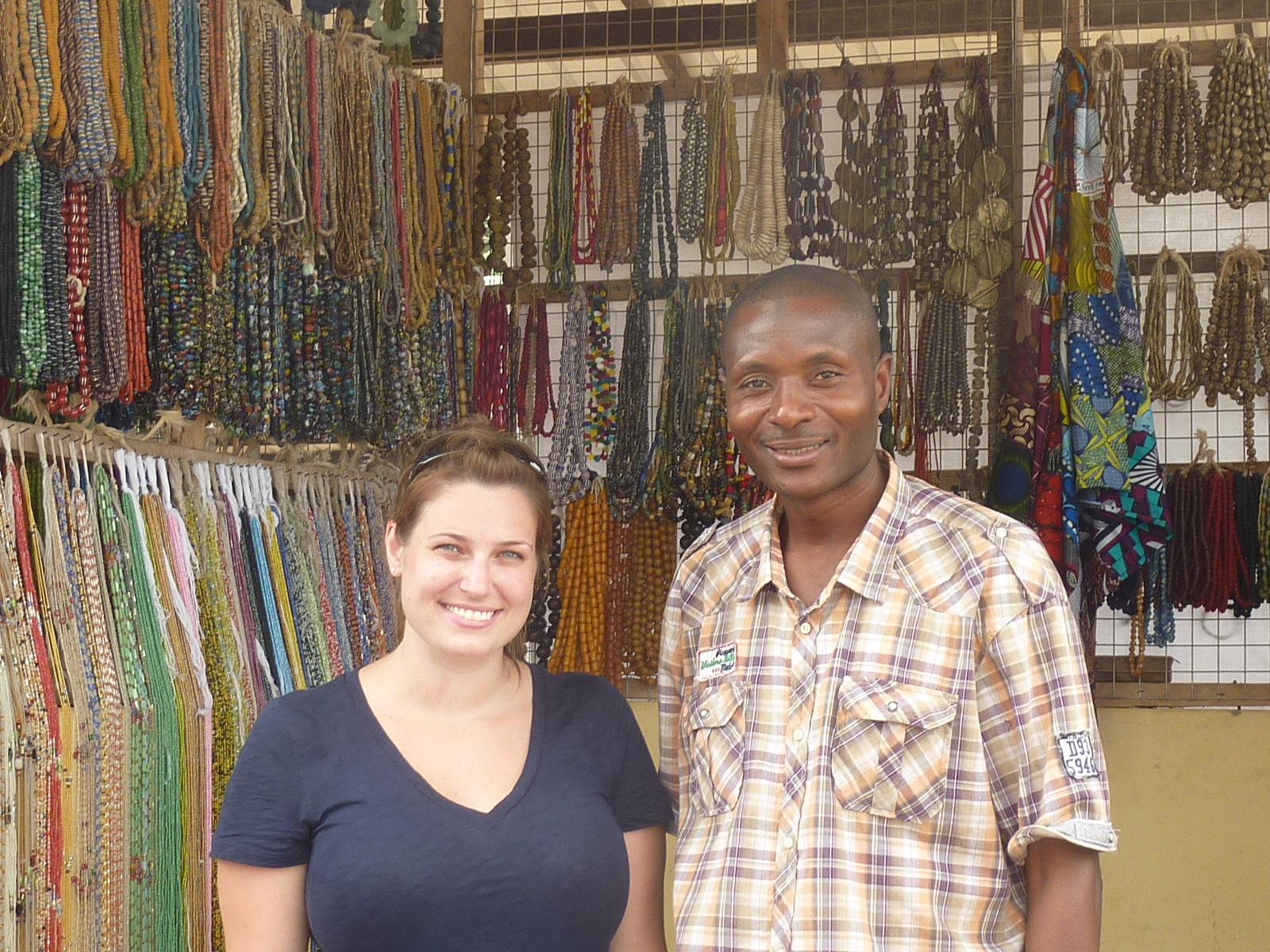
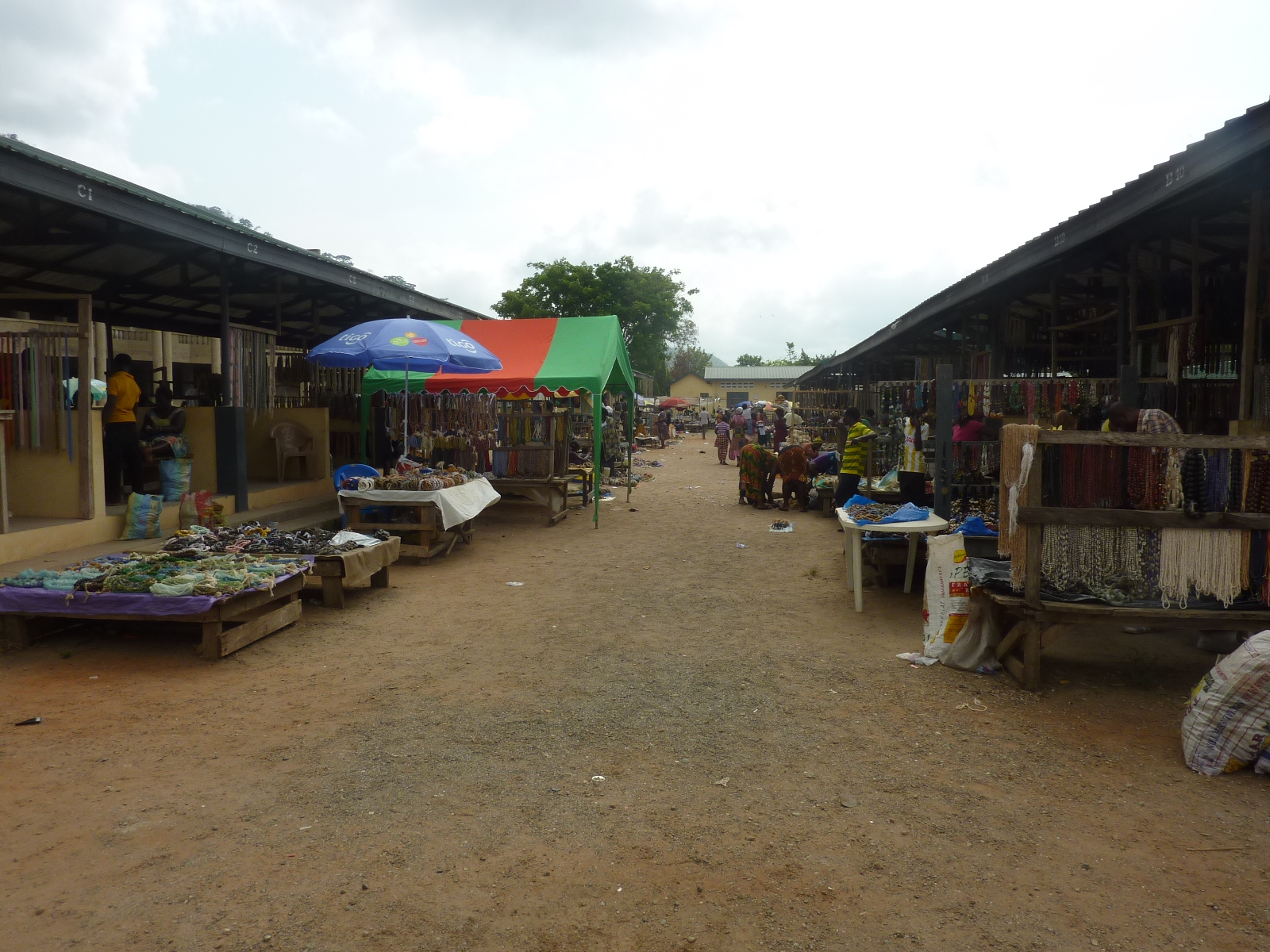
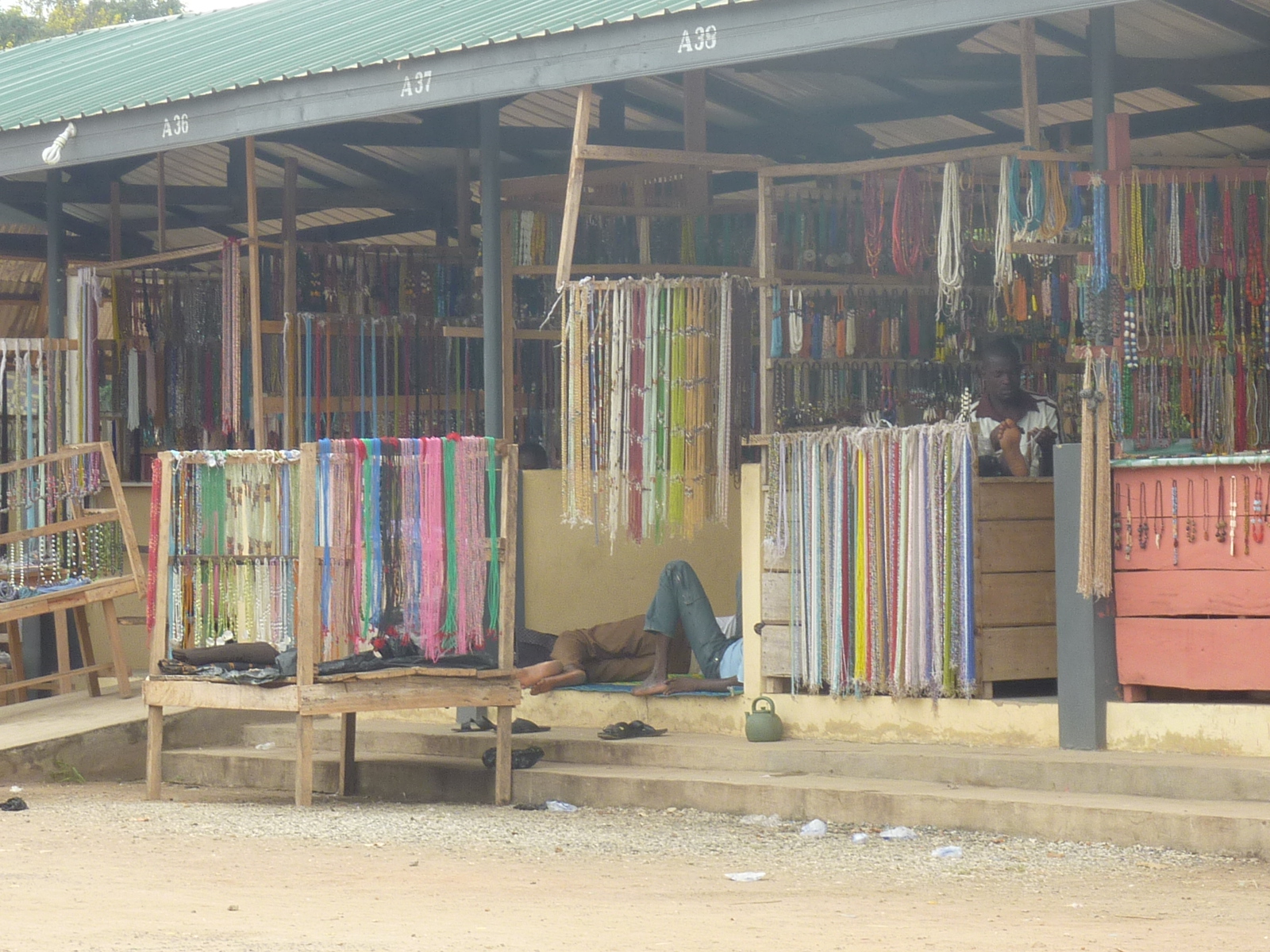
Koforidua is home to the Thursday bead market. The largest in Ghana (the size of a soccer field) and maybe the world. Ghana is famous for its bead making (we actually got to visit a family bead making business which I will blog about at some point) and we took the opportunity to pick up some souvenirs and browse the colorful collection of beads for the morning.
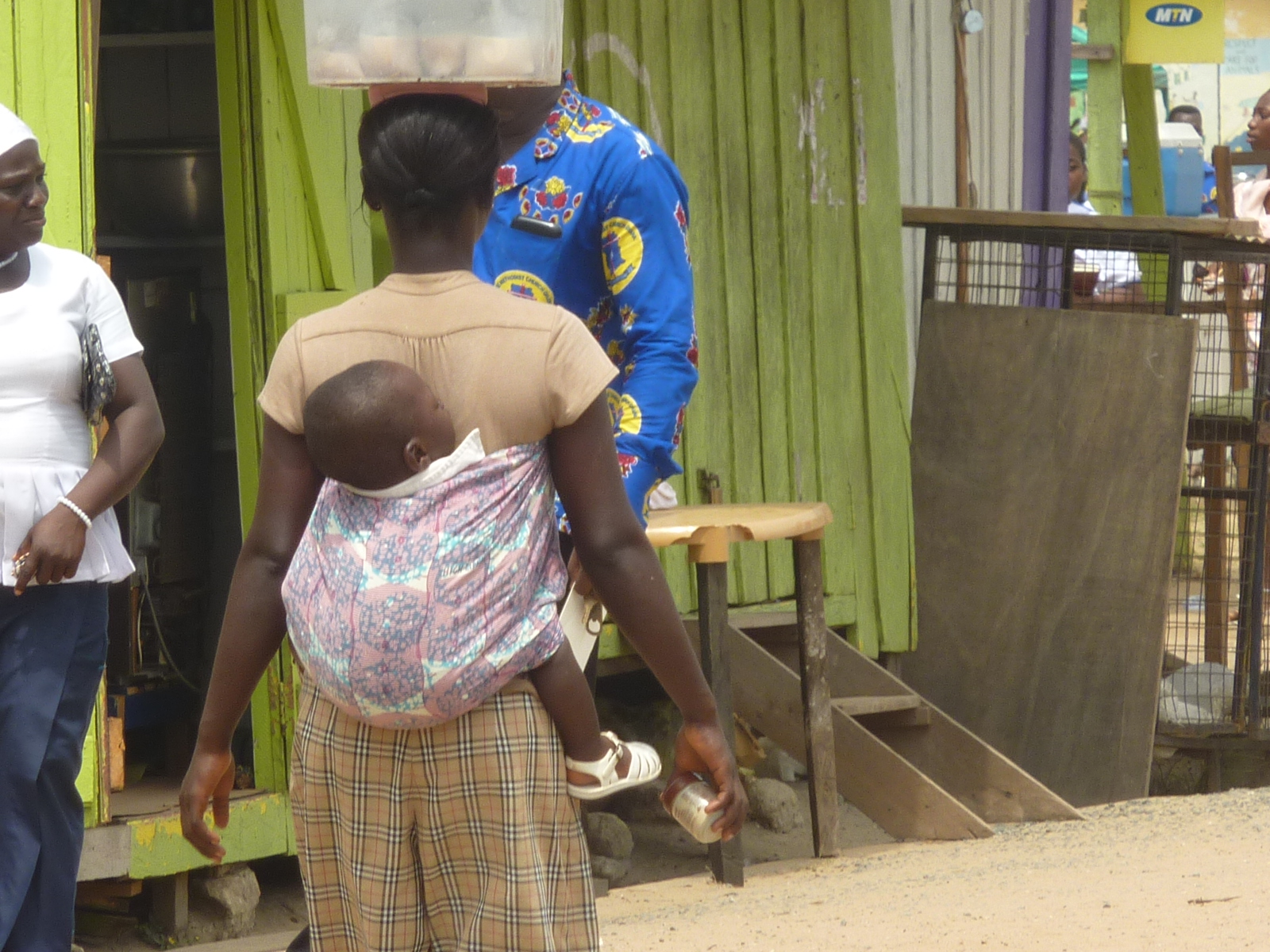
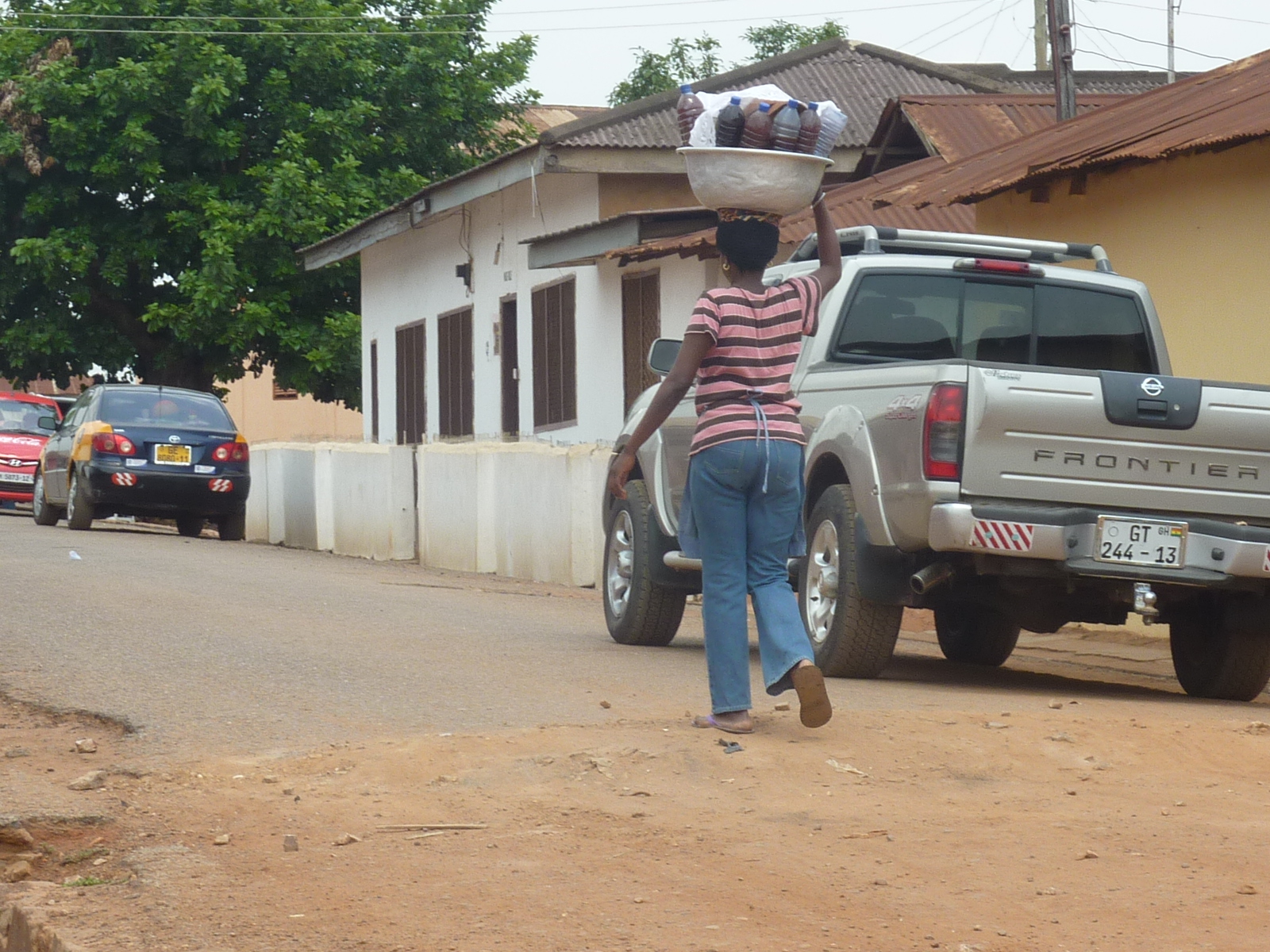
We watched a young girl of about 11 years old-ish get her father to help her lift a 5 gallon jug of water onto her head and she balanced it on her head all the way back to her house. Let me repeat: she couldn’t lift in onto her head but she could balance it while walking all the way back to her house.
Meg says “I think any person that hasn’t grown up packing these things on their head would have a compression fracture in their neck”.
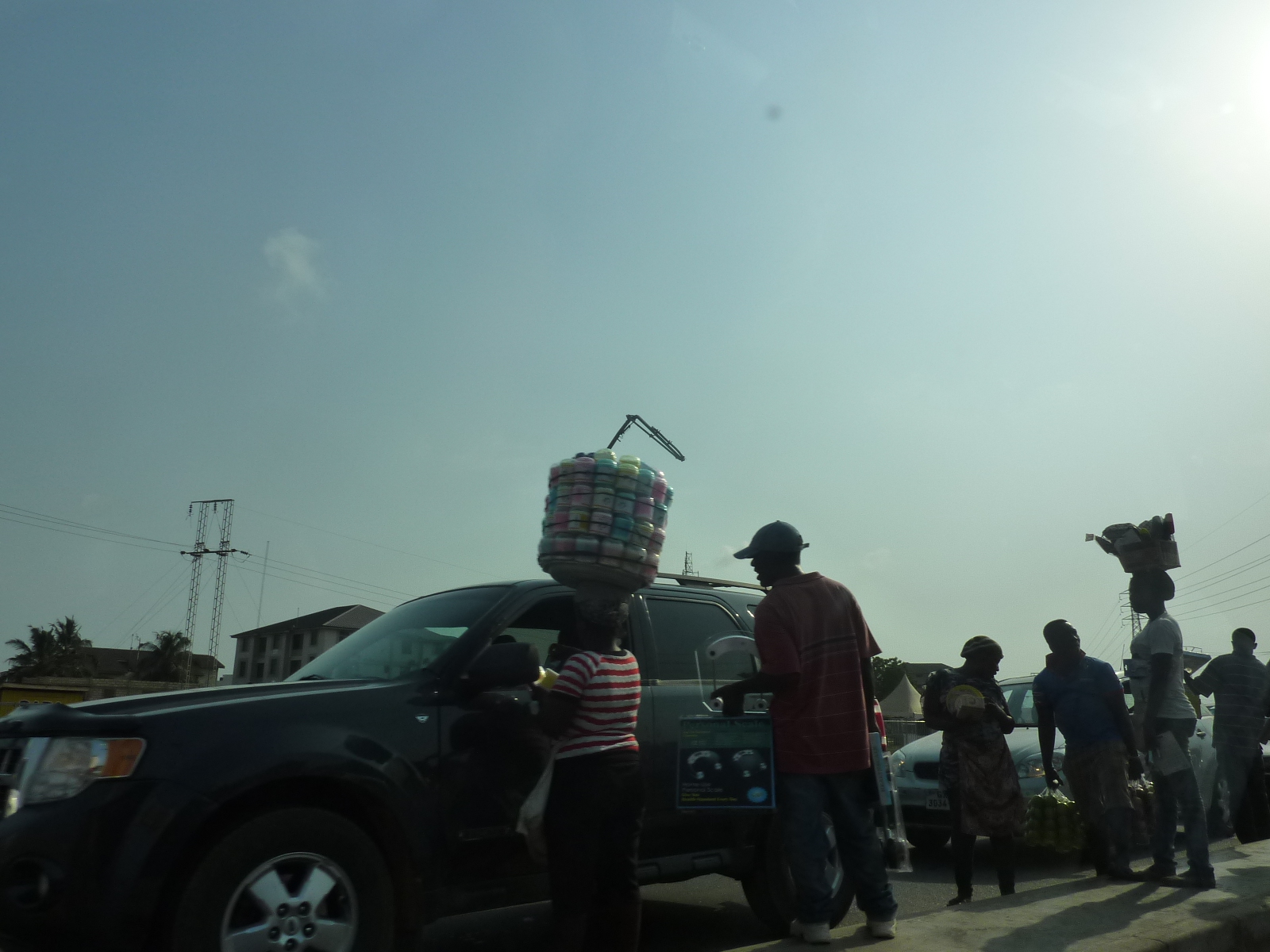
2. You can buy anything you want when you’re stopped at an intersection.
You stop for 1 second and flocks of vendors approach the vehicle selling their wares. Lighters? Bananas? Water? Super Glue? Handkerchiefs? Whatever you want – you can find it. Some of the fastest transactions I’ve ever seen happen through the window of a vehicle. It’s a mad scramble and somehow when the dust settles everyone has what they want and has the correct change.
3. “Lights out”.
Due to increasing power demands and a lack of power, Ghana has frequent power outages. You never know when you’ll be sitting at a computer and it suddenly shuts down or you’re on the toilet and suddenly you’re taking the browns to the superbowl in the dark. It’s something you get used to.
4. Water satchets.
Due to a lack of clean drinking water, everyone drinks out of plastic bags full of water called water satchets. Imagine the litter created by millions of people drinking these satchets every day. It’s an environmental nightmare. To make matters worse, Ghana doesn’t do much recycling to put it mildly.
5. Hissing.
Want the attention of you’re friend? A shopkeeper? A waiter? Hiss at them. Loudly. Like a giant snake. Somehow it works. Bizarre.
6. Religion is everywhere!
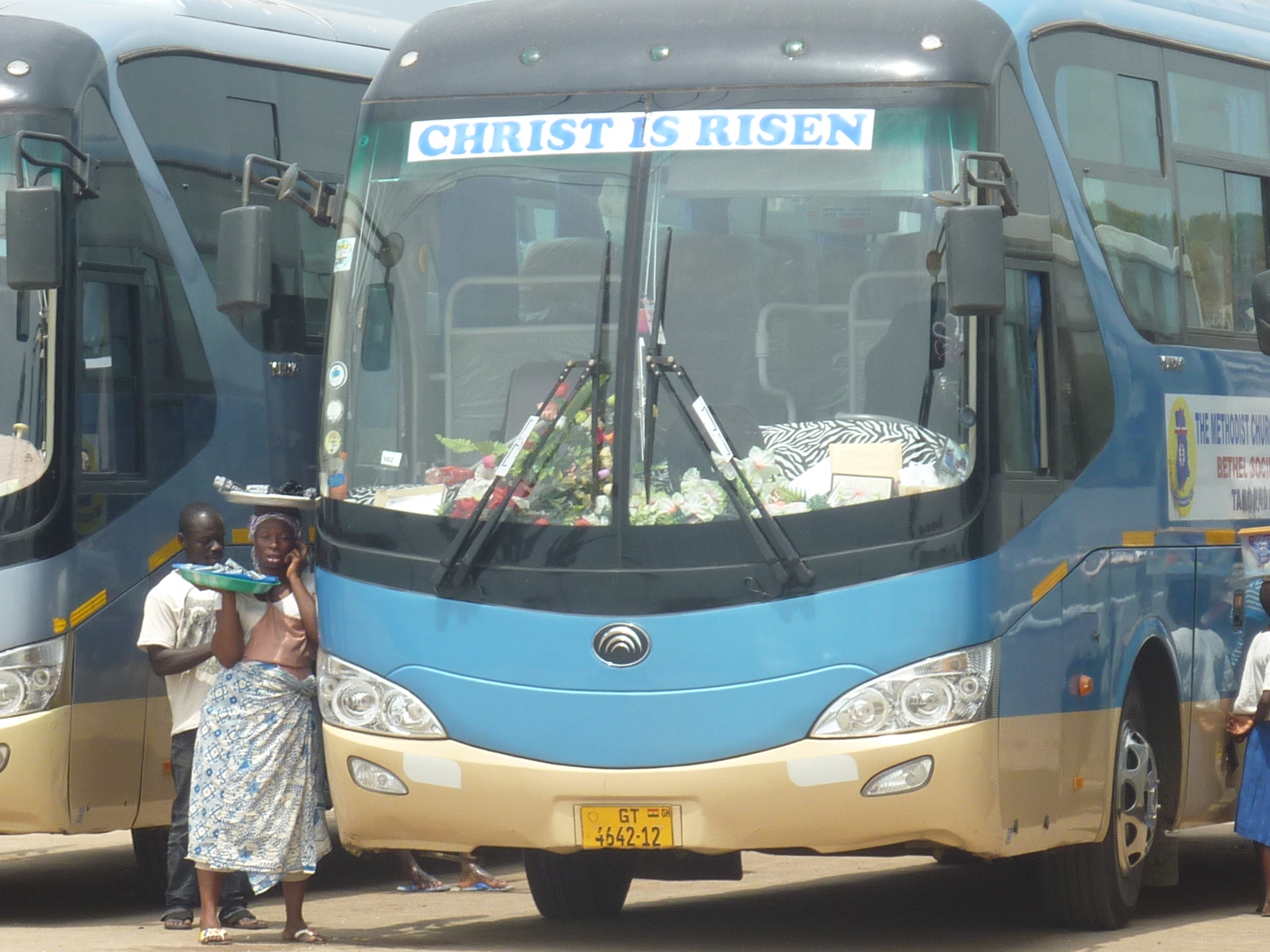
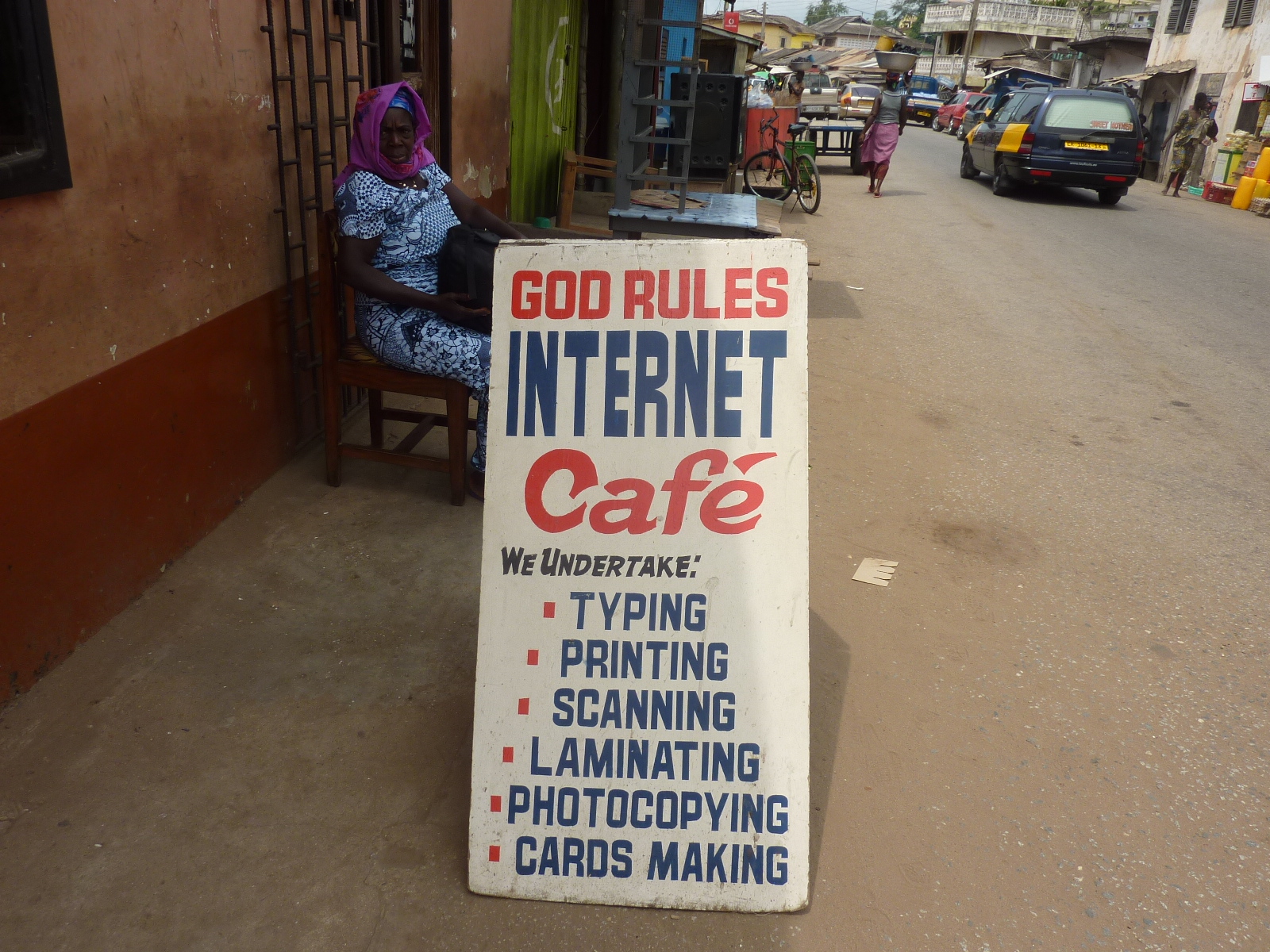
I know I’ve said this before but I can’t get enough of it. I would estimate that the majority of businesses are named something about God. “Jesus Loves Fashion”, “Truth in Prayer”, “Holy Ghost Shoemaker”. It puts a smile on my face. I could read the shop names all day.
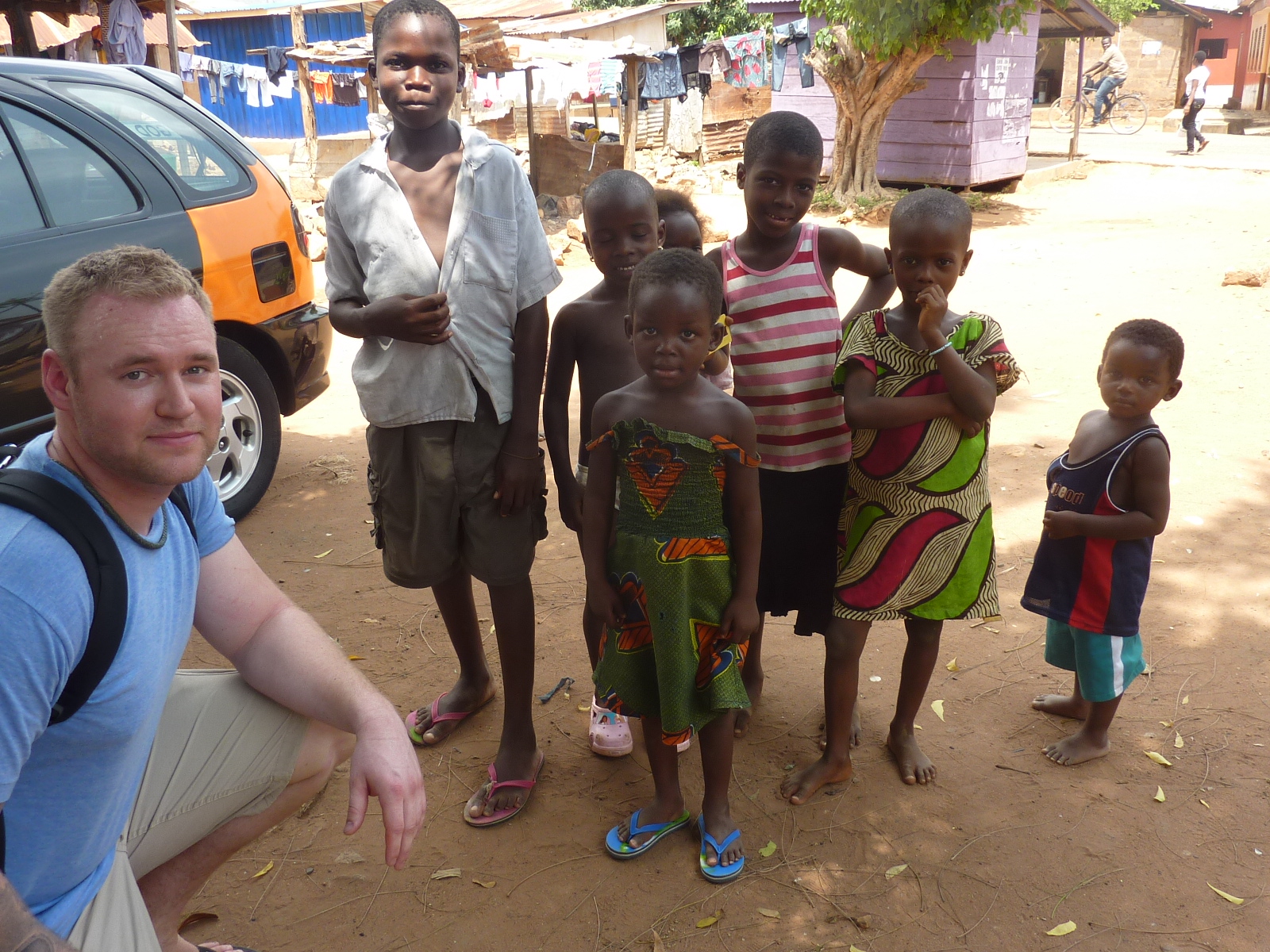
7. Children flock to you yelling “Obruni”
Young kids love to meet foreigners or as they are called here “Obruni’s”. It a common occurrence to have a mob of kids approach you yelling “Obruni!” The kids are so damn cute though.
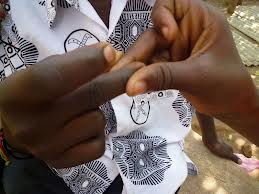
8. The handshake.
When a man greets a man, they do so by shaking hands followed by snapping each others fingers like shown in the pic above. It takes a few times to get the hang of it but I’ve got it now.
9. Cities and Towns are chaotic
Elmina, Ghana (Feb 22, 2013)
Ghanians are passionate and loud. When you put a thousand of them on a busy street, everywhere you look is a soap opera. Sometimes I genuinely can’t tell if two people are mad at each other or if that’s just the way they talk.
10. How full can you stuff a tro tro?
Meg and I are slogging down the road in an old tro tro stuffed with people and products. I am wedged in between Megan and a 40 year old local woman who is loudly yelling at her mobile phone (I wanted to use my Grandpas’ line “Put down the phone, I think they can still hear you”). Under my feet is a truck tire and an aluminum basket. On my lap is my backpack. Behind us is 2 bunches of bananas, our large backpacks, water basins, and a couple large white sacks of anonymous goods.
“GOOD. We’re FINALLY full. Now we can make some miles! ………. Wait….. we’re not stopping for those people are we? I don’t believe it…..”
Just when you thought they have stuffed as much as they can into a tro tro, you have your mind blown when they stuff two more people, a couple chairs, a goldfish, and a kitchen sink into the tro tro.
I haven’t seen this yet but I think it’s a definite possibility.
From the 15th century to the 19th century, the colonial powers of Portugal, England, and Holland fought over Ghana. Why?
Gold and slaves mainly.
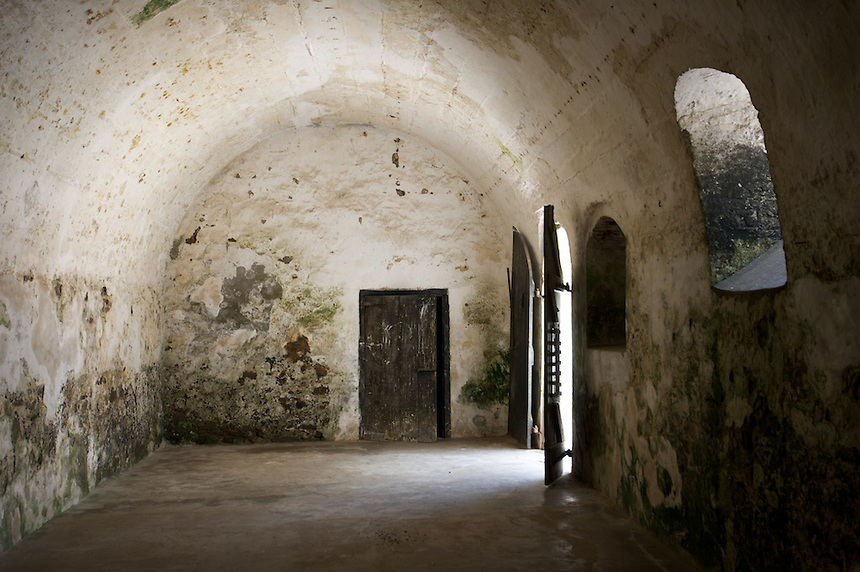
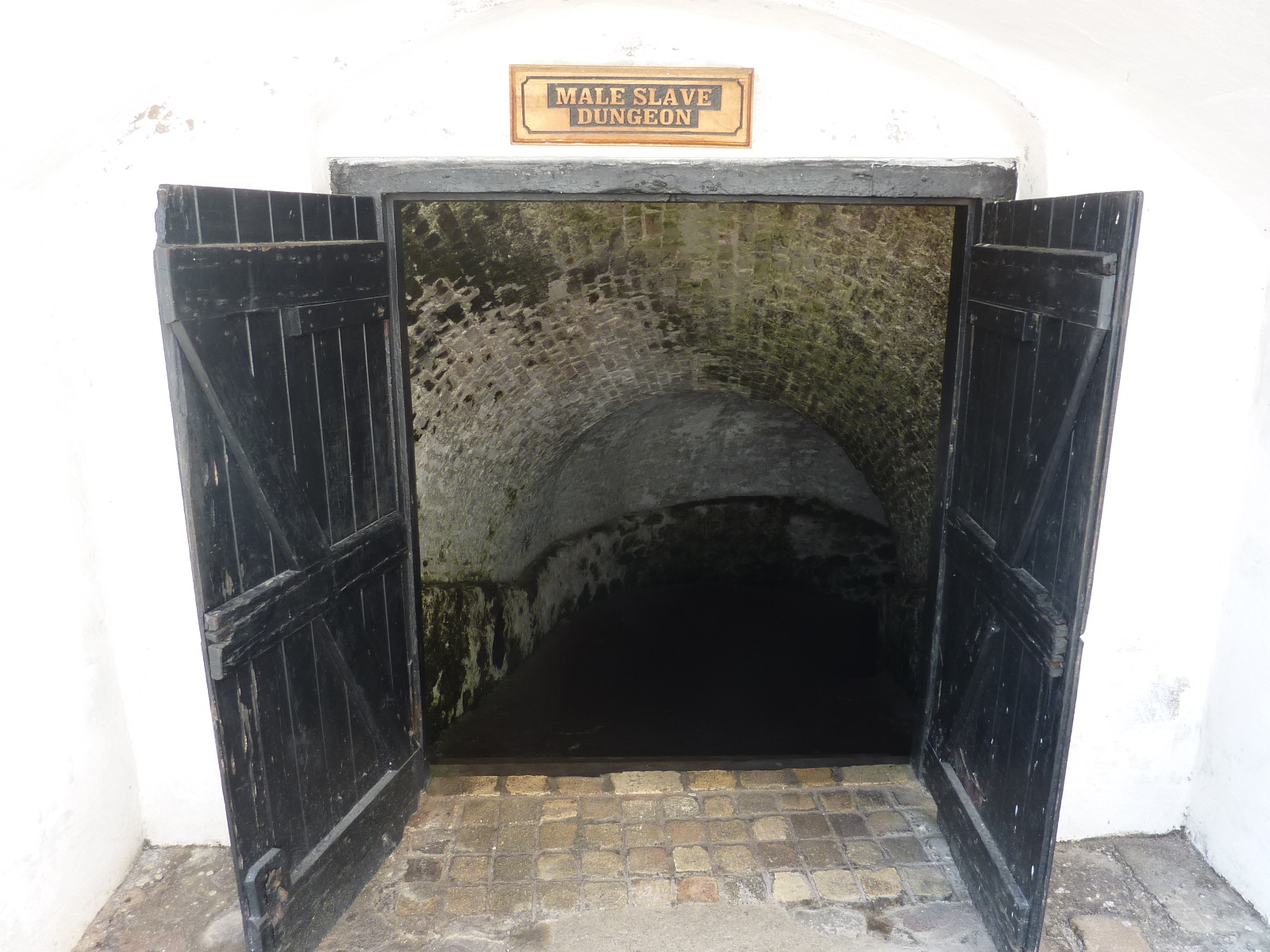
Men and women from all over West Africa were captured and marched (with little or no food/water) to castles on the coast of Ghana, where they were held in appalling conditions until they were shipped overseas as slaves.
Slave holding cell, Elmina Castle
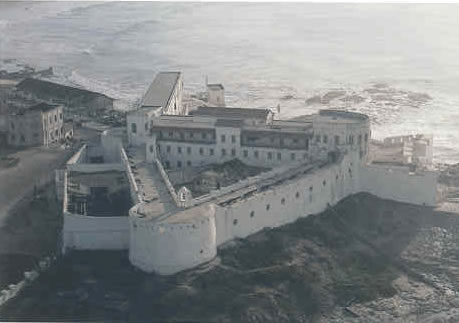
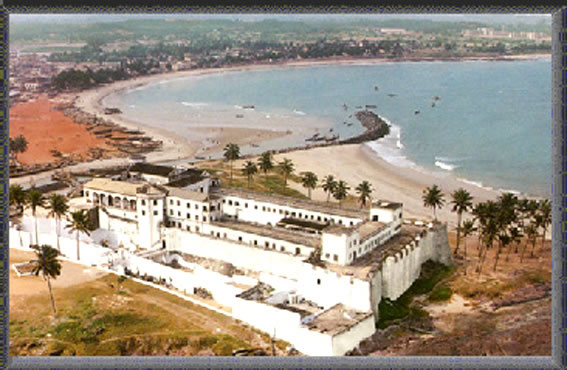
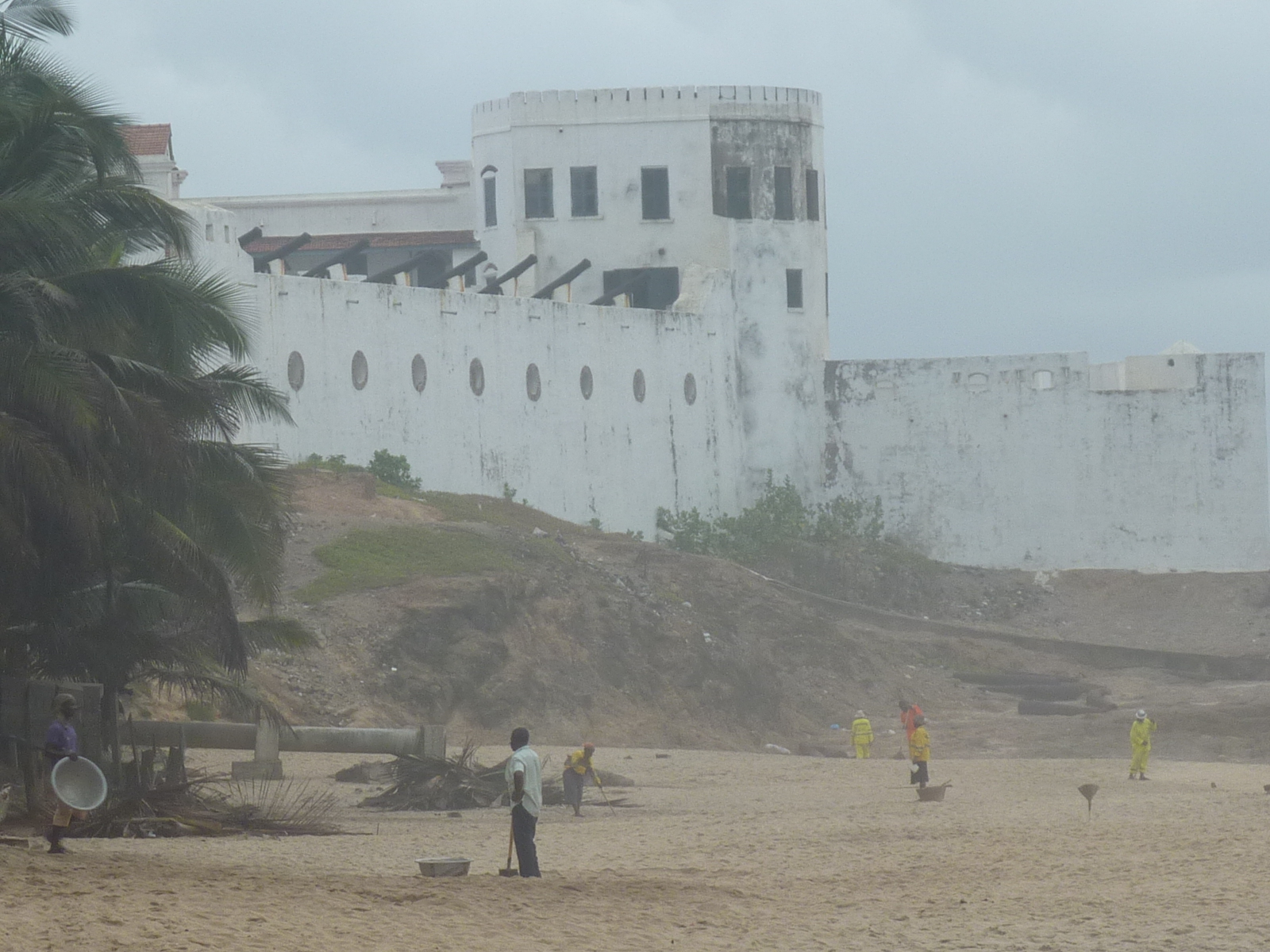
Over the past few days, Meg and I had the opportunity to visit both of those historic castles. Elmina Castle and Cape Coast Castle.
Cape Coast Castle
Elmina Castle
It was a sobering reminder of a dark past that really wasn’t that long ago when you think about it. Slavery was abolished by most countries in the early 19th century.
“If these walls could talk” I was thinking as I walked through the dungeons. 600 male slaves and 400 female slaves at a time could be held at the castle at a time – that is until a ship came in to take some away. Many of the slaves died from disease in the holding cells from living in their own fecies and urine with little ventilation in the cells. Other slaves tried to fight back against the soldiers by bashing them with their shackles and chains – These slaves were used as an example. They were chained in the main square of the castle and starved to death in plain sight of the other slaves.
So how in the world did the Europeans gather all these millions of slaves around West Africa. Are you ready for this? They didn’t.
They simple traded material goods like gin, wine, tobacco, guns, ammo, etc. to regional chiefs in exchange for the slaves. Most of the slaves were actually gathered by fellow Africans and transported to the castles by fellow Africans who would then collect their payment.
According to our tour guide, most of the chiefs didn’t know that these slaves were going to be transported across the Atlantic Ocean and forced into manual labour for the rest of their lives.
Actual shackels and chains used in Cape Coast Castle.
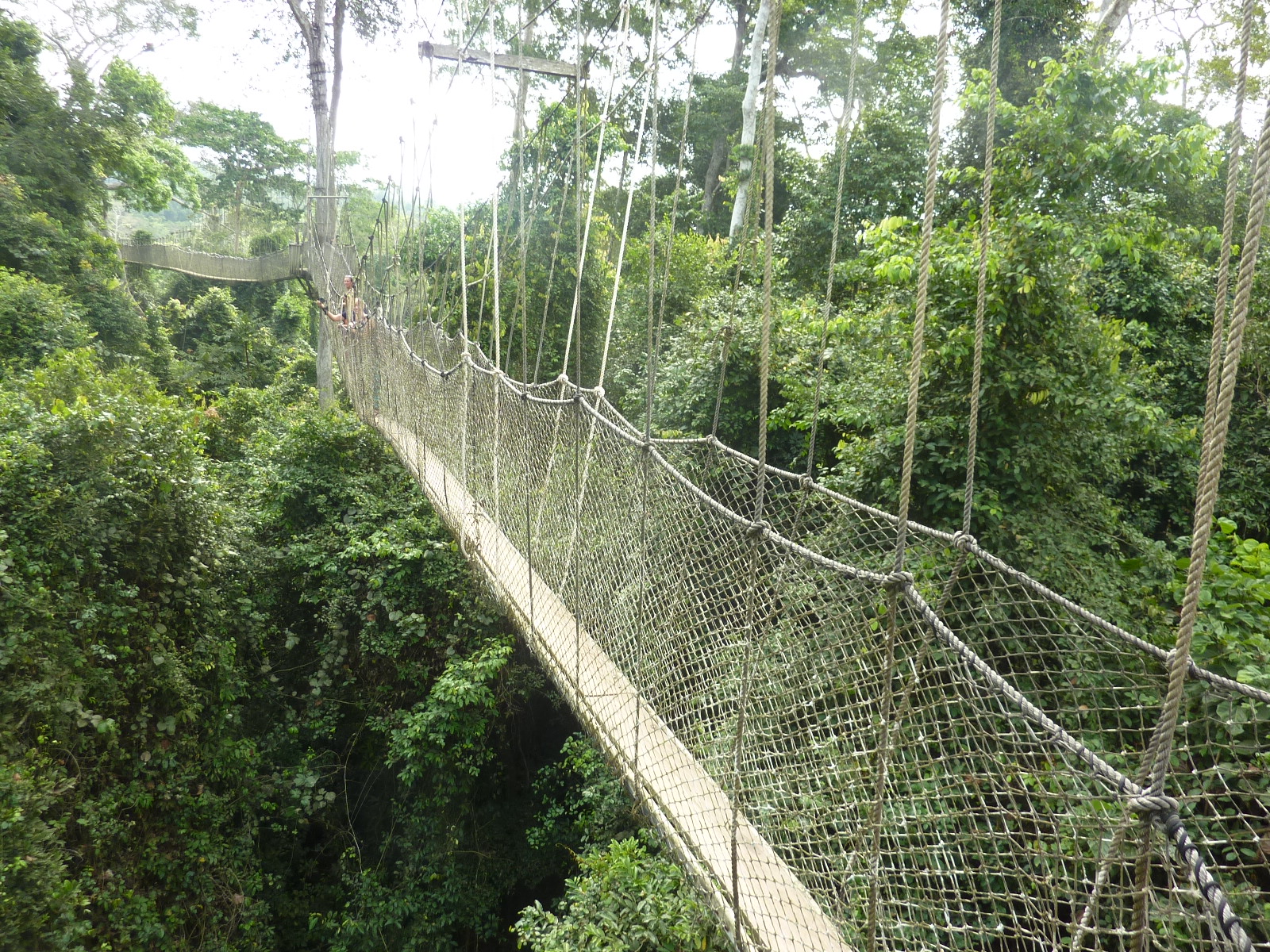
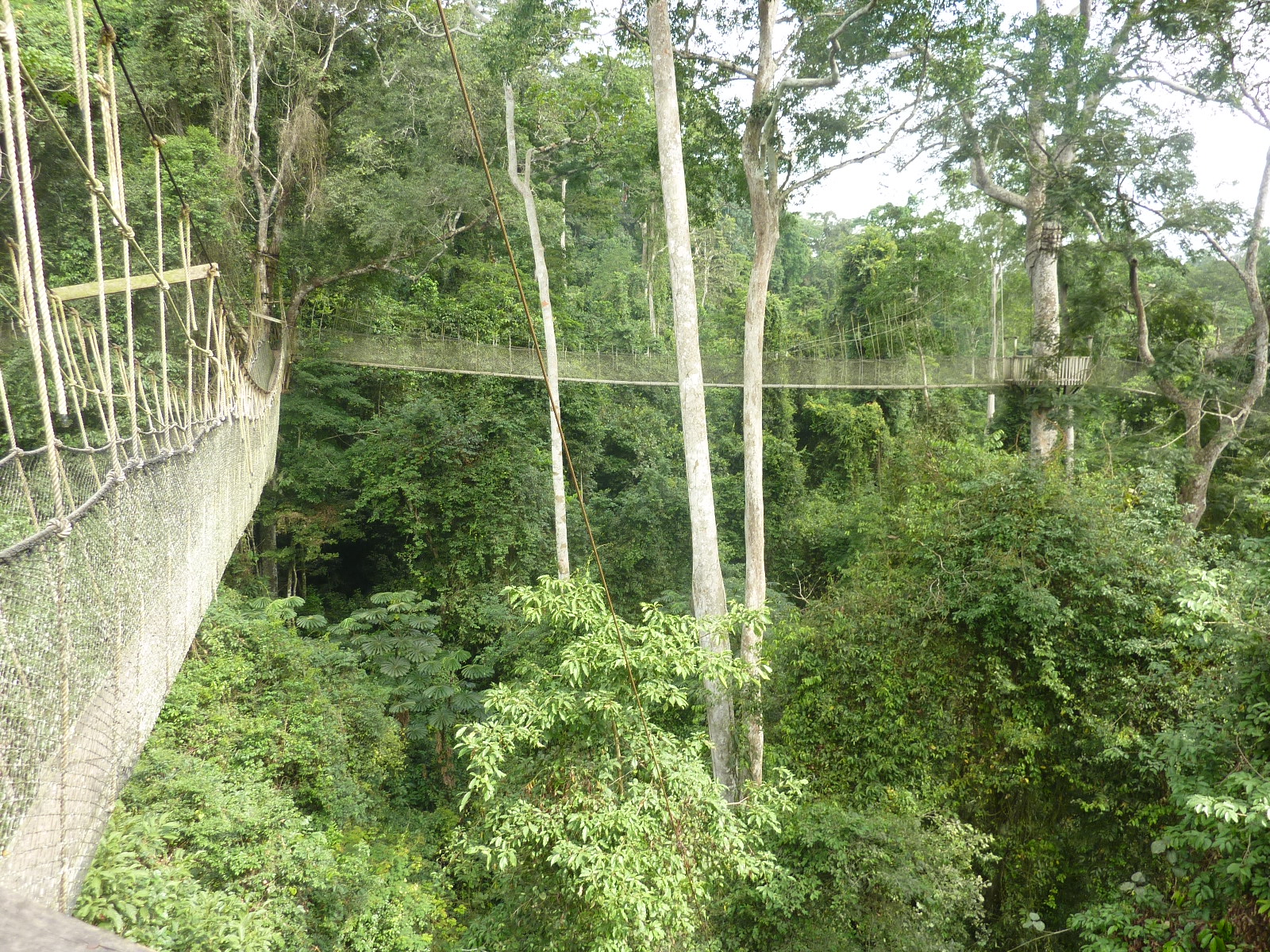
The next day we visited Kakum National Park where 2 Canadian engineers (from Vancouver actually) designed and built a canopy walkway high in the rainforest in 1995.
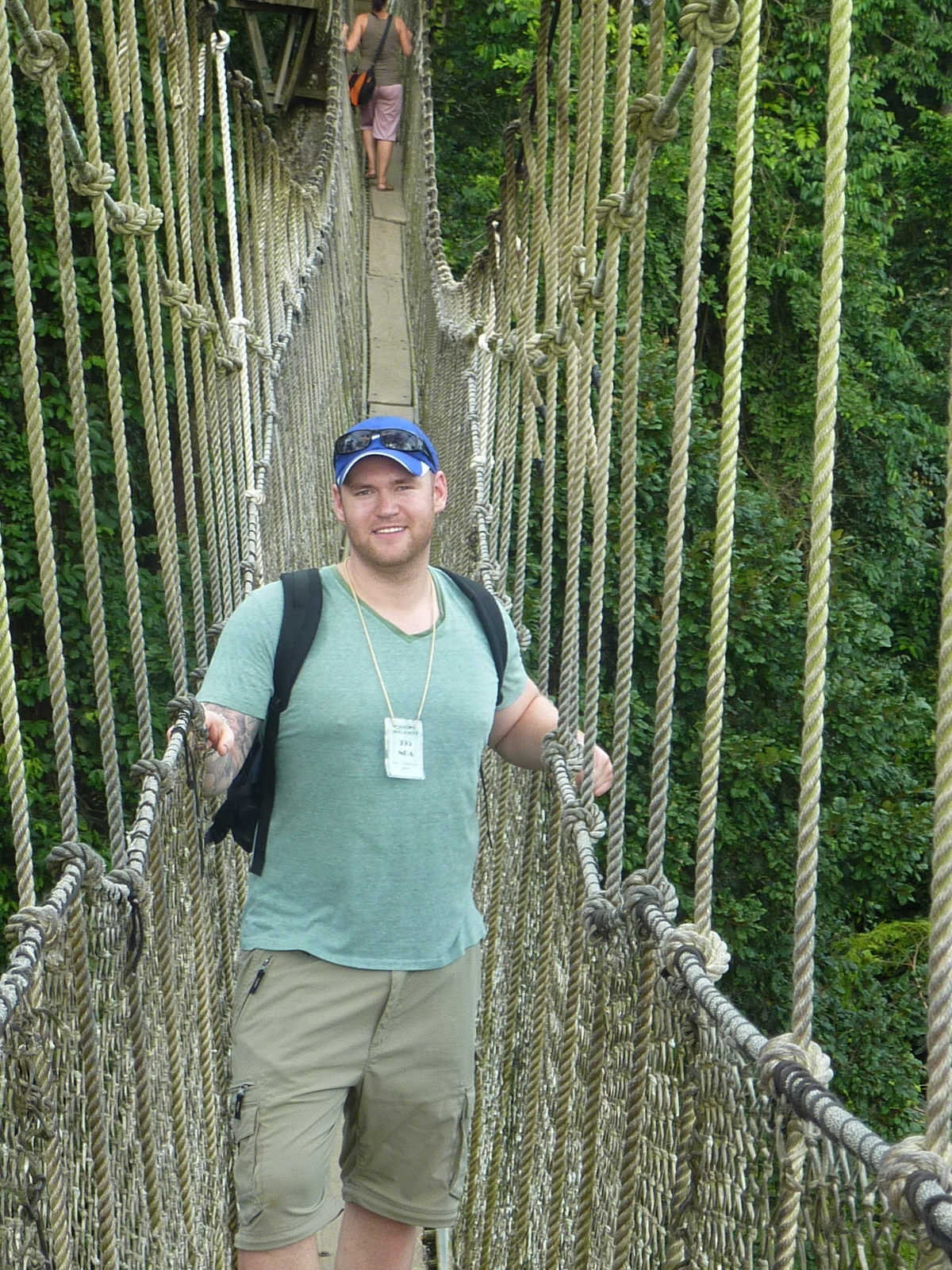
The canopy walkway consisted of 7 rope bridges that span 330 meters in length high in the rainforest canopy. It was a riot but it was 30 Ghanian Cedis each ($15)
I say, I say, how much boy?
Which is CRAZY expensive here is Ghana.
Ok here are the pics:
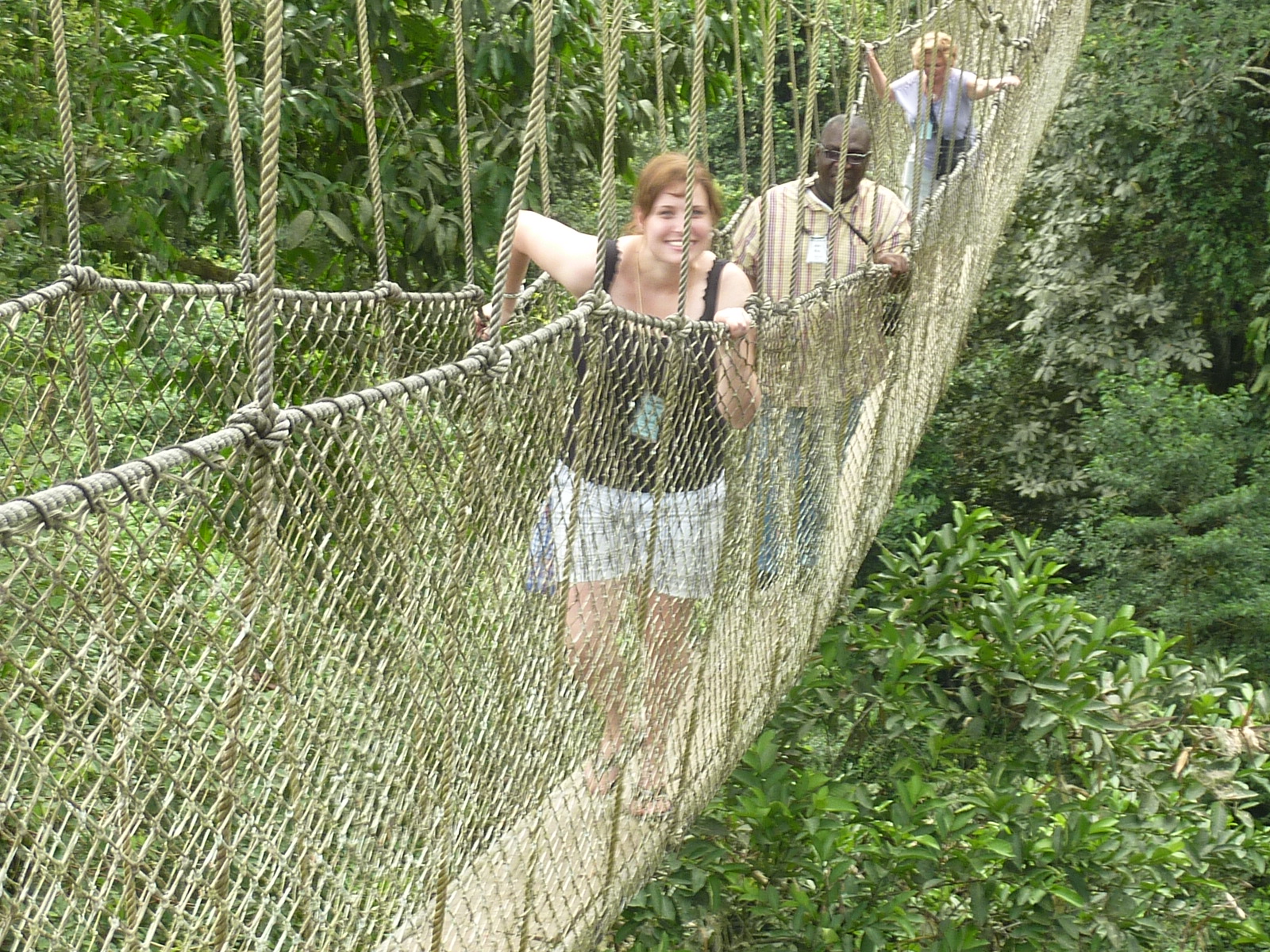
Don’t be fooled by the confident smile. She’s nervous as hell.
The bridges actually sway a surprising amount. Some people can’t handle the feeling of being so high up without sturdy footing. Meg said it wasn’t her “cup of tea”. But that may be because I was walking behind her saying things like “Geez we sure are a long ways up!” or “Does it look to you like these ropes are starting to fray?”
After my computer crashed yesterday and I lost the blog that I had been working on for 2 hours
I gained my composure and tried to blog again today – and if you’re reading this, it was a success.
Let’s catch you up on what Meg and I have been eating, how we’ve been getting around, and where we’ve been staying.
What have we been eating?
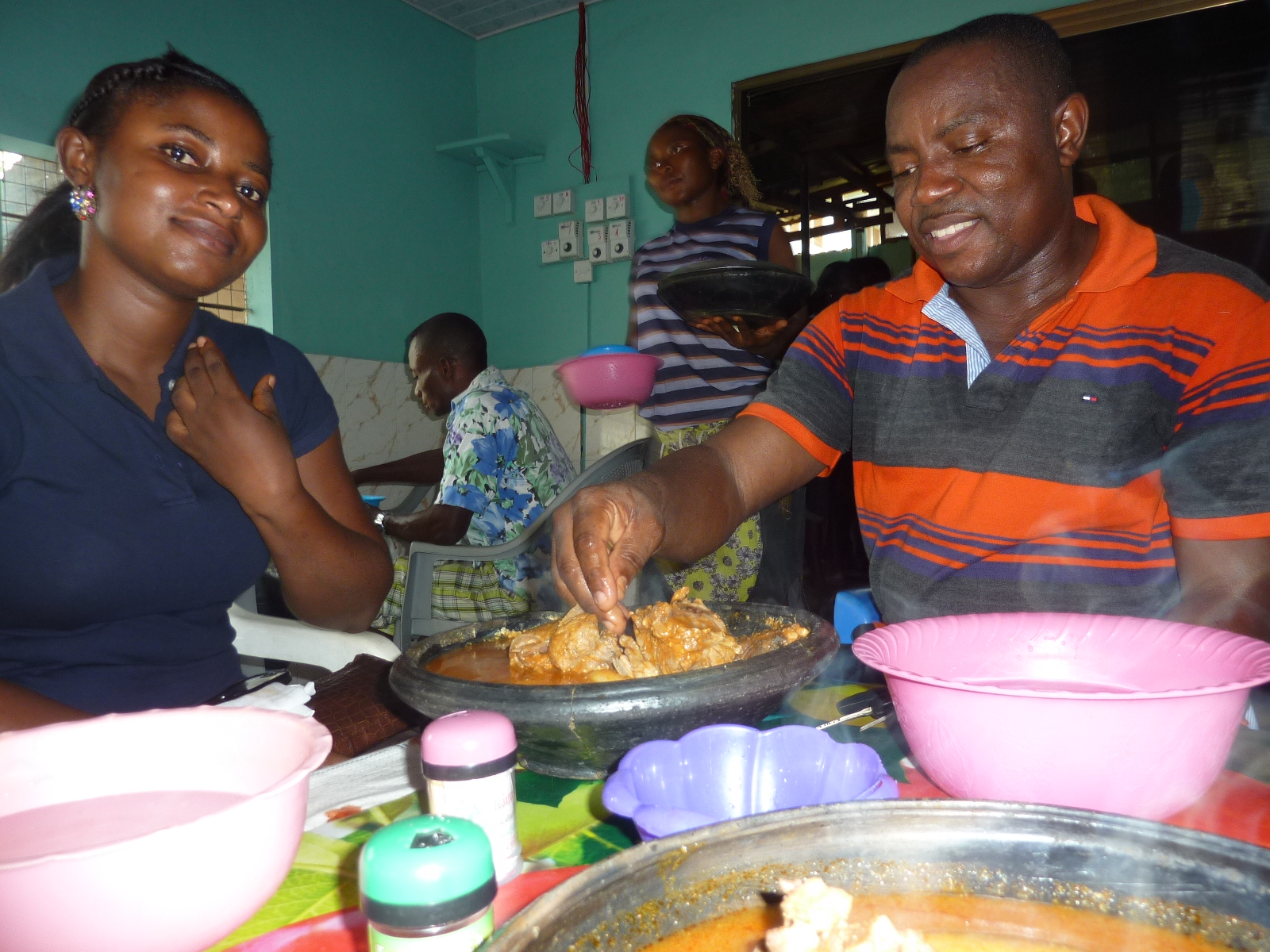
Everyone here RAVES about Fufu. Fufu fufu fufu fufu fufu is all you hear about. Meg and I were invited to try this “Fufu” by Gabriel and his girlfriend (below). Gabriel was a teacher at 2 Ghana Universities who happened to be staying at the same guesthouse as us. When we mentioned that we would like to try fufu, he offered to take us to a place that prepares fufu “the local way”.
This is the result…..
So what the heck is it?
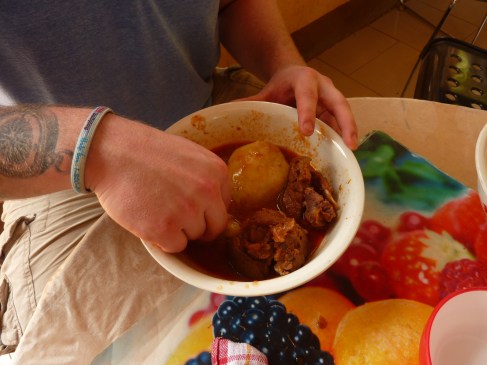
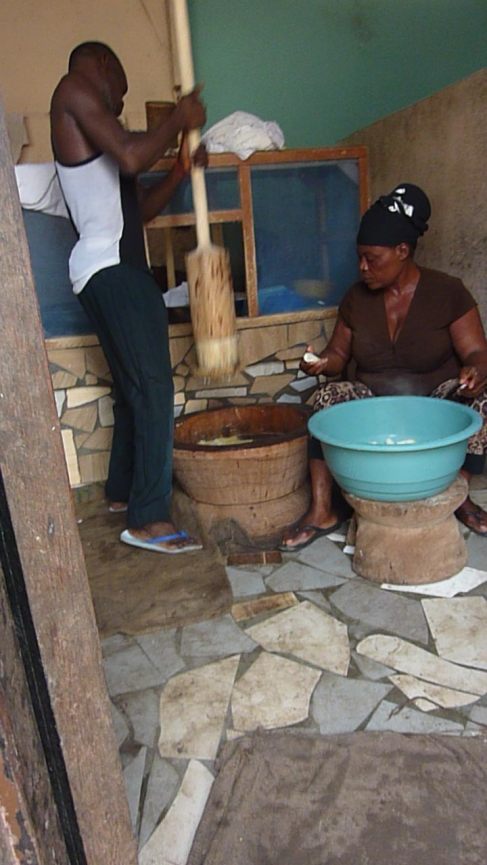
Fufu is boiled cassava (a starchy root) that is then pounded with a huge tool called a pestol (seen below). As the cassava is being pounded, someone slowly adds the plantain until the mix is approx 50/50. After 30-45 minutes of pounding, you end up with a doughy substance that is then shaped into balls. Those balls are then plopped into a spicy soup containing ground ginger and liver. Then the meat of your choice is put on top.
Fufu is eaten with your right hand by using your fingers as scissors to cut the dough and use the dough to shovel soup into your mouth. You don’t chew it either – just swallow.
(In Ghana, you use your right hand for eating, shaking hands, dealing with money, passing items, etc. Left hand: Wiping your bum)
The first time we ordered it, we ordered it with salmon. Thinking delicious pink fluffy Canadian salmon. Wrong. They plopped an entire salmon on top of the fufu. ENTIRE salmon. Skin, head, eyes, everything. I thought Meg was going to pass out.
I didn’t mind Fufu, Meg wasn’t a big fan.
The next time we went to a restaurant I ordered Fufu:
Meg ordered this:
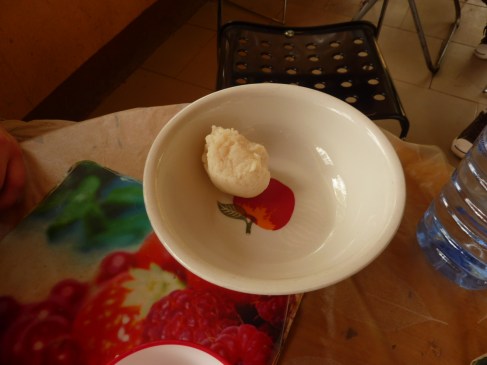
Ball of rice
Where have we been staying?
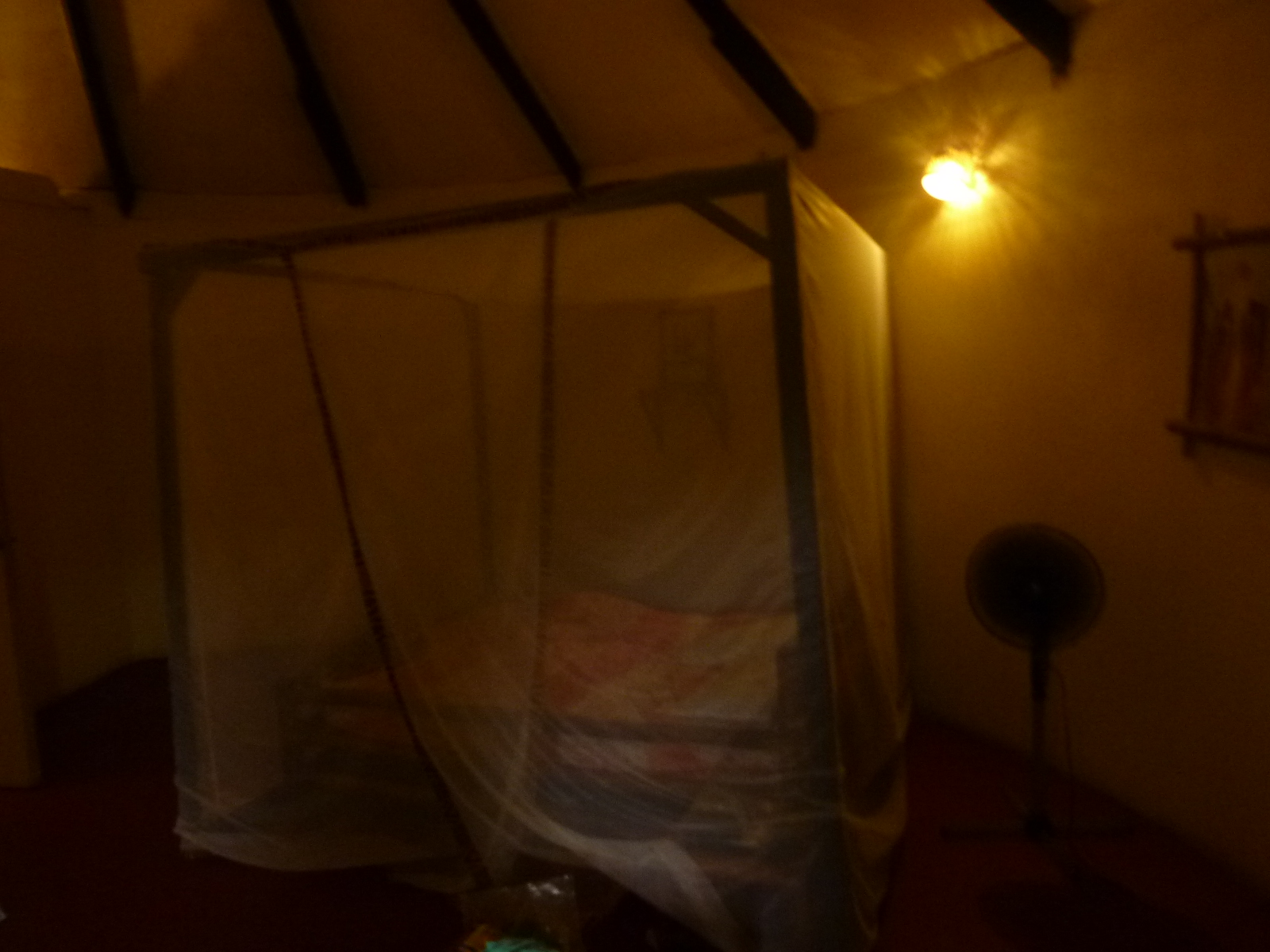
Barbara’s Highlife Village in Kokrobite was the second place we stayed. Nice little huts with basic amenities including a fan that worked when the power wasn’t out.
Barbara, the Slovenian owner of the guesthouse, teaching us a Ghanian card game.
The friendly staff at Barbaras Highlife Village
The place we are currently staying is the Oasis Beach Resort which is a nice place with an ocean-side view. The cleanliness is somewhat questionable, but the staff is friendly and the beer is cold.
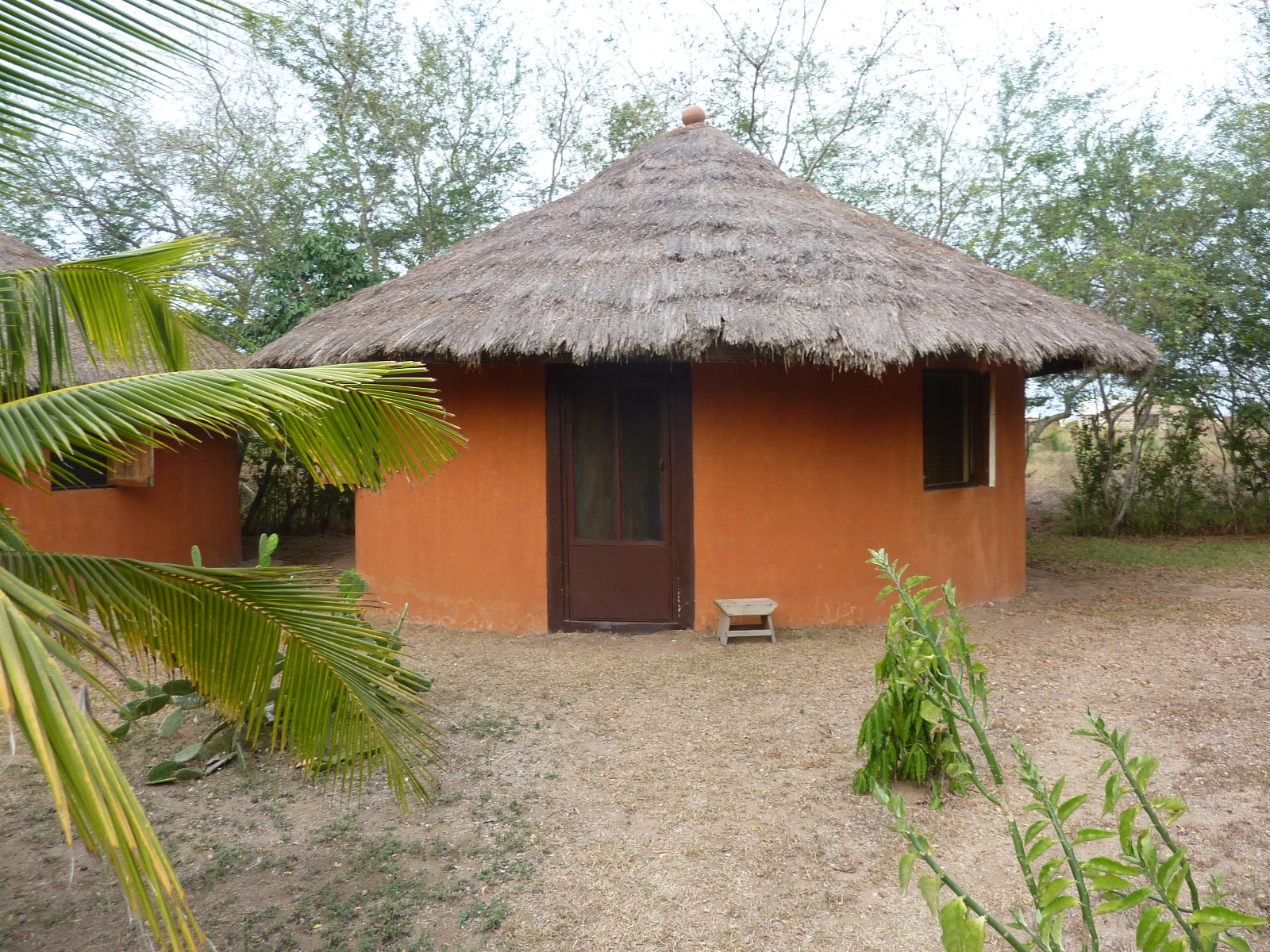
Our hut at Oasis Beach Resort
How are we getting around?
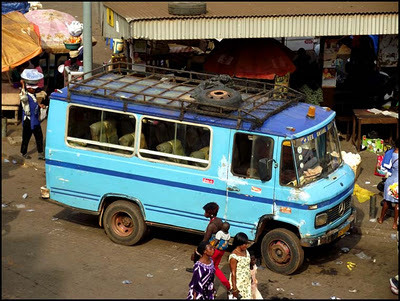
Tro tro is by far the most economical and adventurous way to get around in Ghana. A Tro tro is a large 15 person van that you stand on the side of the road and wait for. Their are hundreds or even thousands of tro tros’ in Ghana going every which direction.
Meg and I just got done a 3 hour tro tro trip where a farmer got on with his 3 goats and shoved his goats under the seat we were sitting on. Every once in a while a goat would brush up against Megs leg and she would give out a little shriek which would incite laughter from the farmer. I snapped a quick undercover video of the situation for your enjoyment:
We met a Dutch couple last night and were talking about how crazy Ghana is over a beer. The Dutch lad summed it up best when he said “You must be thinking….. how am I going to explain this to the people back home?”
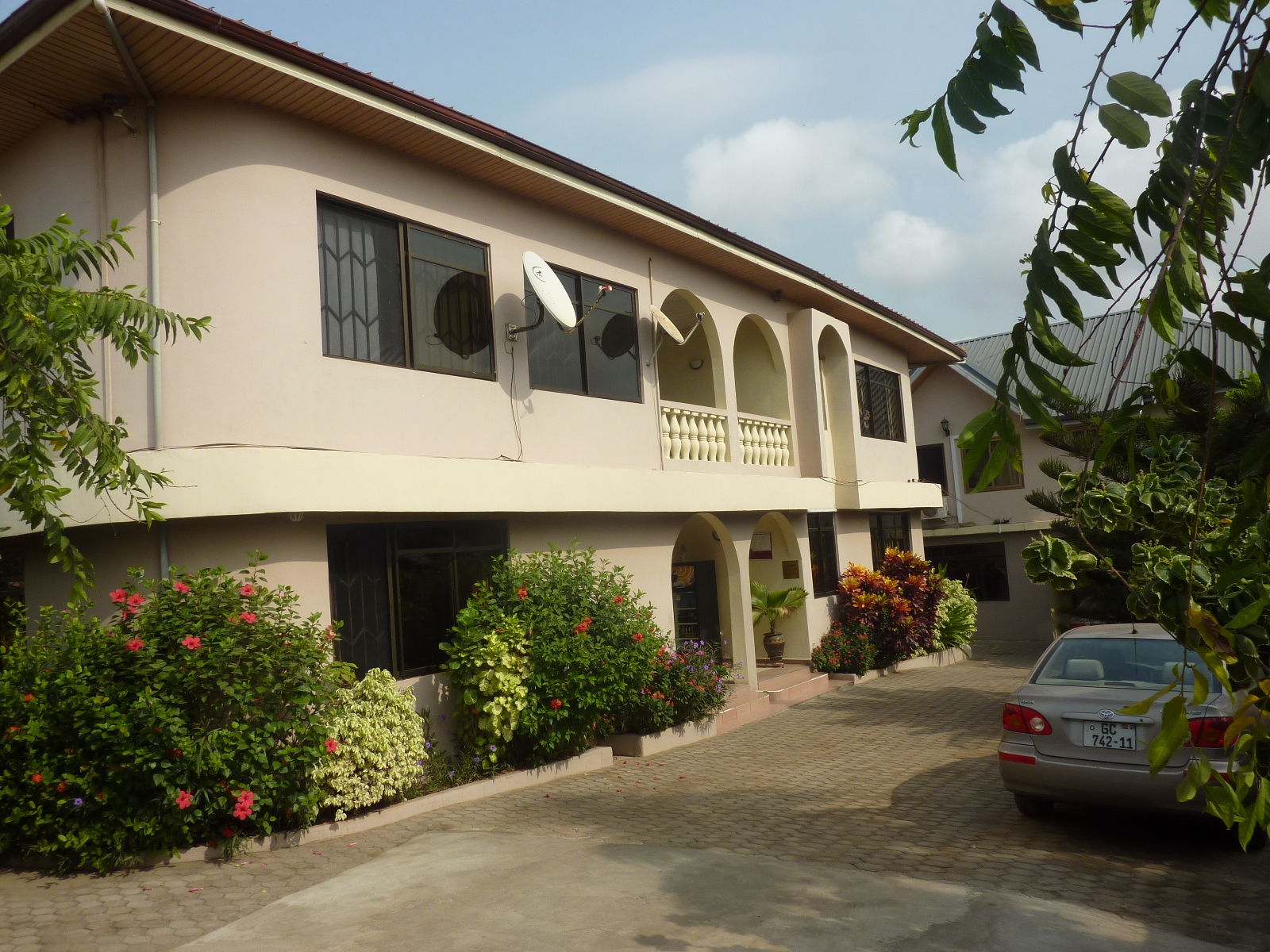
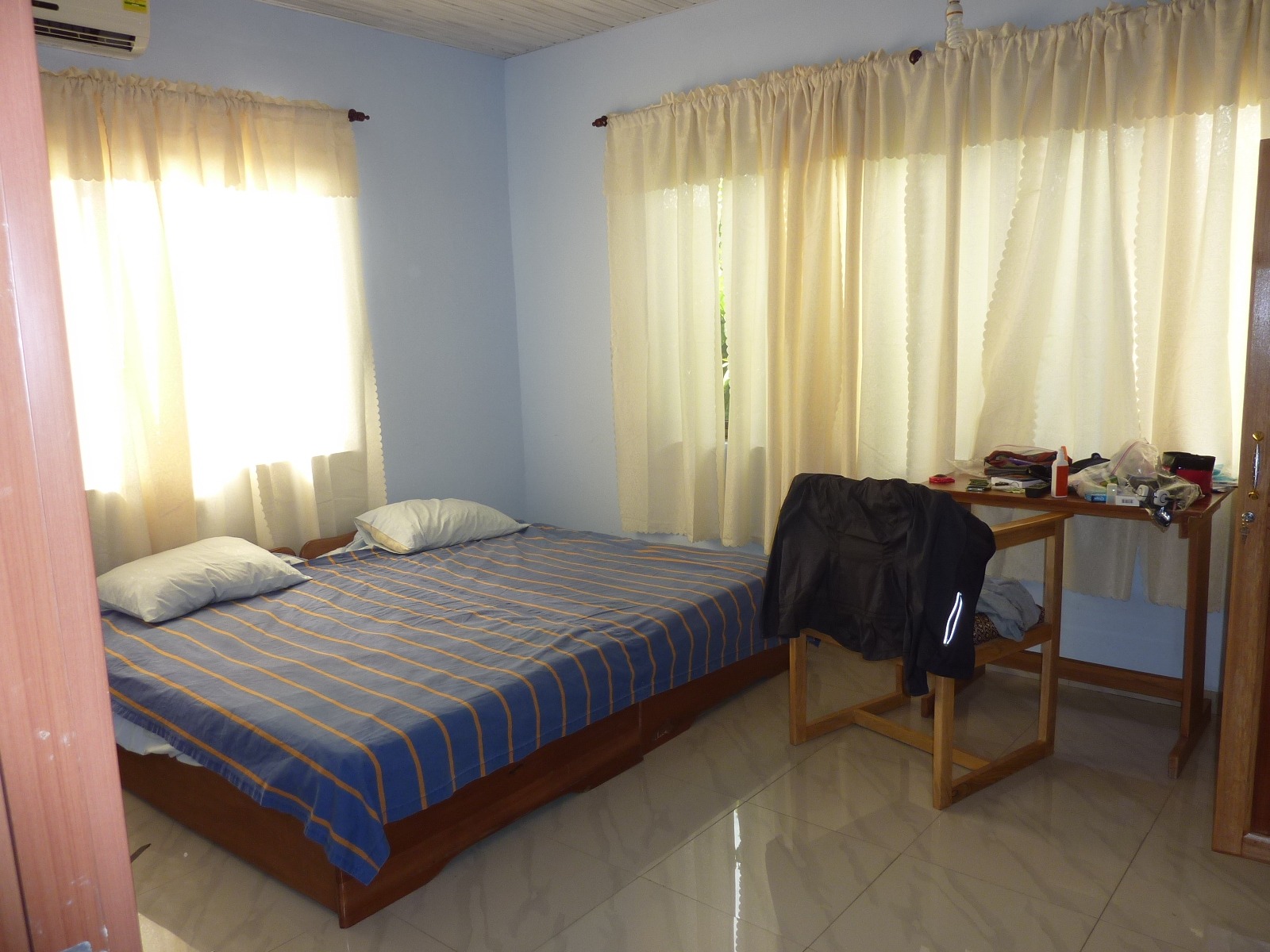
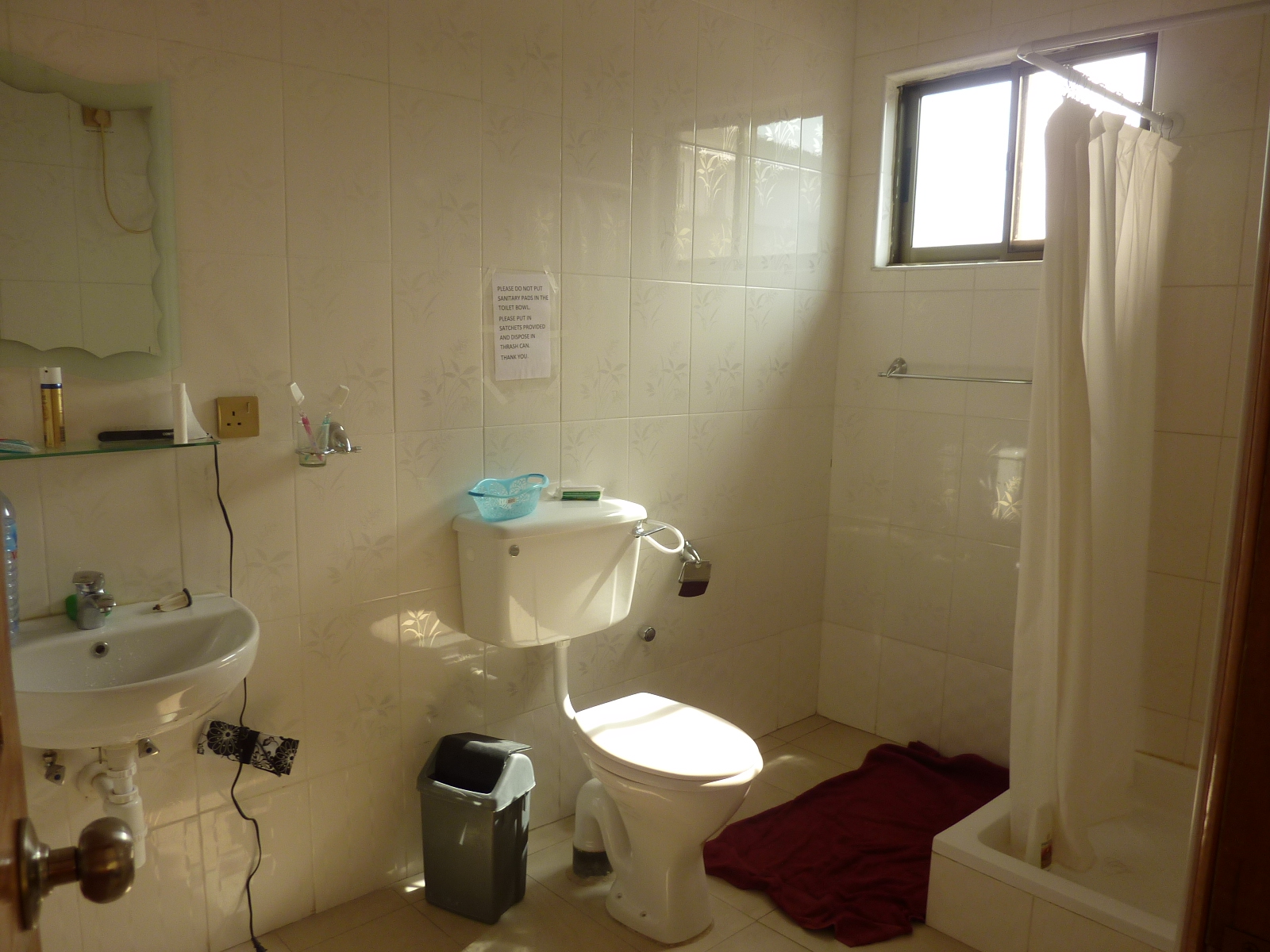
After a seemingly neverending flight, we landed in Ghana. A wall of heat and humidity hit us like a ton of bricks as soon as we stepped off the plane. After clearing customs we were met by a sea of hollering Ghanaian taxi drivers vying for our business. Amidst the chaos, we spotted a grey haired man with an ear to ear smile holding a sign that said: “Osdahouse Home Lodge – Jason Green”. It was Seth, the owner of the guesthouse. Seth and his wife Dorothy are a retired Marine Biologist and Zoo-ologist respectively, and had returned to Ghana after living in Boston for 30 years to open a guesthouse in Accra. We were pleasantly surprised by both the hospitality we received and the cleanliness of our room (pics below). We crashed for the night and caught up on some much needed sleep.
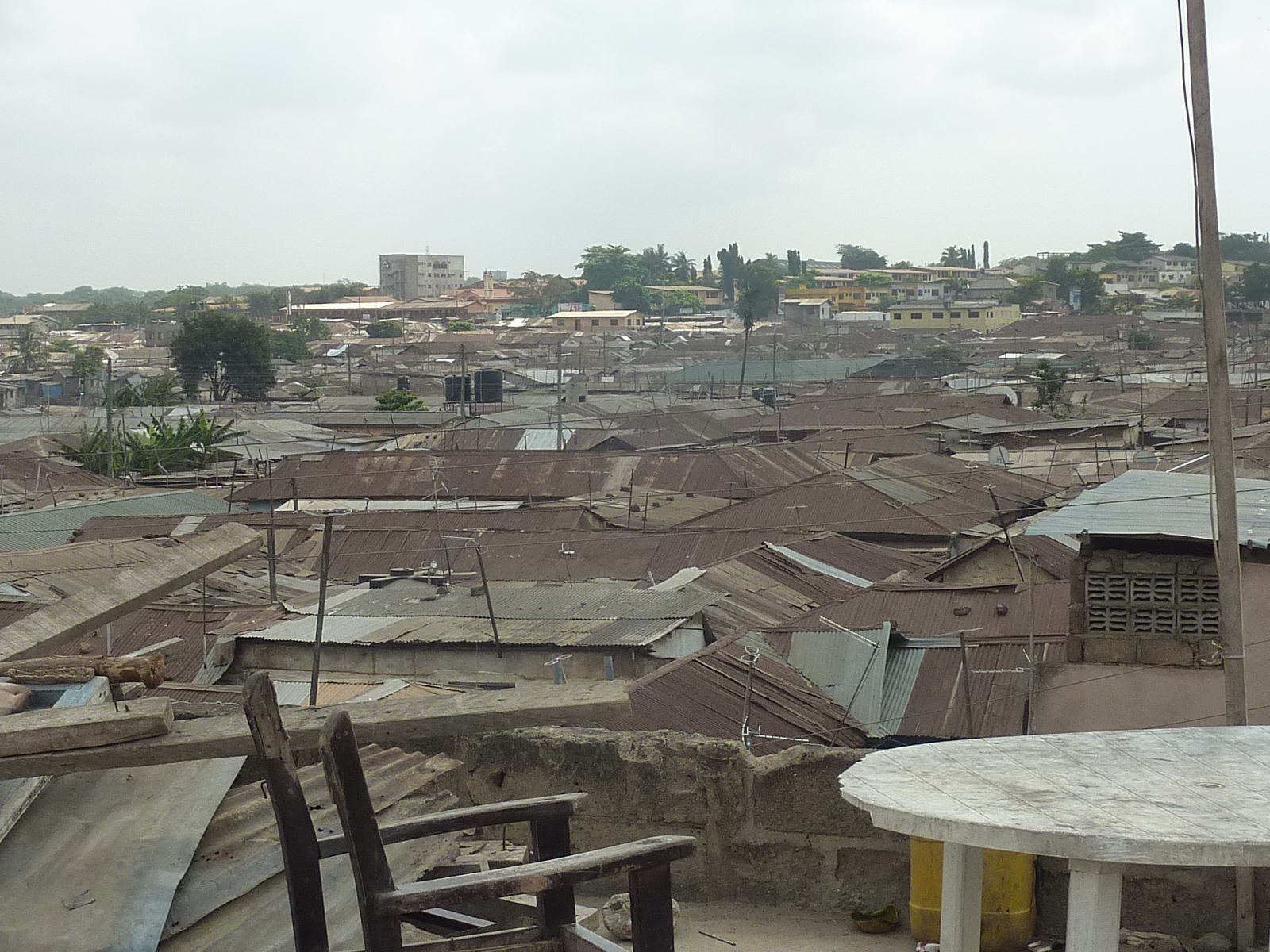
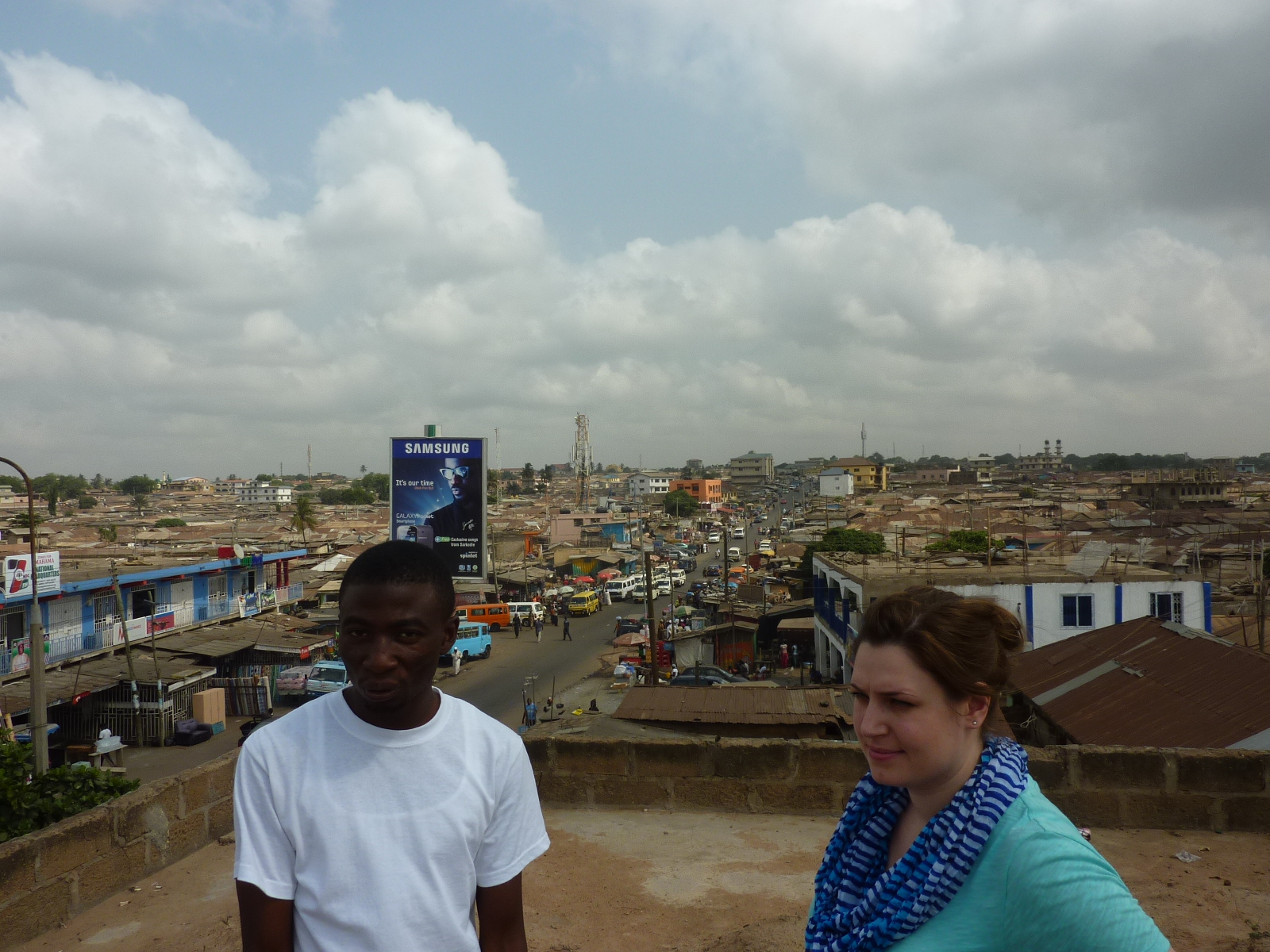
The next morning we woke up early and met our guide for the day; Charles. Charles was a slim, smiley 29 year old man who had been raised in the slums of Accra. He came highly recommended by other travellers so I booked him for two days via email. It was money well spent. Charles quickly put us at ease with his easy-going yet professional attitude. He was quick and eager to answer any questions we put to him and he made sure that we saw a side of Accra that most tourists don’t see. Our first stop was Nima (below) – where Charles was raised.
Nima was a sprawling lower class area of central Accra. It’s residents are from a blend of countries including Nigeria, Togo, Benin, Burkina Faso, Ivory Coast, Mali, and of course, Ghana – making it a melting pot for culture. It’s comprised of about 54,000 people who live in harmony – equal parts Muslim and Christian.
An ocean of tin roofs held down by cinder blocks was literally all we could see from above. Once we were taken below into the winding alleys, the suburb came alive. Friendly smiles started popping up everywhere. People dressed in colourful garbs passed us welcoming us to Ghana. Charles instructed us to reply with “Kolafia” (meaning “good morning”) but my pronounciation must have been crap because everyone laughed when I said that. Charles seemed to know everyone. It seemed like every 50 meters someone was greeting Charles and doing some fancy handshake with him – one that white people could never master.
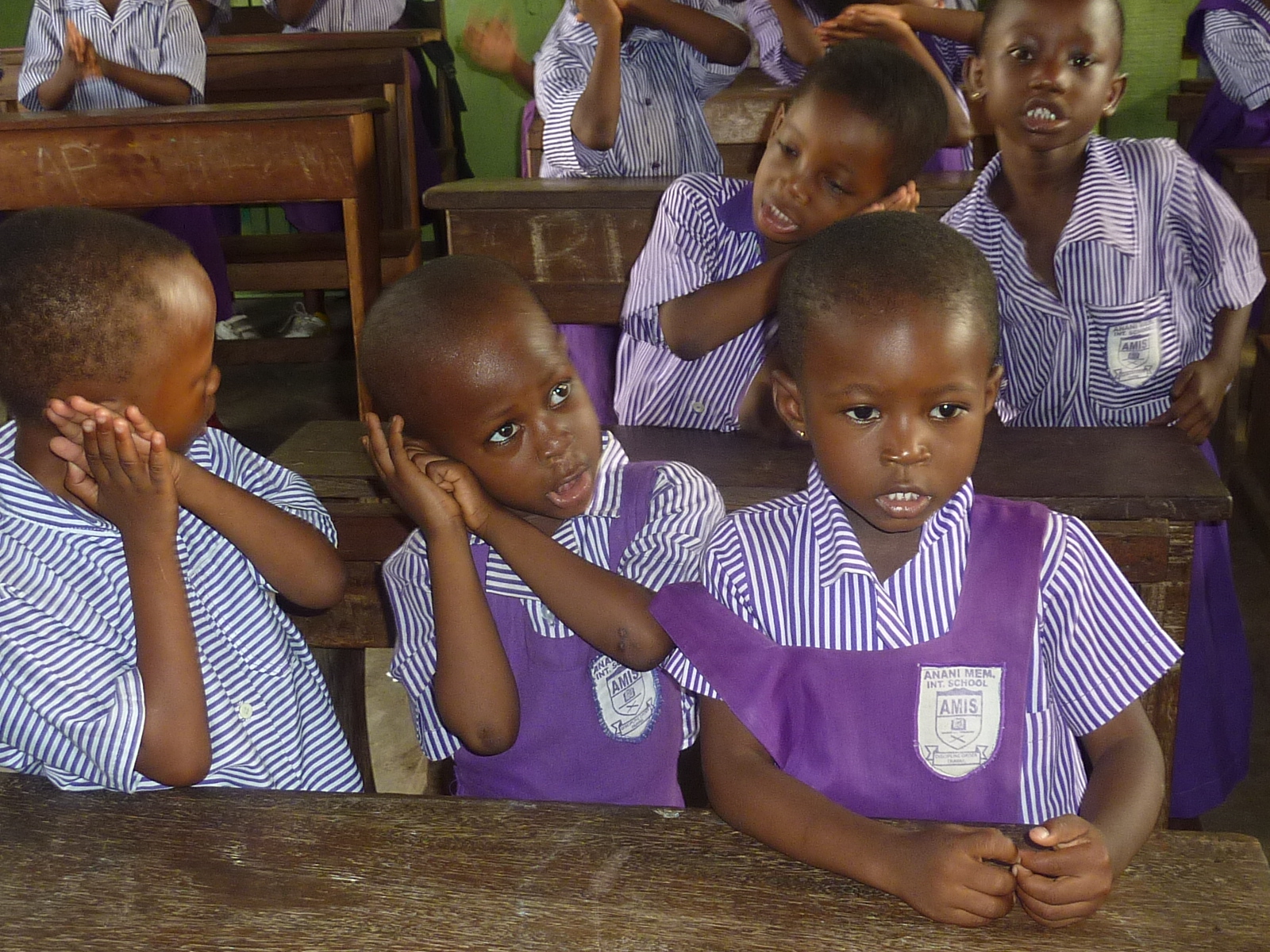
We eventually made our way to a school. It was a small, open air compound called the Nima Elementary school. We were greeted by the schools principal who shared some brief history about the school before we got to meet the children. The school was started in 1972 by his father who had a dream of providing an education to children of lower class families who couldn’t otherwise afford it. Here is a quick video of what we seen and heard walking into the school (I tried to keep the camera at my hip to not make it obvious that I was filming):
As we got to spend time in the classroom I was very surprised at the quality of education that the children were receiving and the obedience of the children. The teachers seemed to be very legitimate and teaching advanced material to young children. On top of that, half of the instruction is in French and half in English. Every child is bilingual. Clearly, singing is a very important part of school life in Ghana. Each classroom serenaded us with songs in both French and English.
At the end of our visit, the principal asked two favours of us. 1) We teach the children a song, and 2) we give the children advice about their future. Talk about putting us on the spot!
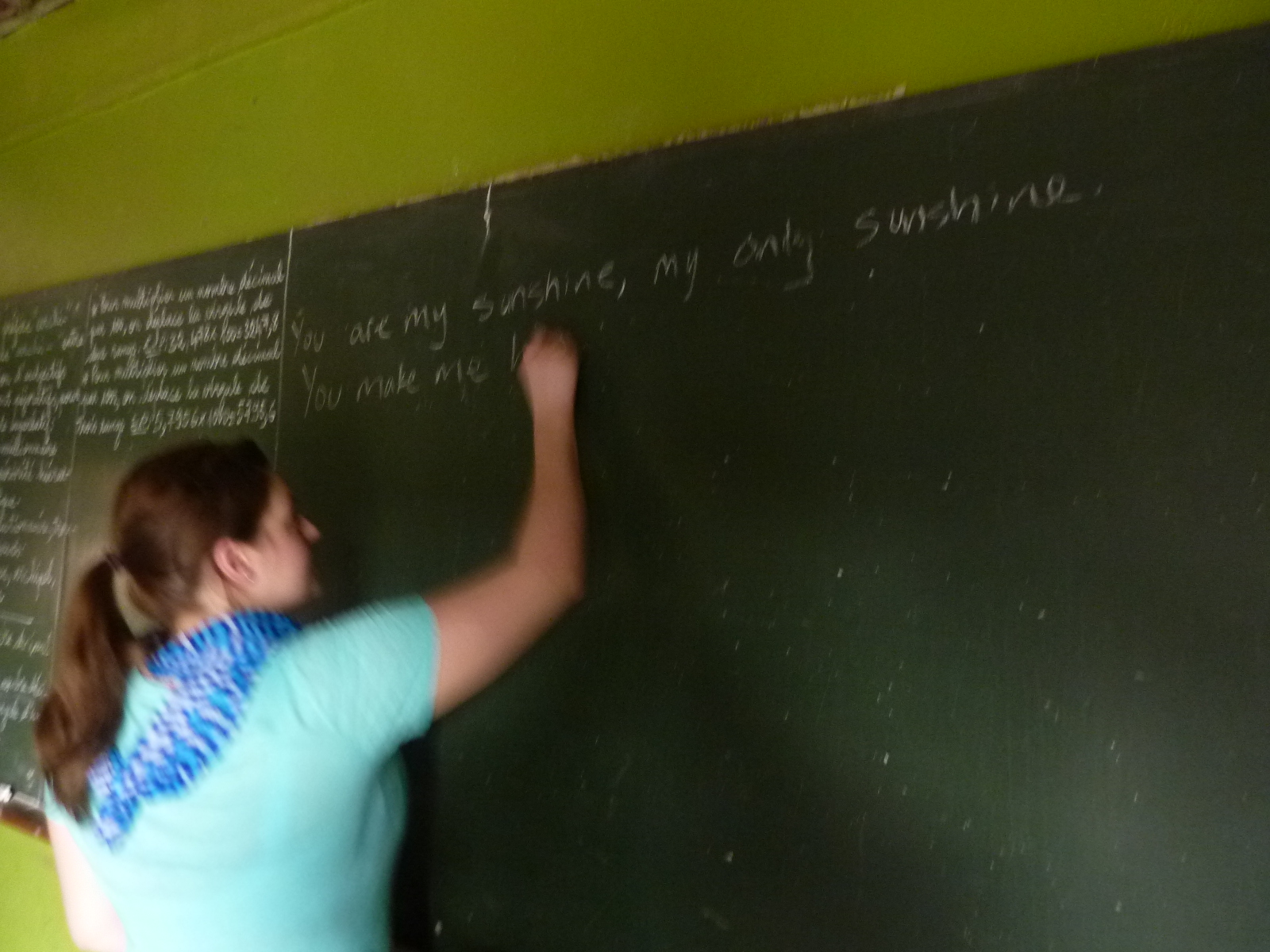
Meg writing the lyrics of “You Are My Sunshine” on the chalkboard for the children.
After sharing some words of wisdom and teaching the children “You Are My Sunshine”, we were nearing the end of our visit.
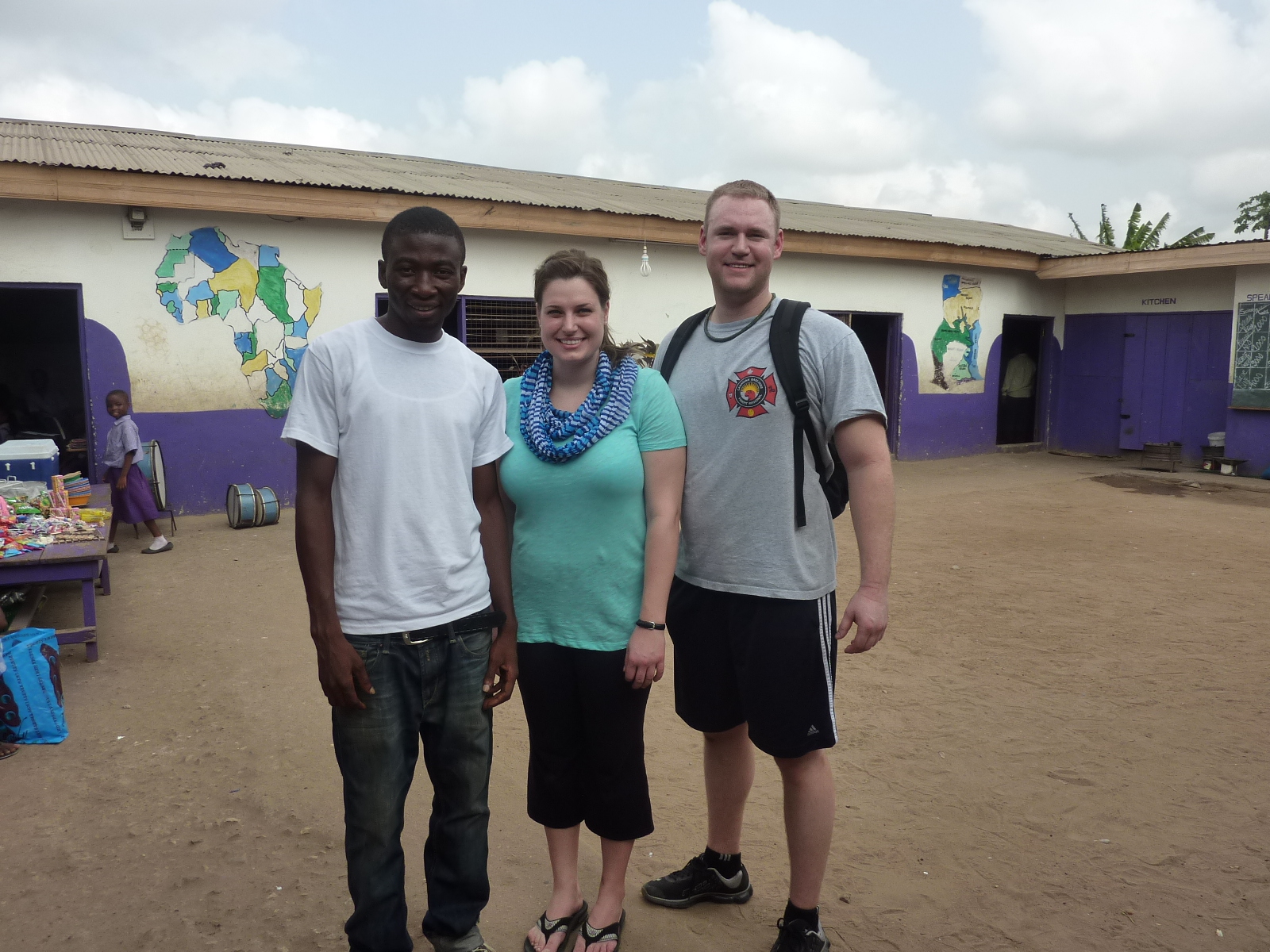
Charles, Megan, Jason
The principal explained to us that the childrens tuitions are paid by charity and that many of the 280 children at the school were currently unsponsored. For $105, we could pay 1 years tuition for a student of our choice. Meg and I chose to sponsor two young twin boys from the Greater Accra area. $210 seemed to be a small price to pay for the difference it will make in these two boys’ lives.
After some more touring around, we left Nima to visit the largest market in Accra: Makola Market.
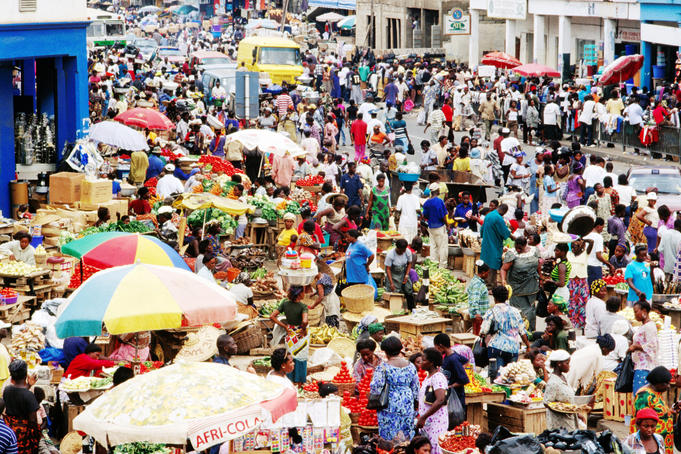
I’m trying to think of some adjectives to describe Makola Market (the largest market in West Africa) but they won’t do it any justice. Small dusty alleys are flanked by shops selling everything from used clothing to sunglasses to vegetables. Women carrying large baskets on their head yelling incoherent words. The picture above was found on google. I didn’t take any pictures because I didn’t feel appropriate pulling out a flashy camera in such a cramped environment (in case it gave someone the idea to pull the old snatch and run). After drinking from a couple fresh coconuts we departed to see the old part of Accra. The British part : James Town
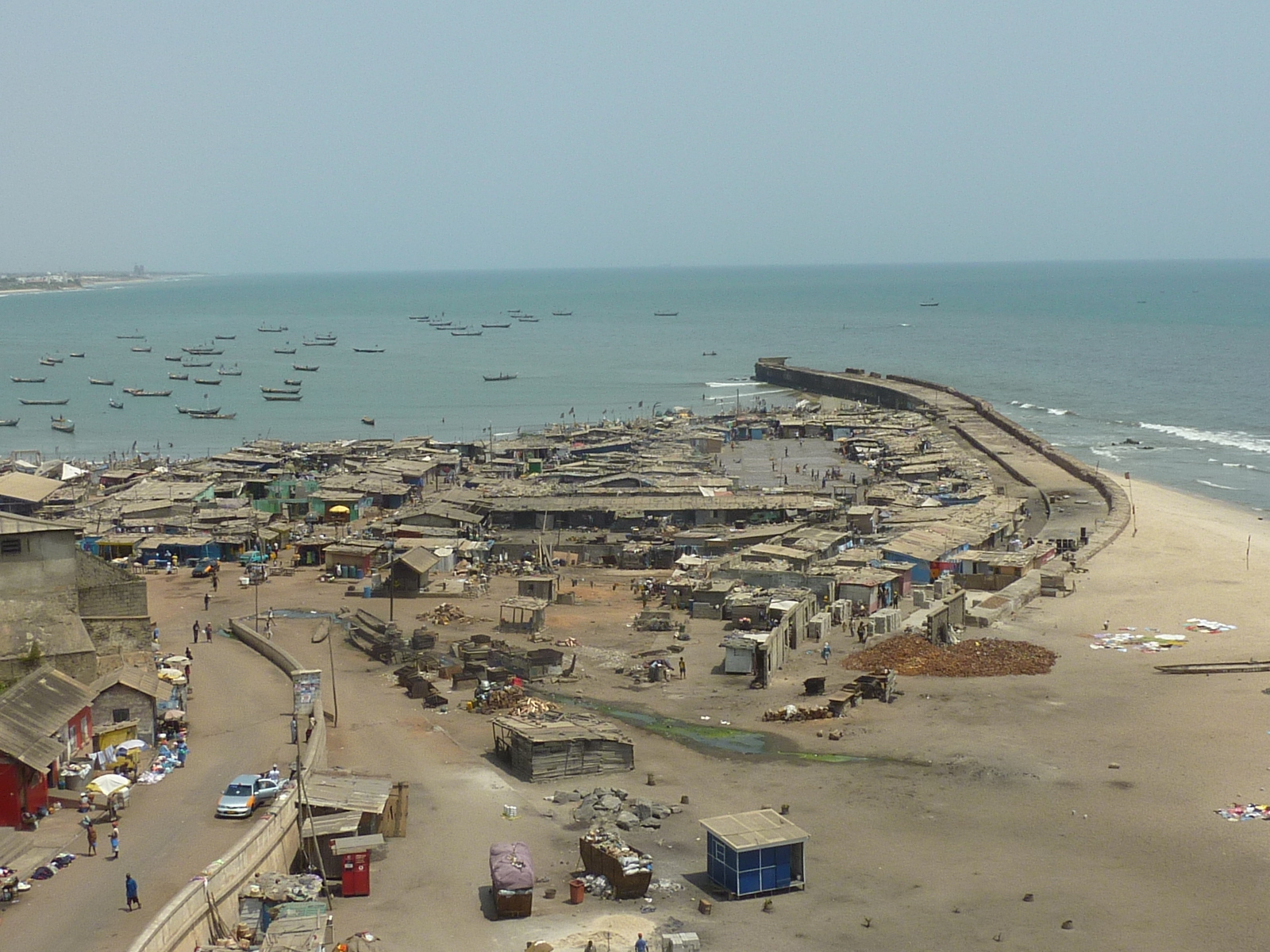
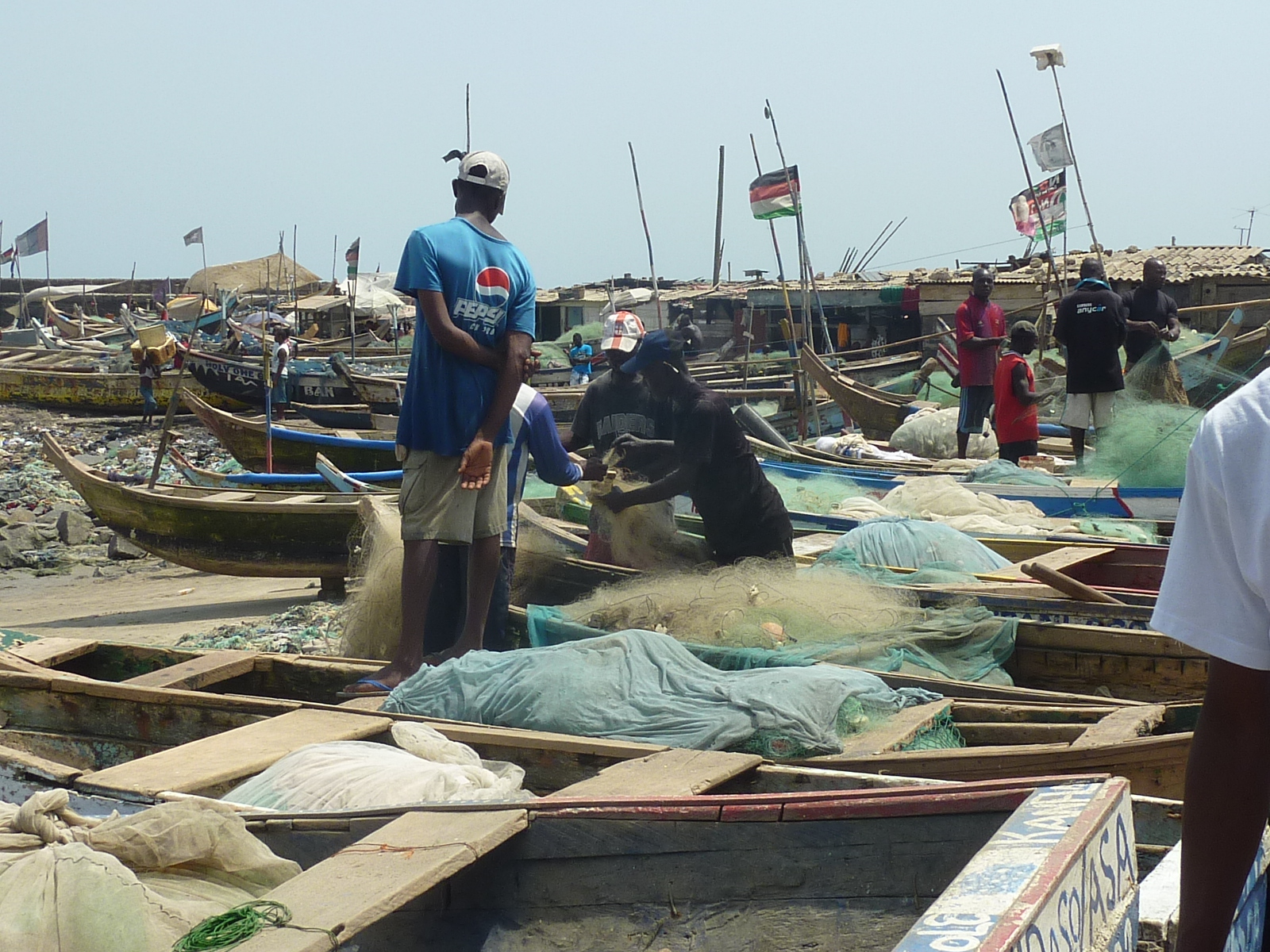
James Town harbour was a bustling harbour at one point in time. Passing trade ships would stop here to trade various goods with the British. Today it’s a small fishing village where migrant fisherman try to eek out a living on their long, thin, wooden, fishing boats.
Above: All the small fish caught are dried in the sun and boiled into a soup or grilled.
Below: Fishermen repair their nets. One fisherman came up to me and gave me a 6″ fish as a gift. I said thanks and gave it back (Seriously…..what was I going going to do with a fish). He looked at me puzzled wondering why I gave his gift back. Charles was laughing at this whole scene unfolding before him.
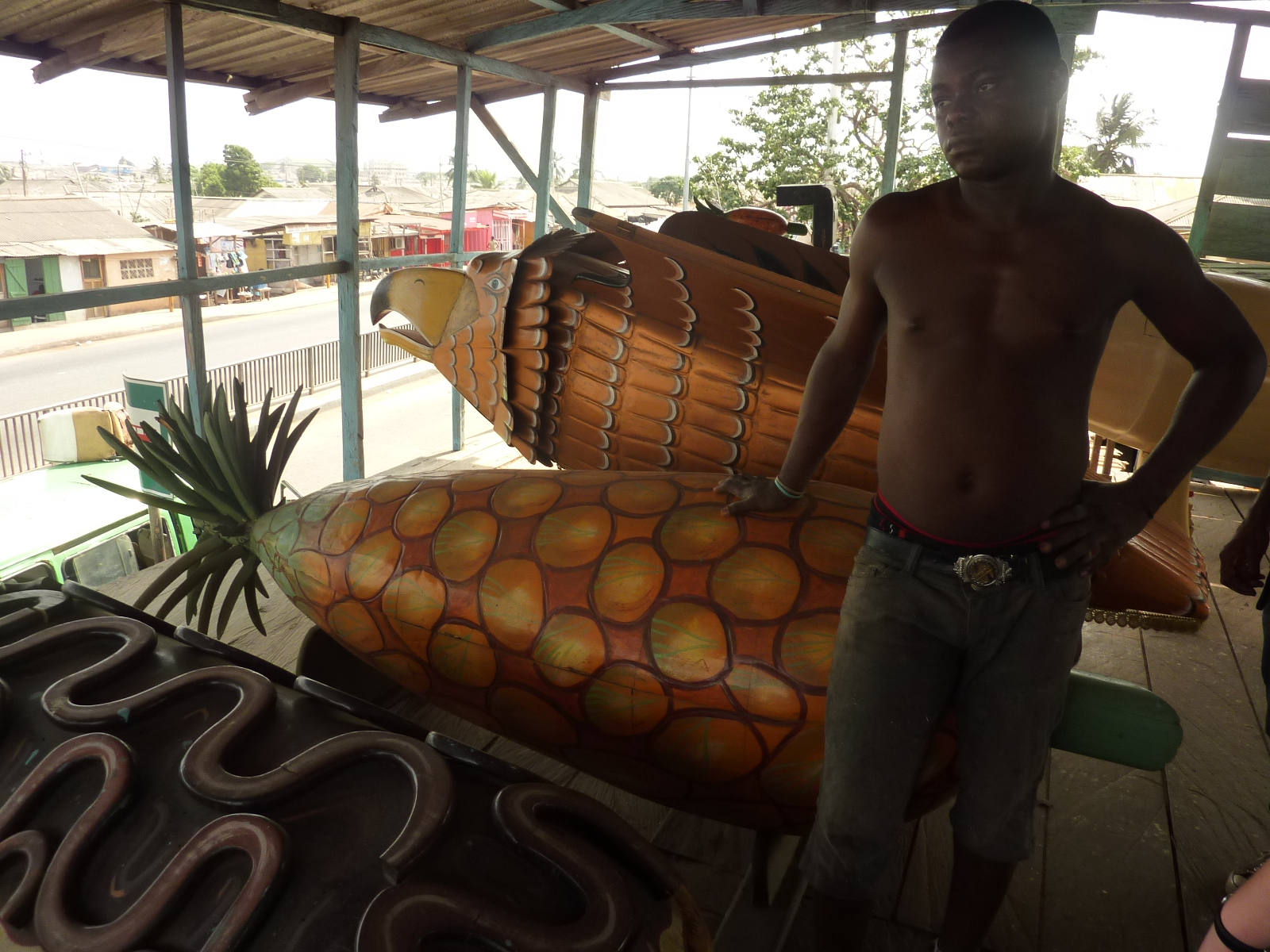
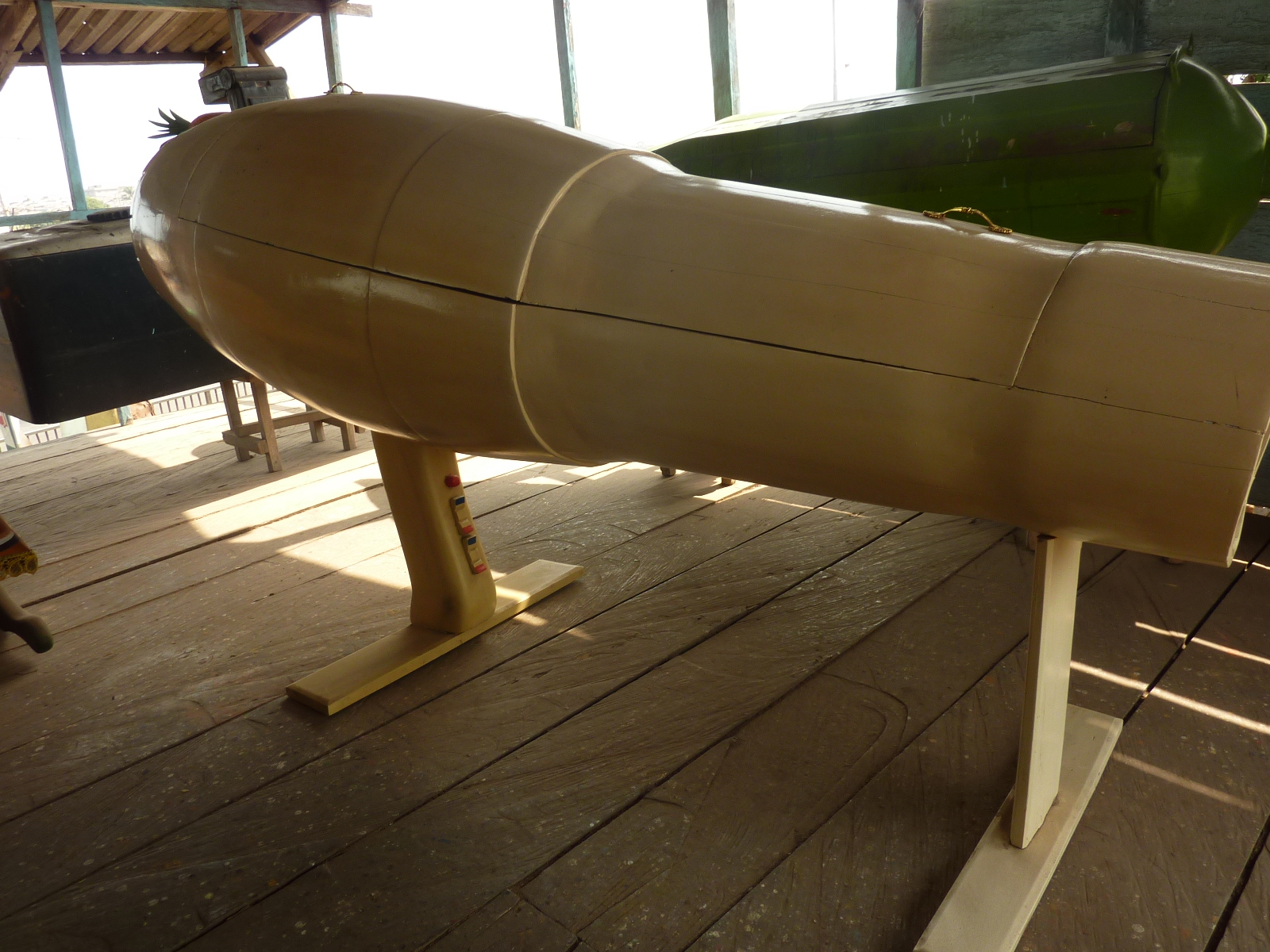
Our last stop of the day was at the custom coffin makers. In Ghana, some wealthy people like to be buried in weird coffins like the ones below.
A bird and a pineapple
A hair dryer
One thing I have to say is that the humidity here is killing both of us. It’s almost unbearable for me – Meg is coping a bit better. I think I’ll be ready for the Canadian winter after this…….
You mean winter, as in igloos and Eskimos and penguins and ICE?
It’s the first time either one of us have set foot in Africa and I can’t be more excited. I have a hunch that this will be the best backpacking trip I’ve ever been on!
Why Ghana You Ask?
It’s got a bit of everything.
Colourful culture
Beautiful beaches
Great food
Wonderful people
Cheap prices.
It’s also well off the tourist radar which guarantees us an authentic look at the real Africa.
Ghana in a Nutshell
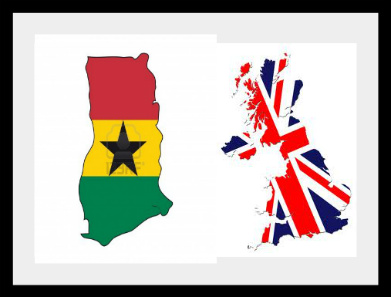
Ghana is about the same size as the UK and has about 23 million people.
It’s a former British colony which makes it one of the only English speaking countries in West Africa. Until 1957 (when Ghana gained independence from the British) Ghana was called “The Gold Coast”.
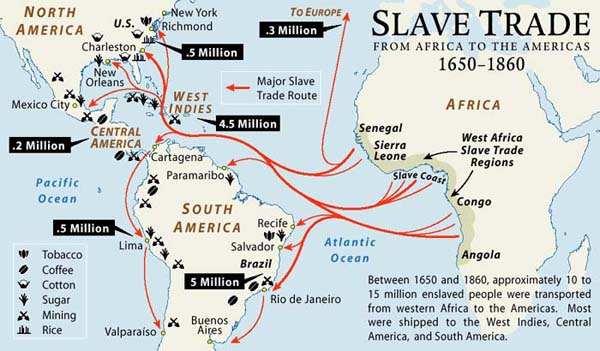
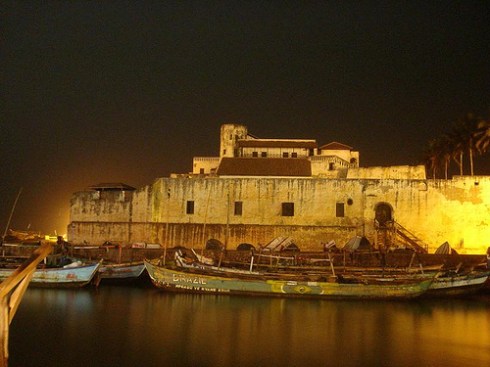
It is estimated that an astounding 1.5 million slaves were taken out of Ghana during the slave trading days. We plan on touring some of the coastal forts where slaves were held before being shipped off to North and South America (see above). Elmina Castle is the oldest European building in Africa.
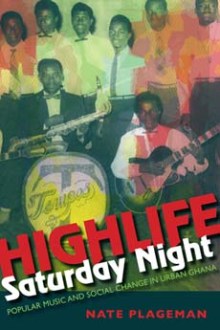
It has made it’s own genre of music called “highlife” (Funk + Reggae)
It has been called “the most religious country in the world”. Every business is named after Christianity in one way or another. Homosexuality is illegal for men (often ending in prison sentences) but not for women – I have trouble wrapping my head around that one.
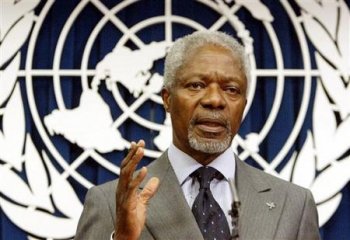
Secretary-General of the United Nations Kofi Annan is from Ghana.
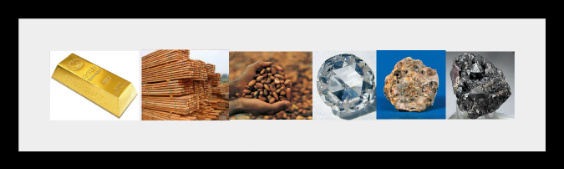
Ghana is also a very safe and stable country with a rapidly growing economy. It’s main exports are gold, timber, cocoa, diamond, bauxite, and manganese.



























 Kamikaze Canuck